Japanese
English
- 販売していません
- Abstract 文献概要
- 1ページ目 Look Inside
- 参考文献 Reference
はじめに
脊髄梗塞は,側副血行路が発達しているため,頻度は脳卒中の1〜2%とまれな疾患である1).症状は感覚障害,運動障害,排尿障害,呼吸不全など多岐にわたる2, 3).呼吸不全を呈した脊髄梗塞の過去の報告例は,われわれの知る限りでは20例であった4-15).横隔神経麻痺を呈していた症例は3例であった5, 11, 13).今回われわれは,脊髄梗塞により呼吸筋麻痺を呈し人工呼吸管理を要した症例を経験したので,そのリハビリテーション治療の経過を報告する.本症例報告に関して,患者本人に説明のうえ,書面にて同意を得た.
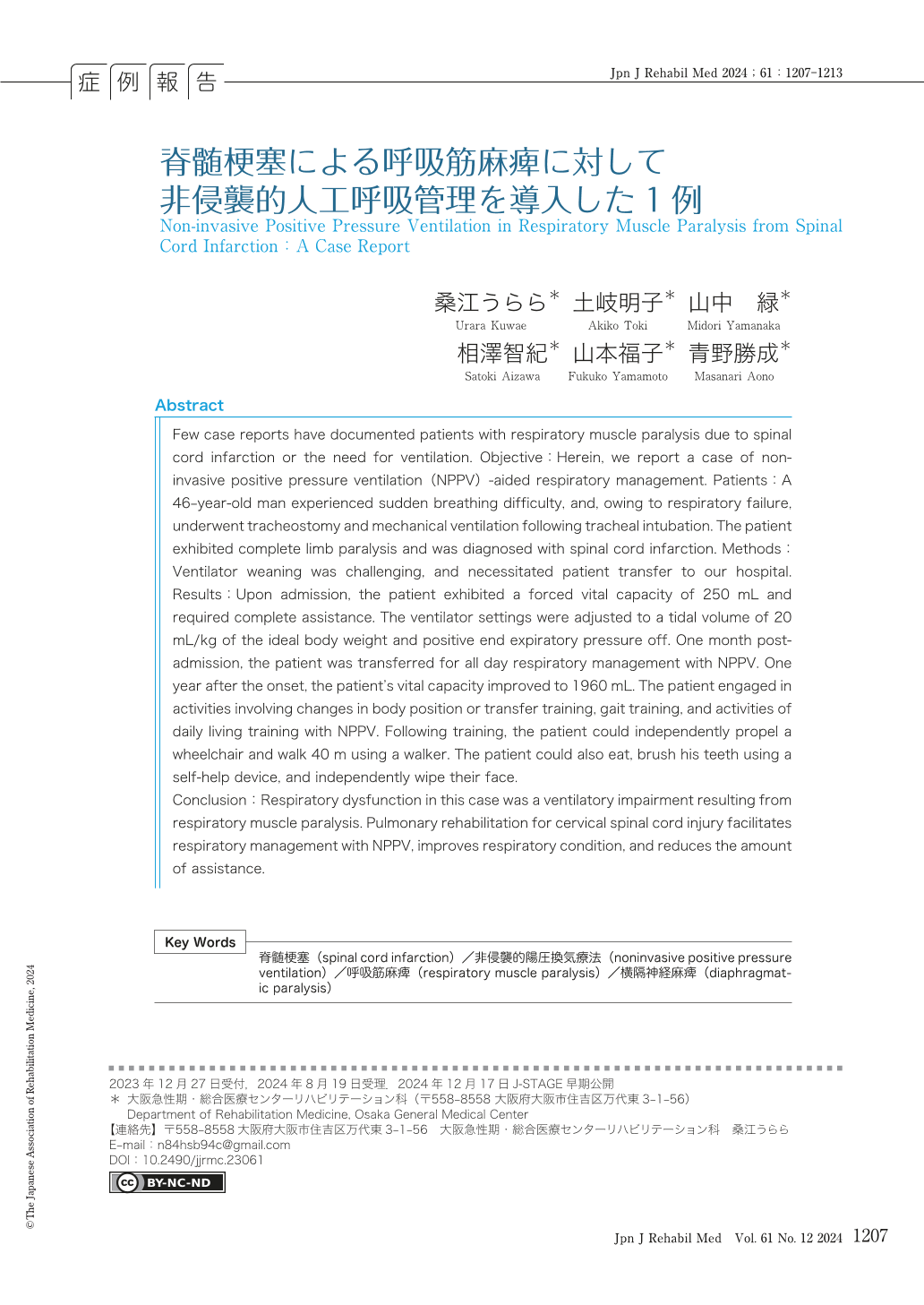
Abstract Few case reports have documented patients with respiratory muscle paralysis due to spinal cord infarction or the need for ventilation. Objective:Herein, we report a case of non-invasive positive pressure ventilation (NPPV)-aided respiratory management. Patients:A 46-year-old man experienced sudden breathing difficulty, and, owing to respiratory failure, underwent tracheostomy and mechanical ventilation following tracheal intubation. The patient exhibited complete limb paralysis and was diagnosed with spinal cord infarction. Methods:Ventilator weaning was challenging, and necessitated patient transfer to our hospital. Results:Upon admission, the patient exhibited a forced vital capacity of 250 mL and required complete assistance. The ventilator settings were adjusted to a tidal volume of 20 mL/kg of the ideal body weight and positive end expiratory pressure off. One month post-admission, the patient was transferred for all day respiratory management with NPPV. One year after the onset, the patient's vital capacity improved to 1960 mL. The patient engaged in activities involving changes in body position or transfer training, gait training, and activities of daily living training with NPPV. Following training, the patient could independently propel a wheelchair and walk 40 m using a walker. The patient could also eat, brush his teeth using a self-help device, and independently wipe their face.
Conclusion:Respiratory dysfunction in this case was a ventilatory impairment resulting from respiratory muscle paralysis. Pulmonary rehabilitation for cervical spinal cord injury facilitates respiratory management with NPPV, improves respiratory condition, and reduces the amount of assistance.
Copyright © 2024, The Japanese Association of Rehabilitation Medicine. All rights reserved.