Japanese
English
- 有料閲覧
PPV購入案内
1,320円 (1,200円+税10%) こちらは、113ページから119ページの文献です。購入には医書.jp本会員登録が必要です。
会員登録完了後に改めて上記「購入サイトへ」を選択してください。
または「購入サイトへ」選択後に「購入ログイン」、「新規会員登録」の順に進んでください。
会員登録について詳しくはをご確認ください。
- Abstract 文献概要
- 1ページ目 Look Inside
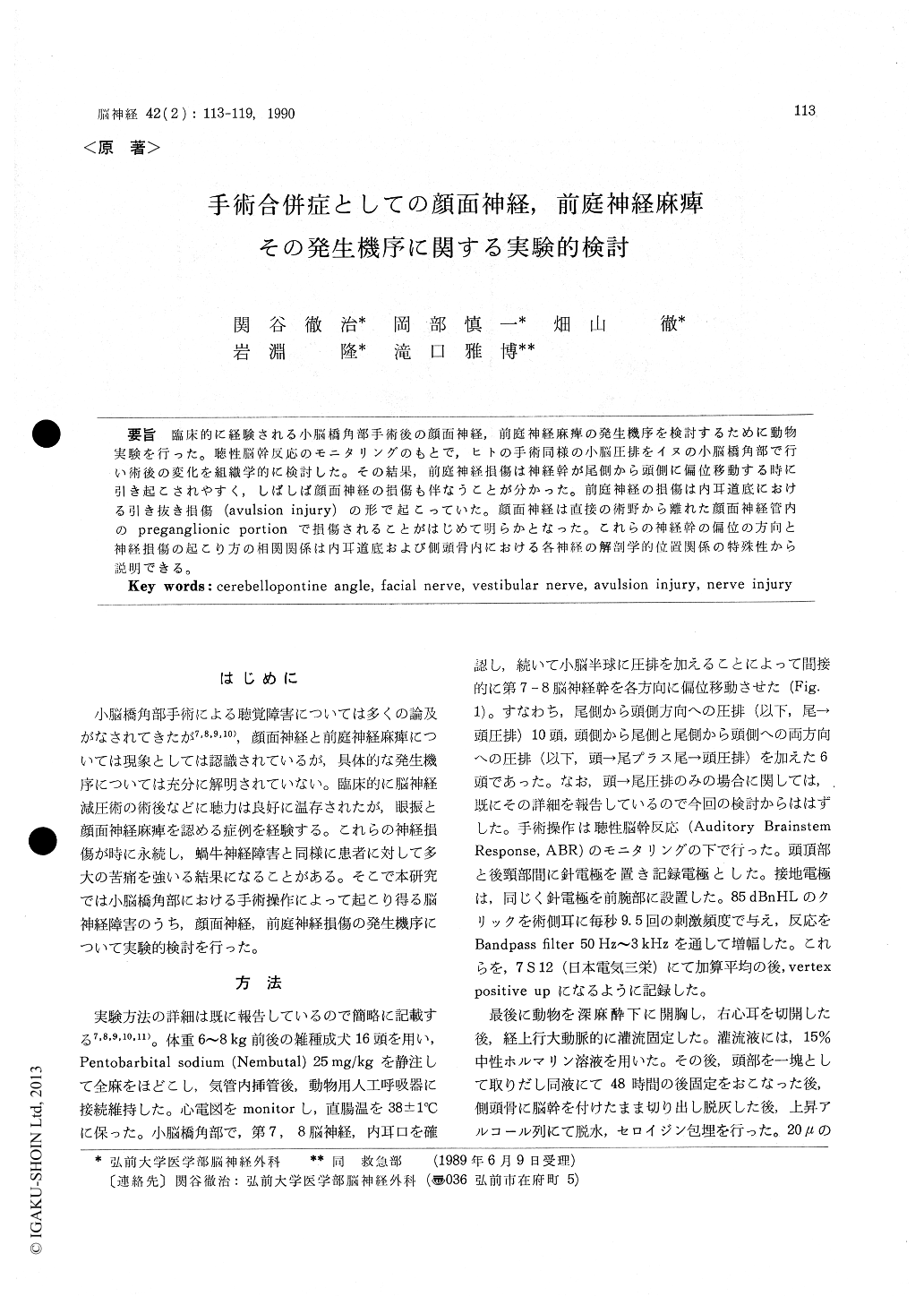
臨床的に経験される小脳橋角部手術後の顔面神経,前庭神経麻痺の発生機序を検討するために動物実験を行った。聴性脳幹反応のモニタリングのもとで,ヒトの手術同様の小脳圧排をイヌの小脳橋角部で行い術後の変化を組織学的に検討した。その結果,前庭神経損傷は神経幹が尾側から頭側に偏位移動する時に引き起こされやすく,しばしば顔面神経の損傷も伴なうことが分かった。前庭神経の損傷は内耳道底における引き抜き損傷(avulsion injury)の形で起こっていた。顔面神経は直接の術野から離れた顔面神経管内のpreganglionic portionで損傷されることがはじめて明らかとなった。これらの神経幹の偏位の方向と神経損傷の起こり方の相関関係は内耳道底および側頭骨内における各神経の解剖学的位置関係の特殊性から説明できる。
The 7th and 8th cranial nerves were shifted in the cerebellopontine (CP) angle of dogs by cerebel-lar retractions that were similar to those perform-ed in humans with monitoring of auditory evoked brainstem responses (ABR). Postoperatively, the vestibular, facial nerves, and brainstem were his-tologically examined.
Cuadal-to-rostral shifts of the nerves could in-duce vestibular and/or facial nerve damages. The most vulnerable portion of the vestibular nerve was located between the vestibular ganglions andthe area vestibularis-the most lateral end of the internal auditory canal. This indicated that due to traction force derived from surgical interven-tions, the nerves and vessels were avulsed at the fundus of the internal auditory canal. The vesti-bular nerve may be potentially injured more easily and frequently than the cochlear and facial nerves in retromastoid craniectomies with lateral decu-bitus position in humans.
Direct injuries of the facial nerves in the CP angles were not observed in this study. It was elucidated that the facial nerve was usually in-jured in the facial canal proximal to the geniculate ganglion due to traction force derived from mani-pulations in the CP angle. It is likely that as facial nerve edema progresses postoperatively, the facial nerve is gradually compressed within the narrow labyrinthine portion of the facial canal. This may be the cause of delayed postoperative facial nerve palsy.
The importance to recognize how not only coch-lear but also vestibular and facial nerve are in-jured by the usual manipulations in the CP angle is stressed.
Copyright © 1990, Igaku-Shoin Ltd. All rights reserved.