Japanese
English
- 有料閲覧
PPV購入案内
1,320円 (1,200円+税10%) こちらは、517ページから520ページの文献です。購入には医書.jp本会員登録が必要です。
会員登録完了後に改めて上記「購入サイトへ」を選択してください。
または「購入サイトへ」選択後に「購入ログイン」、「新規会員登録」の順に進んでください。
会員登録について詳しくはをご確認ください。
- Abstract 文献概要
- 1ページ目 Look Inside
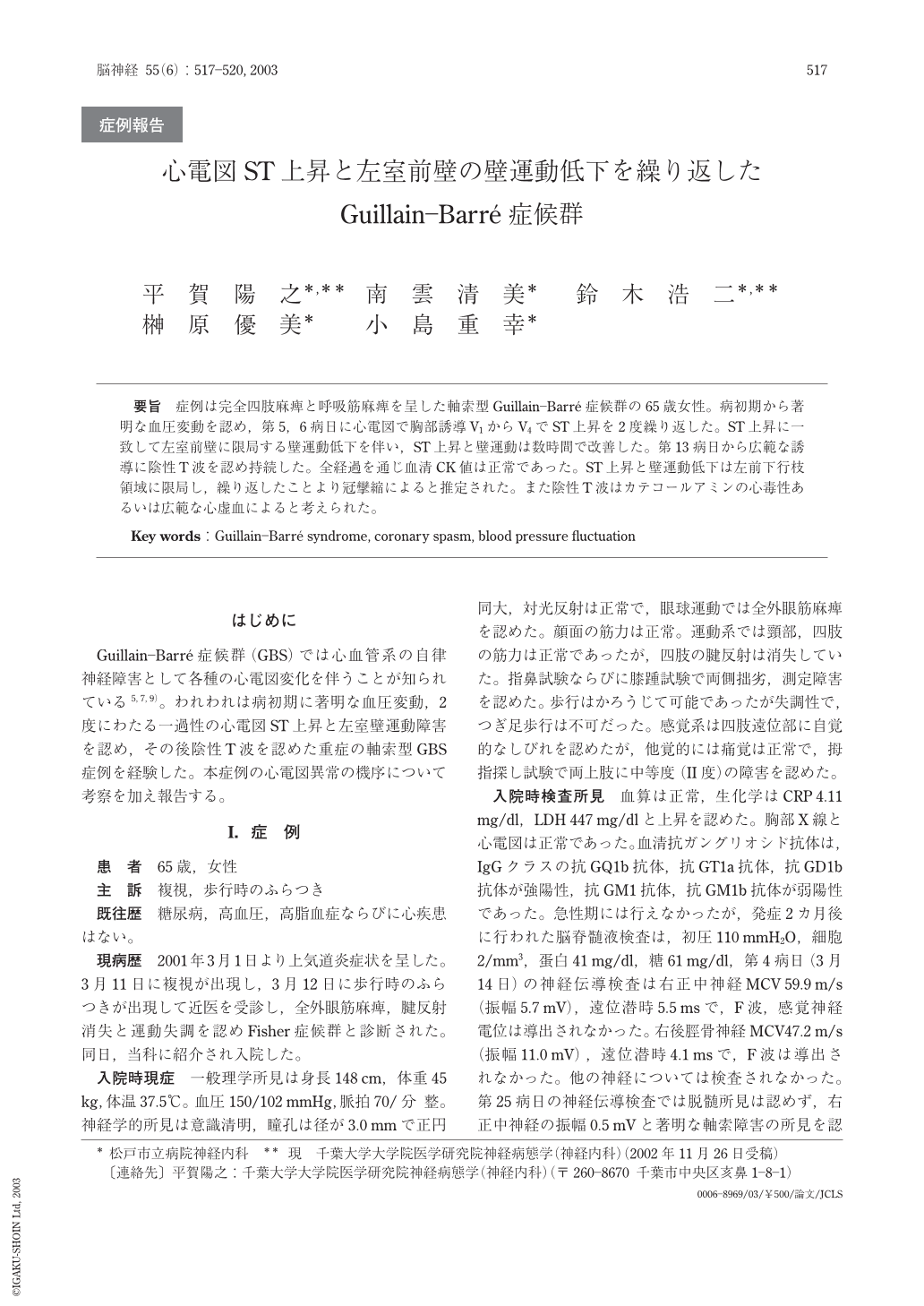
要旨 症例は完全四肢麻痺と呼吸筋麻痺を呈した軸索型Guillain-Barré症候群の65歳女性。病初期から著明な血圧変動を認め,第5,6病日に心電図で胸部誘導V1からV4でST上昇を2度繰り返した。ST上昇に一致して左室前壁に限局する壁運動低下を伴い,ST上昇と壁運動は数時間で改善した。第13病日から広範な誘導に陰性T波を認め持続した。全経過を通じ血清CK値は正常であった。ST上昇と壁運動低下は左前下行枝領域に限局し,繰り返したことより冠攣縮によると推定された。また陰性T波はカテコールアミンの心毒性あるいは広範な心虚血によると考えられた。
A-65-year old woman who developed total ophthalmoplegia, areflexia in all her limbs and ataxia after upper respiratory tract infection was admitted to our hospital on the second day of illness. On day 3, she developed severe tetraparesis and respiratory failure which required mechanical ventilation, and Guillain-Barré syndrome(GBS)was diagnosed. On day 4, bilateral ptosis, facial diplegia, and neck muscle weakness appeared, and her all limbs were flaccid and immobile. An electrophysiological study suggested axonal damage. Marked blood pressure fluctuation also appeared on day 4. On day 5, an electrocardiogram showed a ST-segment elevation in leads V1 through V4 and the echocardiography showed anterior hypokinesia of the left ventricle. Her serum creatine kinase was normal. Left ventricular dysfunction and ST-segment elevation were normalized within hours, but a transient ST-segment elevation re-occurred on day 6. An electrocardiogram on day 13, showed inverted T waves in diffuse leads, which inversion continued. ST-segment elevation and hypokinesia in this patient were restricted to the left anterior descending branch, therefore, coronary spasm of that branch was considered the possible mechanism. In contrast, inverted T wave was due to either catecholamine cardiotoxicity or diffuse cardiac ischemia. Abnormalities of electrocardiogram were presumably due to cardiovascular autonomic dysfunction of GBS.
Copyright © 2003, Igaku-Shoin Ltd. All rights reserved.