Japanese
English
- 有料閲覧
PPV購入案内
1,320円 (1,200円+税10%) こちらは、753ページから760ページの文献です。購入には医書.jp本会員登録が必要です。
会員登録完了後に改めて上記「購入サイトへ」を選択してください。
または「購入サイトへ」選択後に「購入ログイン」、「新規会員登録」の順に進んでください。
会員登録について詳しくはをご確認ください。
- Abstract 文献概要
- 1ページ目 Look Inside
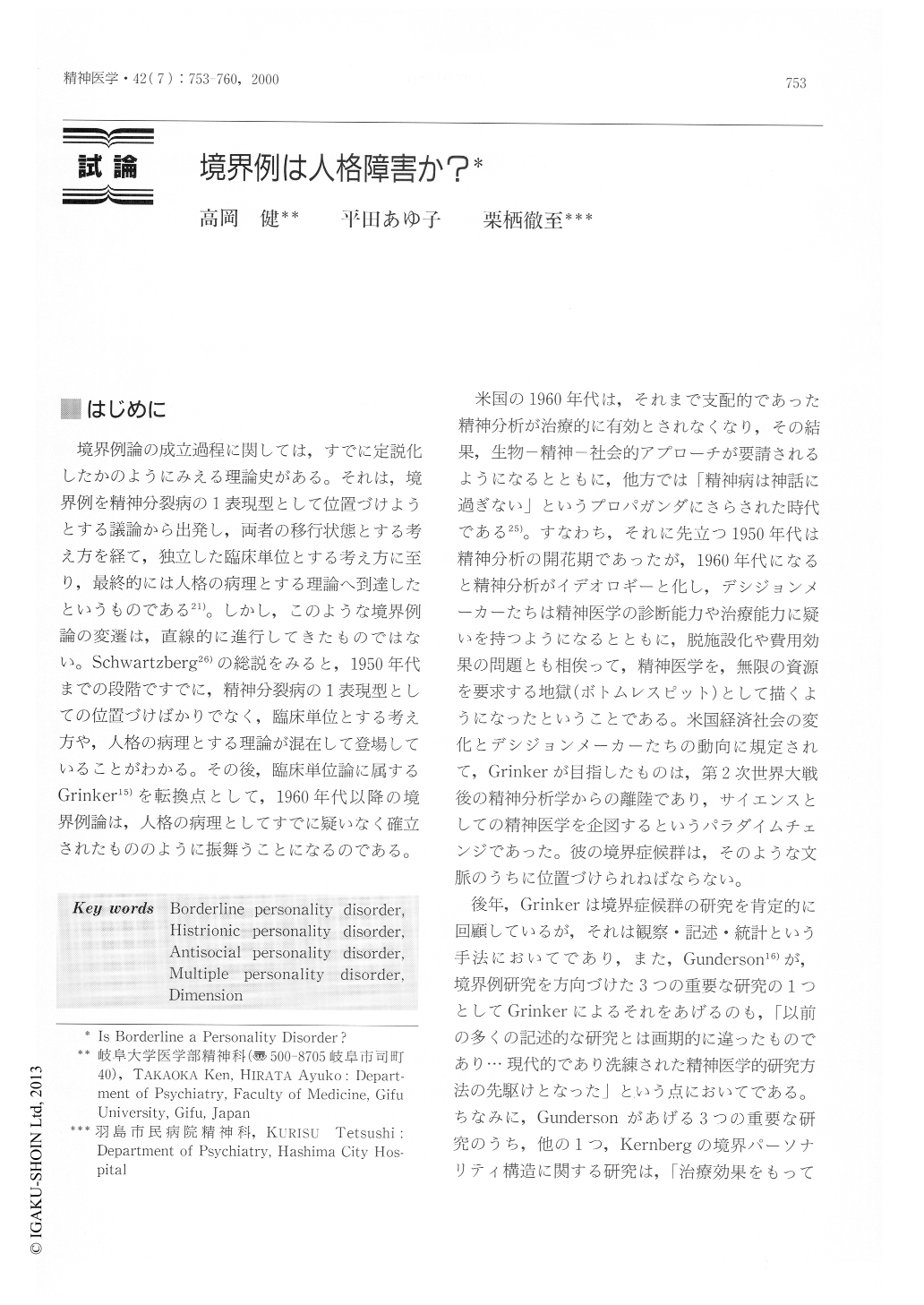
はじめに
境界例論の成立過程に関しては,すでに定説化したかのようにみえる理論史がある。それは,境界例を精神分裂病の1表現型として位置づけようとする議論から出発し,両者の移行状態とする考え方を経て,独立した臨床単位とする考え方に至り,最終的には人格の病理とする理論へ到達したというものである21)。しかし,このような境界例論の変遷は,直線的に進行してきたものではない。Schwartzberg26)の総説をみると,1950年代までの段階ですでに,精神分裂病の1表現型としての位置づけばかりでなく,臨床単位とする考え方や,人格の病理とする理論が混在して登場していることがわかる。その後,臨床単位論に属するGrinker15)を転換点として,1960年代以降の境界例論は,人格の病理としてすでに疑いなく確立されたもののように振舞うことになるのである。
米国の1960年代は,それまで支配的であった精神分析が治療的に有効とされなくなり,その結果,生物-精神-社会的アプローチが要請されるようになるとともに,他方では「精神病は神話に過ぎない」というプロパガンダにさらされた時代である25)。すなわち,それに先立っ1950年代は精神分析の開花期であったが,1960年代になると精神分析がイデオロギーと化し,デシジョンメーカーたちは精神医学の診断能力や治療能力に疑いを持つようになるとともに,脱施設化や費用効果の問題とも相俟って,精神医学を,無限の資源を要求する地獄(ボトムレスピット)として描くようになったということである。米国経済社会の変化とデシジョンメーカーたちの動向に規定されて,Grinkerが目指したものは,第2次世界大戦後の精神分析学からの離陸であり,サイエンスとしての精神医学を企図するというパラダイムチェンジであった。彼の境界症候群は,そのような文脈のうちに位置づけられねばならない。
Background : The paradigm shift which occurred in American psychiatry in the 1960s, from ideology to scientific research and from pessimism to optimistic treatment, led psychiatrists to regard borderline as a personality disorder. However, two previous theories, the St. Louis group's critical study concerning hysteria and Blackburn's criticism of the myth of the sociopath, implied that the concept of borderline as a personality disorder should be abandoned.
Design and Method : The authors hypothesized that borderline is not a personality disorder but a clinical feature exhibited by the collapse of various personality disorders during the patient's crisis. To verify this hypothesis, they considered current debates with respect to borderline.
Result : The view put forward by researchers that multiple personality disorder is an extreme type of borderline state supports the authors' hypothesis because multiple personality disorder is regarded not as a personality disorder per se but as a type of clinical feature. Furthermore, debates regarding the comorbidity of borderline have revealed a contradiction in DSM criteria, namely, borderline is classified as an axis-II personality disorder while the concept and criteria of borderline overlap those of several axis-I diseases. This contradiction also supports the authors' hypothesis because it indicates the questionability of regarding borderline as a personality disorder. Finally, even recent dimension theories concerning temperament and character have been unable to explain some features of borderline, such as micropsychosis, prompting psychiatrists to revisit Kretschmer's multipledimension diagnosis, in which character, environment and experience bring about psychotic features. This view coincides with the authors' hypothesis in terms of regarding borderline as a clinical feature exhibited by collapse of personality disorders during the patient's crisis.
Conclusion : Borderline patients are not regarded as having a personality disorder. Practitioners should treat their condition not as a personality disorder but as a clinical feature.
Copyright © 2000, Igaku-Shoin Ltd. All rights reserved.