Japanese
English
- 有料閲覧
PPV購入案内
1,320円 (1,200円+税10%) こちらは、881ページから891ページの文献です。購入には医書.jp本会員登録が必要です。
会員登録完了後に改めて上記「購入サイトへ」を選択してください。
または「購入サイトへ」選択後に「購入ログイン」、「新規会員登録」の順に進んでください。
会員登録について詳しくはをご確認ください。
- Abstract 文献概要
- 1ページ目 Look Inside
- 参考文献 Reference
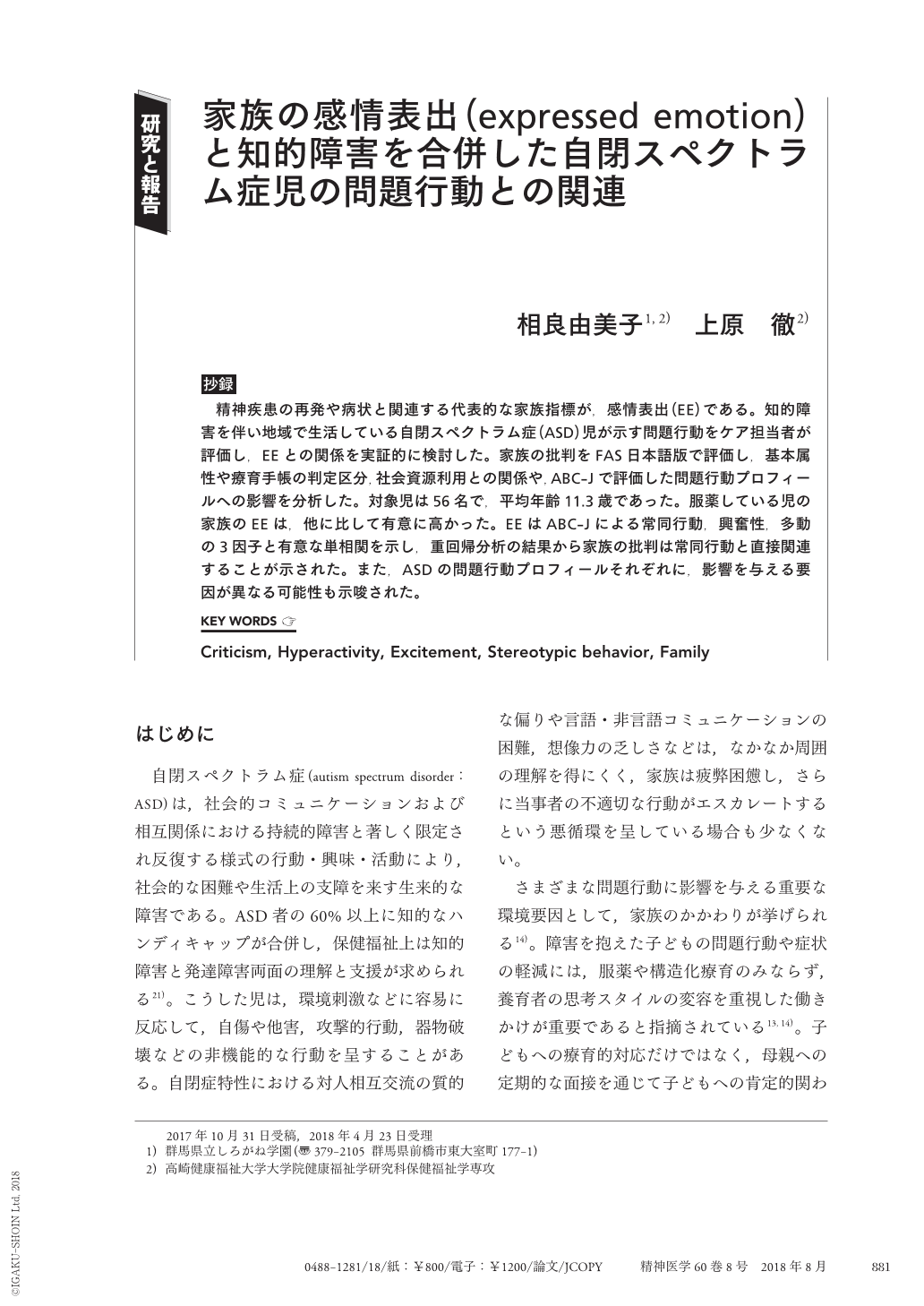
抄録 精神疾患の再発や病状と関連する代表的な家族指標が,感情表出(EE)である。知的障害を伴い地域で生活している自閉スペクトラム症(ASD)児が示す問題行動をケア担当者が評価し,EEとの関係を実証的に検討した。家族の批判をFAS日本語版で評価し,基本属性や療育手帳の判定区分,社会資源利用との関係や,ABC-Jで評価した問題行動プロフィールへの影響を分析した。対象児は56名で,平均年齢11.3歳であった。服薬している児の家族のEEは,他に比して有意に高かった。EEはABC-Jによる常同行動,興奮性,多動の3因子と有意な単相関を示し,重回帰分析の結果から家族の批判は常同行動と直接関連することが示された。また,ASDの問題行動プロフィールそれぞれに,影響を与える要因が異なる可能性も示唆された。
Backgrounds:Aberrant behaviors of children with autism spectrum disorder(ASD) or intellectual disability(ID) often are influenced by familial interaction. Expressed emotion(EE) is a significant measure to assess empirically family emotional attitudes and its relationship with outcome has been widely supported. The present study aimed to investigate associations between EE and behavioral problems of youths with both ASD and ID lived with own families.
Methods:The Family Attitude Scale(FAS) was used to evaluate family criticism, and backgrounds including medication, complication and severity of ID were analyzed regarding EE. The 5 subscales of the Aberrant Behavior Checklist Japanese version(ABC-J) were administered by careers of respective children. Participants were 56 children(11.3, 6-18 years) and their mothers, and 31 care givers assessed the ABC-J. Correlation between the ABC-J and the FAS was calculated, and multiple regression analysis was conducted to find variables to be associated with aberrant behaviors.
Results:Persons with medication showed higher family criticism than those without it(p<.01). Stereotypic behavior(p<.01), irritability/excitement(p<.01), and hyperactivity/noncompliance(p<.01) in the ABC-J were significantly correlated with EE. Regression analysis indicated criticism was related with stereotypic behavior directly(p<.05) and also suggested the other scales of the ABC-J were influenced by different factors.
Conclusion:Stereotypic behaviors were strongly associated with EE, and related factors varied according to aberrant behaviors profiles.
Copyright © 2018, Igaku-Shoin Ltd. All rights reserved.