Japanese
English
- 有料閲覧
PPV購入案内
1,320円 (1,200円+税10%) こちらは、537ページから544ページの文献です。購入には医書.jp本会員登録が必要です。
会員登録完了後に改めて上記「購入サイトへ」を選択してください。
または「購入サイトへ」選択後に「購入ログイン」、「新規会員登録」の順に進んでください。
会員登録について詳しくはをご確認ください。
- Abstract 文献概要
- 1ページ目 Look Inside
- サイト内被引用 Cited by
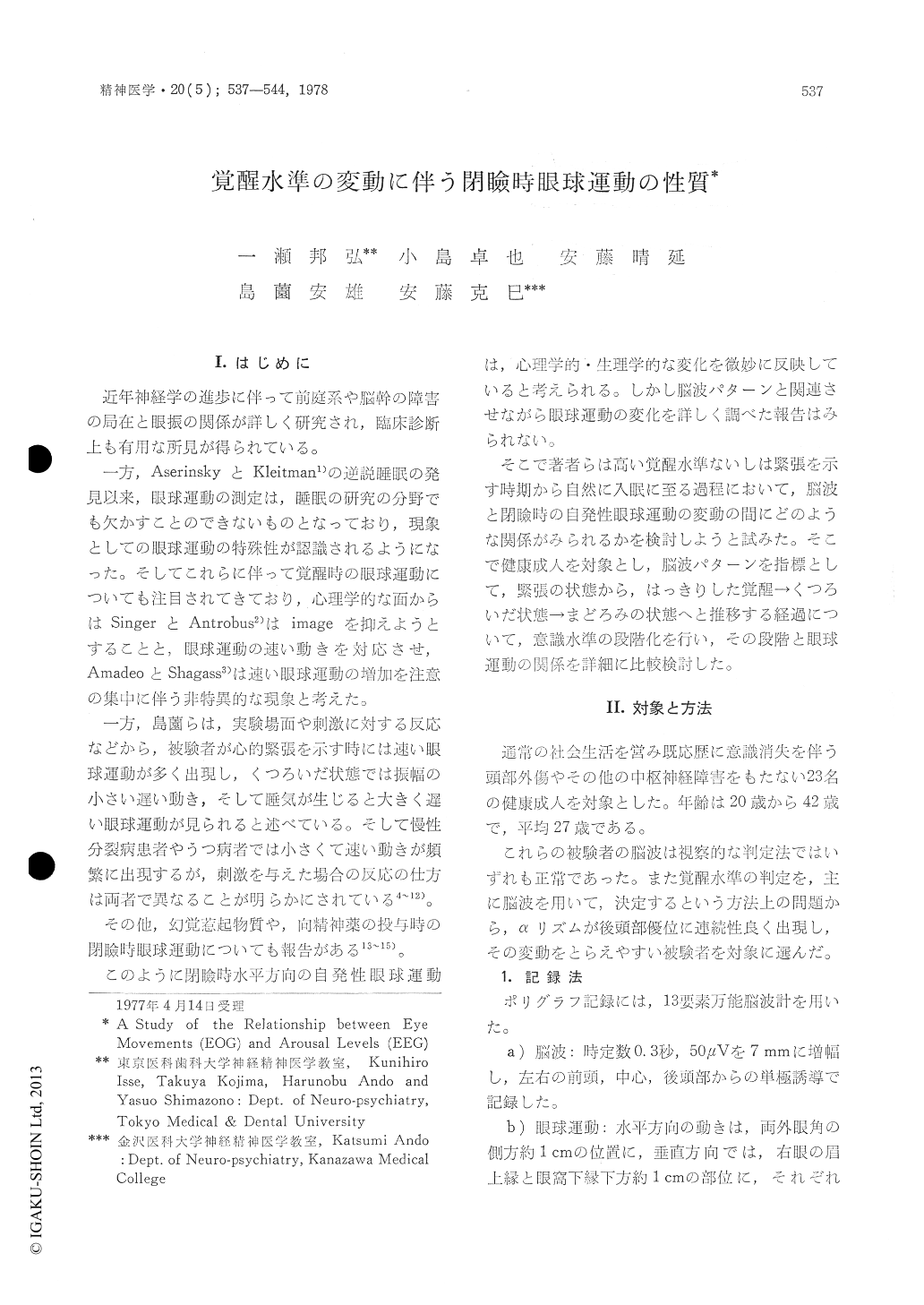
I.はじめに
近年神経学の進歩に伴って前庭系や脳幹の障害の局在と眼振の関係が詳しく研究され,臨床診断上も有用な所見が得られている。
一方,AserinskyとKleitman1)の逆説睡眠の発見以来,眼球運動の測定は,睡眠の研究の分野でも欠かすことのできないものとなっており,現象としての眼球運動の特殊性が認識されるようになった。そしてこれらに伴って覚醒時の眼球運動についても注目されてきており,心理学的な面からはSingerとAntrobus2)はimageを抑えようとすることと,眼球運動の速い動きを対応させ,AmadeoとShagass3)は速い眼球運動の増加を注意の集中に伴う非特異的な現象と考えた。
一方,島薗らは,実験場面や刺激に対する反応などから,被験者が心的緊張を示す時には速い眼球運動が多く出現し,くつろいだ状態では振幅の小さい遅い動き,そして睡気が生じると大きく遅い眼球運動が見られると述べている。そして慢性分裂痛患者やうつ病者では小さくて速い動きが頻繁に出現するが,刺激を与えた場合の反応の仕方は両者で異なることが明らかにされている4〜12)。
その他,幻覚惹起物質や,向精神薬の投与時の閉瞼時眼球運動についても報告がある13〜15)。
このように閉瞼時水平方向の自発性眼球運動は,心理学的・生理学的な変化を微妙に反映していると考えられる。しかし脳波パターンと関連させながら眼球運動の変化を詳しく調べた報告はみられない。
そこで著者らは高い覚醒水準ないしは緊張を示す時期から自然に入眠に至る過程において,脳波と閉瞼時の自発性眼球運動の変動の間にどのような関係がみられるかを検討しようと試みた。そこで健康成人を対象とし,脳波パターンを指標として,緊張の状態から,はっきりした覚醒→くつろいだ状態→まどろみの状態へと推移する経過について,意識水準の段階化を行い,その段階と眼球運動の関係を詳細に比較検討した。
The process of the change from a high arousal level immediately after the sonic-electric stimulation to a natural sleep and the changes made by sonic stimulation in the initial stages of light sleep were recorded polygraphically on 23 normal subjects with closed eyes. The precise relationships between the EEG pattern and eye movements were studied.
1) The process of the arousal level gradually deepening to a natural sleep from a high arousal level immediately after stimulation was divided into four stages by the use of EEG patterns as an index: Alert, Resting Ⅰ, Resting Ⅱ and Drowsy.
2) Eye movements of R-type (large and rapid) significantly decreased as the arousal level deepened. A greater occurrence of eye movements of r-type (small and rapid) was observed at the stages of Alert and Resting Ⅰ, respectively, which are relatively high arousal levels. These movements significantly decreased as the level deepened to Resting Ⅱ and to Drowsy.
3) The eye movements of s-type (small and slow) did not appear during the Alert stage, but significantly increased with the deepening of arousal levels.
The S-type (large and slow) did not appear during the Alert and Resting Ⅰ stages, comparatively high arousal levels; however, they increased at Resting Ⅱ and Drowsy.
In conclusion, in the process of proceeding from a high arousal level to a natural sleep, changes in eye movements closely correspond to the EEG pattern.
4) The reactions of EEG and eye movements were observed not to correspond occasionally in case an arousal stimulation was given at the initial stage of light sleep. Simultaneously the adjusting mechanism of eye movements which varied according to the changes in arousal levels and emotions (uneasiness and tension) was also studied.
Copyright © 1978, Igaku-Shoin Ltd. All rights reserved.