Japanese
English
- 有料閲覧
PPV購入案内
1,320円 (1,200円+税10%) こちらは、97ページから103ページの文献です。購入には医書.jp本会員登録が必要です。
会員登録完了後に改めて上記「購入サイトへ」を選択してください。
または「購入サイトへ」選択後に「購入ログイン」、「新規会員登録」の順に進んでください。
会員登録について詳しくはをご確認ください。
- Abstract 文献概要
- 1ページ目 Look Inside
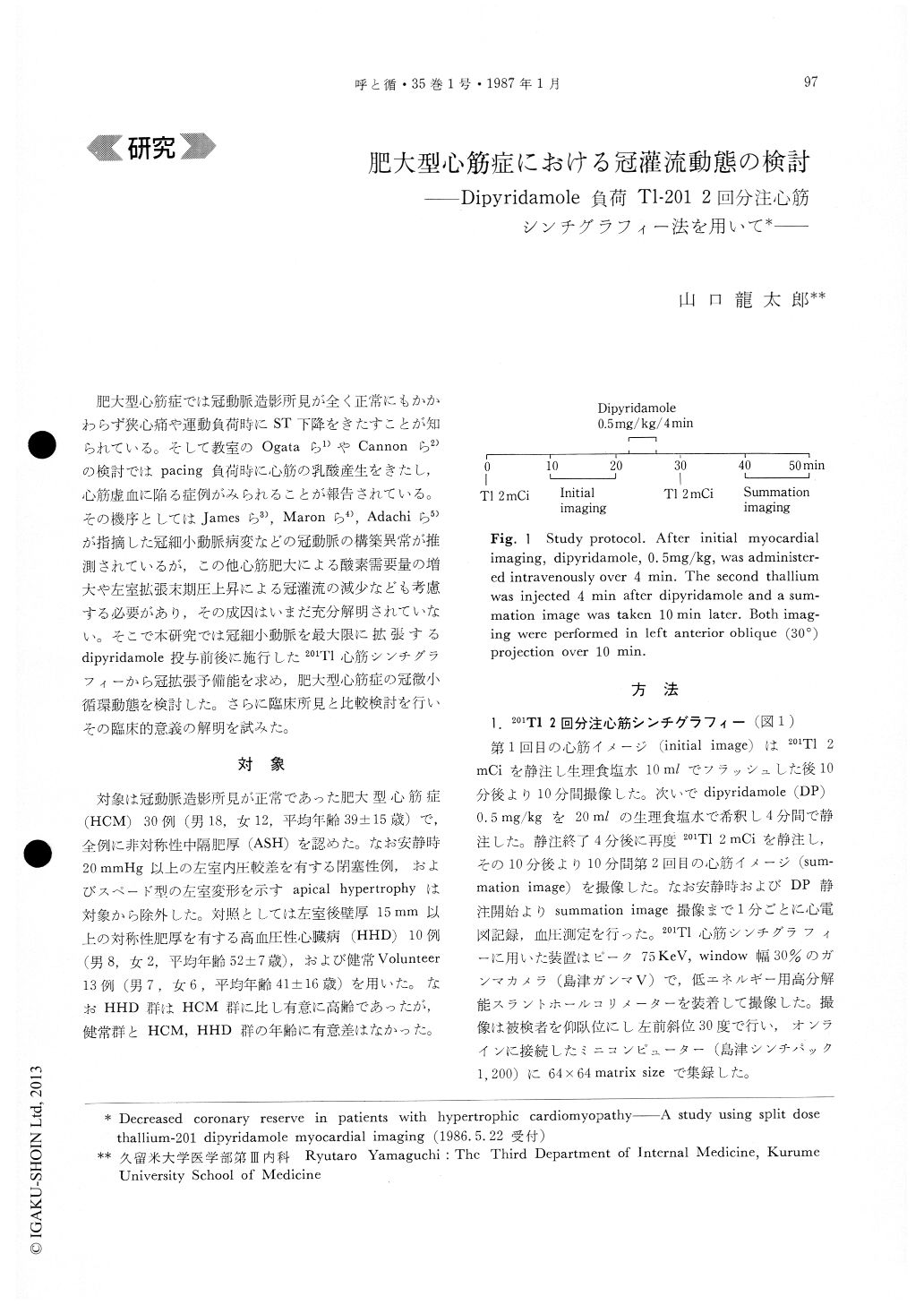
肥大型心筋症では冠動脈造影所見が全く正常にもかかわらず狭心痛や運動負荷時にST下降をきたすことが知られている。そして教室のOgataら1)やCannonら2)の検討ではpacing負荷時に心筋の乳酸産生をきたし,心筋虚血に陥る症例がみられることが報告されている。その機序としてはJamcsら3),Maronら4),Adachiら5)が指摘した冠細小動脈病変などの冠動脈の構築異常が推測されているが,この他心筋肥大による酸素需要量の増大や左室拡張末期圧上昇による冠灌流の減少なども考慮する必要があり,その成因はいまだ充分解明されていない。そこで本研究では冠細小動脈を最大限に拡張するdipyridamole投与前後に施行した201Tl心筋シンチグラフィーから冠拡張予備能を求め,肥大型心筋症の冠微小循環動態を検討した。さらに臨床所見と比較検討を行いその臨床的意義の解明を試みた。
To assess coronary flow reserve in patients with hyper-trophic cardiomyopathy (HCM), split dose thallium-201 dipyridamole (DP) myocardial scintigraphy was per-formed. Subjects included 30 HCM patients with asym-metric septa] hypertrophy and normal coronary angio-gram, 10 hypertensive patients with left ventricular hypertrophy (posterior wall thickness> 15mm) and 13 healthy controls. Coronary reserve index (CRP was calculated as a ratio of myocardial thallium uptake after dipyridamole (0.5mg/kg) to the baseline value. HCM patients showed a significantly lower CRI (177%) as compared with controls (281%) or hypertensive patients (214%), and 17 of them had abnormally decreased CRI below the normal range (mean-2SD of controls). These HCM patients with abnormal CRI showed significantly more frequent family histrory of HCM (71 vs 31%), and a greater degree of systolic narrowing of the septaI perforator as compared with those normal CRI. Maximal work loads were signifi-cantly lower (82 vs 106 watts) in those with abnormal CRI, 31% developed ST depression at 80 watts. How-ever, patients with abnormal CRI did not differ from those with normal CRI in septal and posterior wall thickness, left ventricular end-diastolic pressure, and in the degree of systolic narrowing of the left anterior descending artery. In the segmental CRI analysis, 13 HCM patients showed abnormal CRI in the septal and/or apical segments, while 8 patients presented diffuse CRI decrease, including the non-hypertrophied posterior segment.
These findings indicate that 57% of HCM patients have impaired coronary vasodilatory reserve, which may not only be a consequence of left ventricular hypertro-phy, elevated left ventricular end-diastolic pressure, and systolic narrowing of the coronary artery, but may be related to small vessel coronary disease. This reduced coronary reserve would be an important pathology in patients with HCM, developing myocardial ischemia and impairing cardiac performance during exercise.
Copyright © 1987, Igaku-Shoin Ltd. All rights reserved.