Japanese
English
- 有料閲覧
PPV購入案内
1,320円 (1,200円+税10%) こちらは、1671ページから1677ページの文献です。購入には医書.jp本会員登録が必要です。
会員登録完了後に改めて上記「購入サイトへ」を選択してください。
または「購入サイトへ」選択後に「購入ログイン」、「新規会員登録」の順に進んでください。
会員登録について詳しくはをご確認ください。
- Abstract 文献概要
- 1ページ目 Look Inside
- 参考文献 Reference
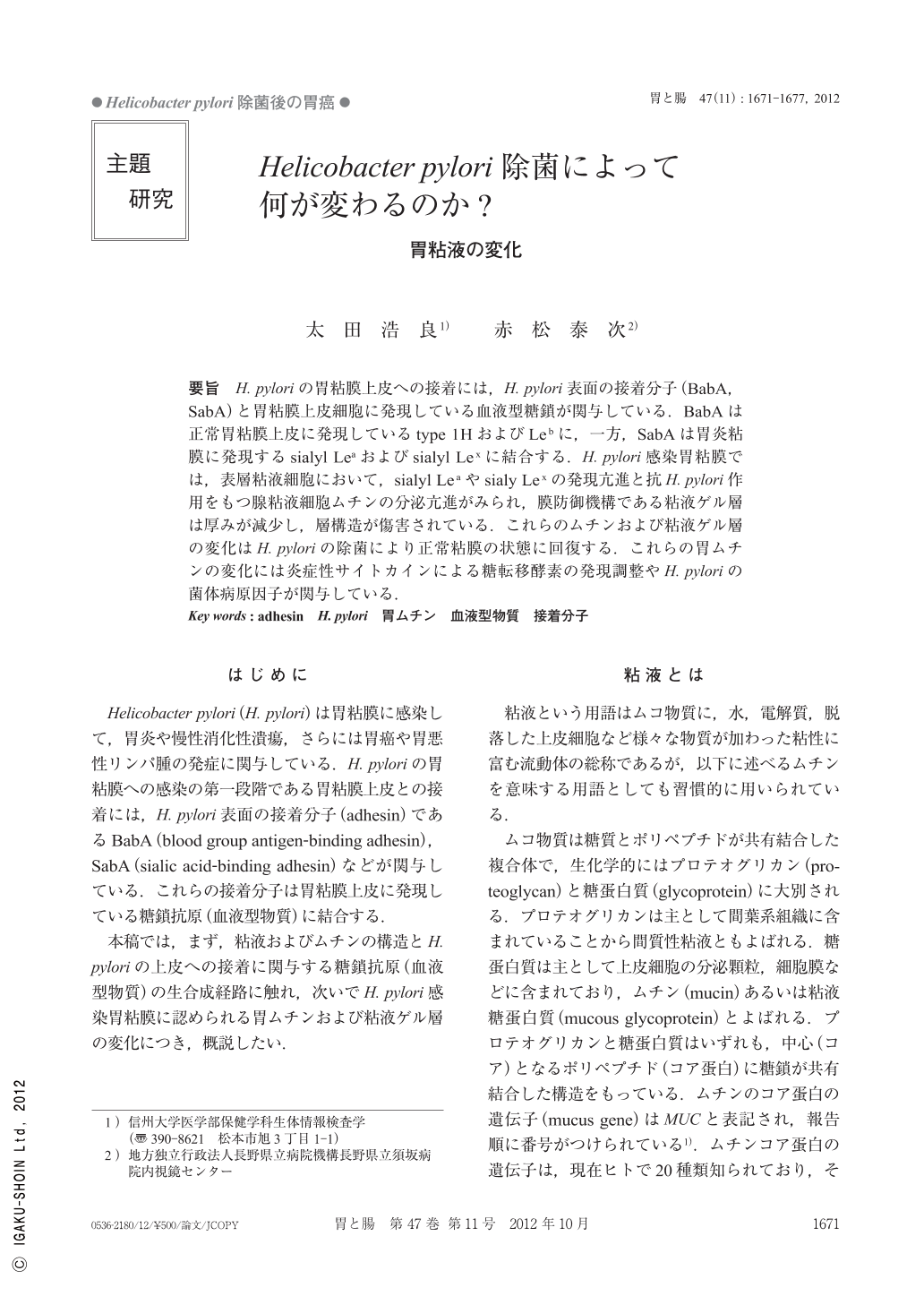
要旨 H. pyloriの胃粘膜上皮への接着には,H. pylori表面の接着分子(BabA,SabA)と胃粘膜上皮細胞に発現している血液型糖鎖が関与している.BabAは正常胃粘膜上皮に発現しているtype 1HおよびLebに,一方,SabAは胃炎粘膜に発現するsialyl Leaおよびsialyl Lexに結合する.H. pylori感染胃粘膜では,表層粘液細胞において,sialyl Leaやsialy Lexの発現亢進と抗H. pylori作用をもつ腺粘液細胞ムチンの分泌亢進がみられ,膜防御機構である粘液ゲル層は厚みが減少し,層構造が傷害されている.これらのムチンおよび粘液ゲル層の変化はH. pyloriの除菌により正常粘膜の状態に回復する.これらの胃ムチンの変化には炎症性サイトカインによる糖転移酵素の発現調整やH. pyloriの菌体病原因子が関与している.
H. pylori(Helicobacter pylori)characteristically attaches to mucous cells on the gastric surface and preferentially colonizes and forms microcolonies within the mucous gel layer of gastric surface mucous cell type mucins. Mucins are the main components in the mucus that covers the epithelium, and they function to protect the epithelium against noxious agents, including digestive fluids, microorganisms, and toxins. Biochemically, mucins are high molecular-weight glycoproteins with complex oligosaccharide side-chains, including blood-group antigens, attached to the mucus core-protein backbone. Lewis(Le)-associated antigens are carbohydrates and may have a role in H. pylori adherence. Type 1H and Le(b)and type 2 antigens(Le[X], Le[Y], and type 2H)are present in surface mucous cells, and both types are under the control of the secretor gene. In addition, type 2 antigens are present in the fundic and pyloric gland cells, but they are not controlled by the secretor gene.
The patterns of glycosylation of gastric mucins vary in different gastric compartments and are reversibly altered by H. pylori infection. Gastric mucosa infected by H. pylori expressed higher levels of Le(b), sialyl-Le(a), and sialyl-Le(x). The BabA adhesion of H. pylori recognizes both types 1H and Le(b)blood-group antigens expressed on normal gastric mucosa of secretor individuals, contributing to the initial steps of infection. With persistent H. pylori infection, an inflammatory response with concomitant expression of sialylated antigens is induced in the gastric mucosa. The SabA adhesin mediates the binding of H. pylori to inflamed gastric mucosa by recognizing sialyl-Le(a)and sialyl-Le(X)antigens.
Mucins secreted from the gastric gland mucous cells have O-glycans with terminalα-1,4-linked N-acetylglucosamine that exhibit an antimicrobial effect against H. pylori by inhibiting the biosynthesis of the cell wall of H. pylori. The mucin secretion from gastric gland mucus cells in patients infected by H. pylori are increased. This upregulation of the mucin secretion may be involved in a defense mechanism against H. pylori infection. Further insight into the complex interactions between the H. pylori adhesins and the host receptors will contribute to the design of alternative strategies for the eradication of H. pylori.
Copyright © 2012, Igaku-Shoin Ltd. All rights reserved.