Japanese
English
- 有料閲覧
PPV購入案内
1,320円 (1,200円+税10%) こちらは、747ページから754ページの文献です。購入には医書.jp本会員登録が必要です。
会員登録完了後に改めて上記「購入サイトへ」を選択してください。
または「購入サイトへ」選択後に「購入ログイン」、「新規会員登録」の順に進んでください。
会員登録について詳しくはをご確認ください。
- Abstract 文献概要
- 1ページ目 Look Inside
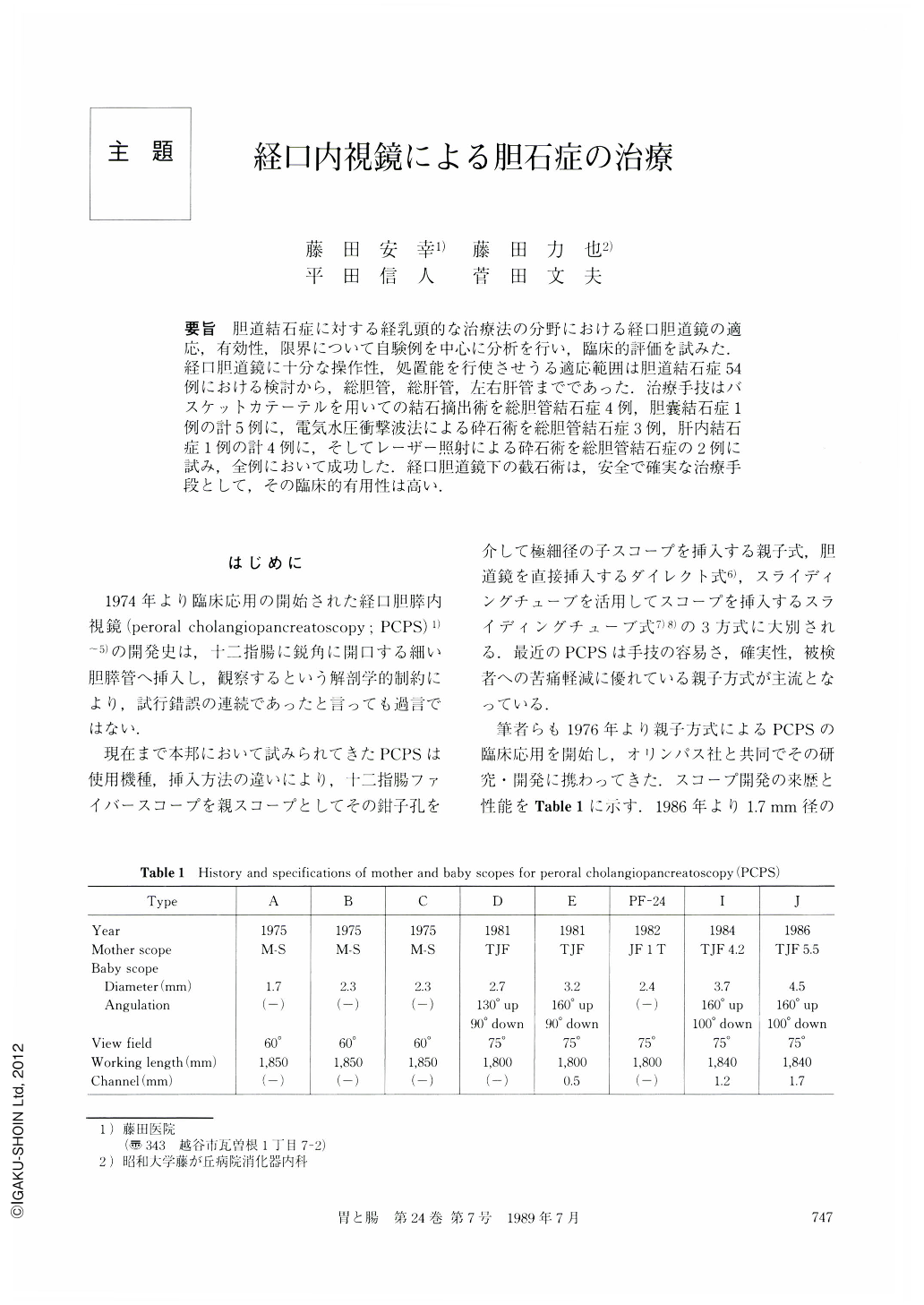
要旨 胆道結石症に対する経乳頭的な治療法の分野における経口胆道鏡の適応,有効性,限界について自験例を中心に分析を行い,臨床的評価を試みた.経口胆道鏡に十分な操作性,処置能を行使させうる適応範囲は胆道結石症54例における検討から,総胆管,総肝管,左右肝管までであった.治療手技はバスケットカテーテルを用いての結石摘出術を総胆管結石症4例,胆囊結石症1例の計5例に,電気水圧衝撃波法による砕石術を総胆管結石症3例,肝内結石症1例の計4例に,そしてレーザー照射による砕石術を総胆管結石症の2例に試み,全例において成功した.経口胆道鏡下の截石術は,安全で確実な治療手段として,その臨床的有用性は高い.
The aim of this paper is to clarify the usefulness of PCS in therapy of cases with biliary stone.
The instruments which we have employed in this study are the latest model mother scope TJFM-20 and baby scope CHFB-20 manufactured by Olympus optical company. The most advanced improvement of this model is that the baby scope is equipped with a bigger channel diameter of 1.7 mm. This bigger channel is large enough to accomodate available basket catheter, biopsy and grasping forceps, the electrode for electrohydraulic shock wave lithotripsy (EHL), and quartz fiber for Nd: YAG laser lithotripsy. An angulation system extends the range of visual field and facilitates selective insertion into the biliary duct system. Such improvements have brought about great advances in therapeutic capabilities.
In the therapeutic field, PCS has two roles. One is to examine whether sludges and/or fragmented stones remain after lithotripsy by conventional methods, and the other is to smash the large such as the lumen-filling stone, which can't be smashed even by mechanical lithotripsy, by EHL or laser lithotripsy under visualization.
In the former role, stone removal with basket catheter was successfully carried out in 5 cases. Of these, gallbladder stones were extracted by peroral cholecystoscopy in one case.
In the latter role, EHL was attempted in three cases with common bile duct stones and one intrahepatic stone. Laser lithotripsy was attempted for two cases with common bile duct stones. These lithotripsy techniques were successfully carried out in all cases.
In comparison with laser lithotripsy, EHL is a more practicable and easier technique from the following view points, namely, powerful lithotripsy effect, thin and flexible probe and a low cost.
From our clinical experiences, we concluded as follows; (1) therapeutic approaches for biliary stone utilizing PCS are clinically becoming much more practicable, and (2) EHL is much superior to laser lithotripsy in transduodenal lithotripsy.
Copyright © 1989, Igaku-Shoin Ltd. All rights reserved.