Japanese
English
- 有料閲覧
PPV購入案内
1,320円 (1,200円+税10%) こちらは、1009ページから1019ページの文献です。購入には医書.jp本会員登録が必要です。
会員登録完了後に改めて上記「購入サイトへ」を選択してください。
または「購入サイトへ」選択後に「購入ログイン」、「新規会員登録」の順に進んでください。
会員登録について詳しくはをご確認ください。
- Abstract 文献概要
- 1ページ目 Look Inside
- 参考文献 Reference
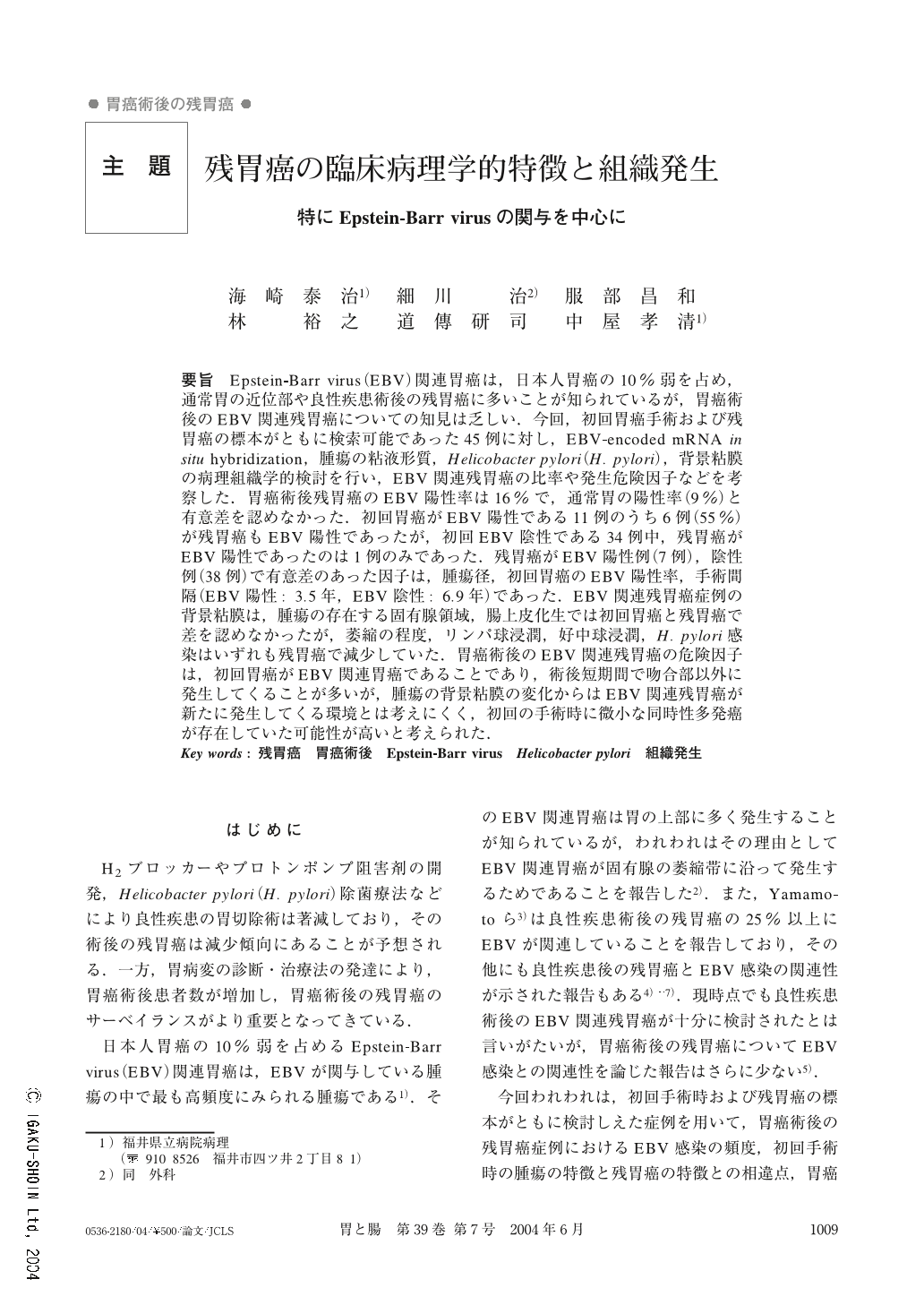
病理 Epstein-Barr virus(EBV)関連胃癌は,日本人胃癌の10%弱を占め,通常胃の近位部や良性疾患術後の残胃癌に多いことが知られているが,胃癌術後のEBV関連残胃癌についての知見は乏しい.今回,初回胃癌手術および残胃癌の標本がともに検索可能であった45例に対し,EBV-encoded mRNA in situ hybridization,腫瘍の粘液形質,Helicobacter pylori(H. pylori),背景粘膜の病理組織学的検討を行い,EBV関連残胃癌の比率や発生危険因子などを考察した.胃癌術後残胃癌のEBV陽性率は16%で,通常胃の陽性率(9%)と有意差を認めなかった.初回胃癌がEBV陽性である11例のうち6例(55%)が残胃癌もEBV陽性であったが,初回EBV陰性である34例中,残胃癌がEBV陽性であったのは1例のみであった.残胃癌がEBV陽性例(7例),陰性例(38例)で有意差のあった因子は,腫瘍径,初回胃癌のEBV陽性率,手術間隔(EBV陽性:3.5年,EBV陰性:6.9年)であった.EBV関連残胃癌症例の背景粘膜は,腫瘍の存在する固有腺領域,腸上皮化生では初回胃癌と残胃癌で差を認めなかったが,萎縮の程度,リンパ球浸潤,好中球浸潤,H. pylori感染はいずれも残胃癌で減少していた.胃癌術後のEBV関連残胃癌の危険因子は,初回胃癌がEBV関連胃癌であることであり,術後短期間で吻合部以外に発生してくることが多いが,腫瘍の背景粘膜の変化からはEBV関連残胃癌が新たに発生してくる環境とは考えにくく,初回の手術時に微小な同時性多発癌が存在していた可能性が高いと考えられた.
Epstein-Barr virus (EBV)-associated gastric carcinoma (EBVaGC) has been reported to account for 10% or less of gastric carcinoma in Japan. It occurs predominantly in the proximal stomach. A high frequency of EBVaGC was observed in de novo carcinoma in the remnant stomach. However, the clinicopathological features of EBV-associated gastric remnant carcinoma after gastrectomy for gastric carcinoma have yet to be clearly demonstrated. In 45 cases, in so far as tissue specimens of the initial operation could be obtained, the primary and secondary carcinomas were analyzed retrospectively for EBV-encoded mRNA (EBER)-in situ hybridization (ISH), mucous phenotype of the tumor, Helicobacter pylori(H. pylori), and the pathological feature of the background mucosa. Seven of 45 secondary carcinomas (16%) were positive for EBER-ISH. EBV involvement in the secondary carcinomas was not significantly different from that found in the ordinary gastric carcinoma. In patients in whom the primary carcinoma was EBV-positive, the second carcinoma was also EBV-positive in six of 11 cases. Clinicopathologically, during the interval between the surgeries, EBV-positive cases were significantly different from EBV-negative cases in EBV prevalence in the primary carcinoma, and also in tumor size. Grade of atrophy, lymphocytic infiltration, neutrophilic infiltration and H. pylori infection in the background mucosa of the secondary carcinoma was lower than that found in the primary carcinoma. In conclusion, we can say that the risk factor for EBV-associated gastric remnant carcinoma after gastrectomy for gastric carcinoma is EBV involvement in the primary carcinoma. The short period after the initial surgery and the background mucosa changing after the initial operation would be unlikely to give rise to a new occurrence of EBV-associated gastric remnant carcinoma. So it is possible that, at the initial surgery, a minute EBVaGC that could not be discovered macroscopically, may have existed at the oral side of the resected stomach.
1) Department of Pathology, Fukui Prefectural Hospital, Fukui, Japan
2) Department of Surgery, Fukui Prefectural Hospital, Fukui, Japan
Copyright © 2004, Igaku-Shoin Ltd. All rights reserved.