Japanese
English
- 販売していません
PPV購入案内
都合により販売していません- Abstract 文献概要
- 1ページ目 Look Inside
- 参考文献 Reference
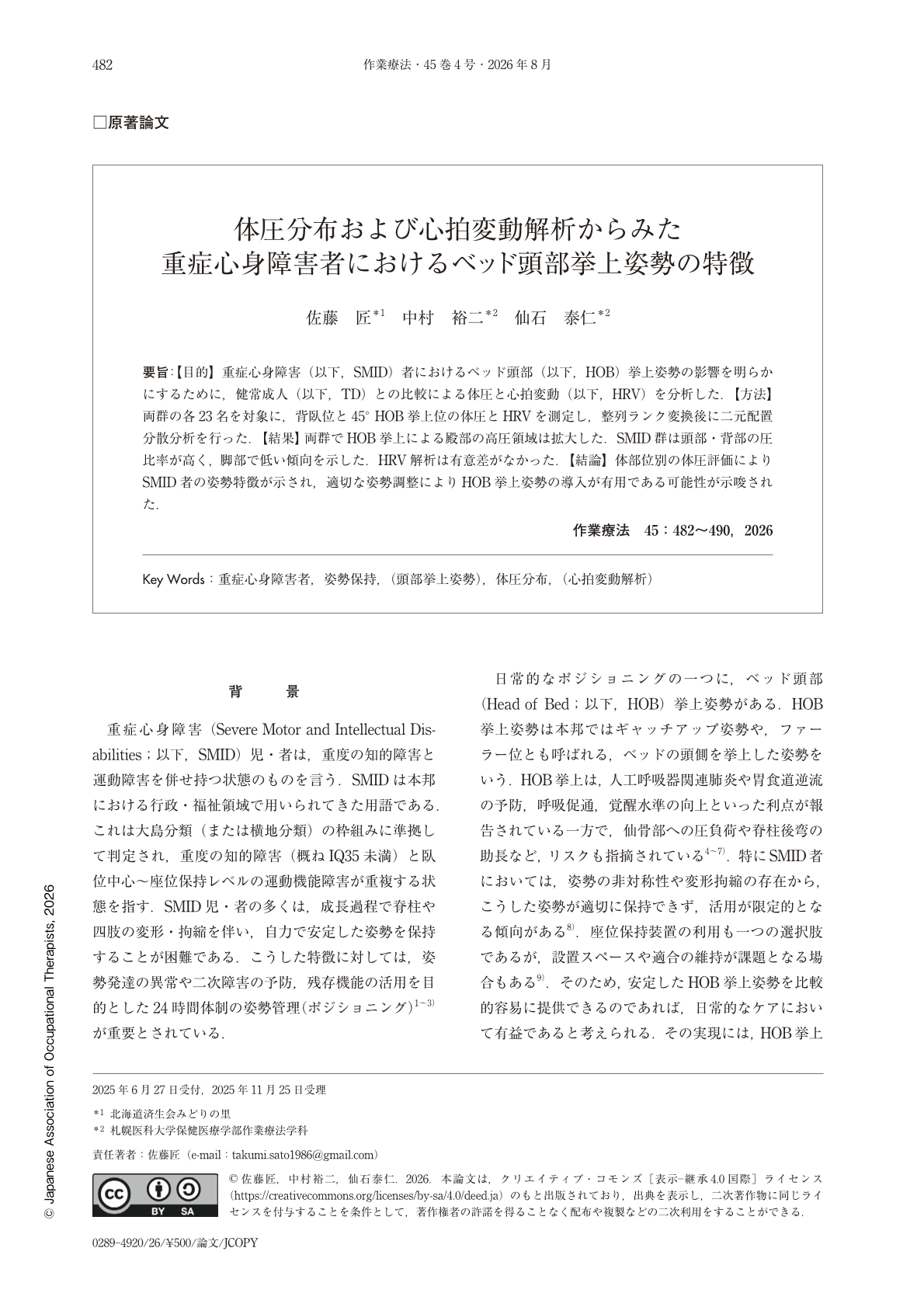
要旨:【目的】重症心身障害(以下,SMID)者におけるベッド頭部(以下,HOB)挙上姿勢の影響を明らかにするために,健常成人(以下,TD)との比較による体圧と心拍変動(以下,HRV)を分析した.【方法】両群の各23名を対象に,背臥位と45°HOB挙上位の体圧とHRVを測定し,整列ランク変換後に二元配置分散分析を行った.【結果】両群でHOB挙上による殿部の高圧領域は拡大した.SMID群は頭部・背部の圧比率が高く,脚部で低い傾向を示した.HRV解析は有意差がなかった.【結論】体部位別の体圧評価によりSMID者の姿勢特徴が示され,適切な姿勢調整によりHOB挙上姿勢の導入が有用である可能性が示唆された.
[Objective] This study aimed to clarify the effects of Head of Bed (HOB) elevation in individuals with Severe Motor and Intellectual Disabilities (SMID) by comparing body pressure distribution and Heart Rate Variability (HRV) with those of the Typical Development (TD) group. [Methods] The subjects were 23 TD and 23 SMID. Body pressure distribution and HRV were measured under two conditions: the supine position and a 45° HOB elevated position. Data were analyzed using a two-way mixed-design Analysis of Variance (ANOVA) following aligned rank transformation. [Results] In both groups, HOB elevation led to an increase in the high-pressure area in the buttocks. In the SMID group, the pressure area ratios were higher in the head and back regions and lower in the leg region compared with those in the TD group. No significant differences were observed in heart rate variability. [Conclusion] Evaluating posture-specific body pressure distributions helped reveal the distinct postural characteristics of individuals with SMID. These findings suggest that with appropriate postural adjustments, HOB elevation may be a feasible and beneficial positioning strategy even for individuals with SMID.
Copyright © 2026, Japanese Association of Occupational Therapists. All rights reserved.