Japanese
English
- 有料閲覧
- Abstract 文献概要
- 1ページ目 Look Inside
- 参考文献 Reference
要旨
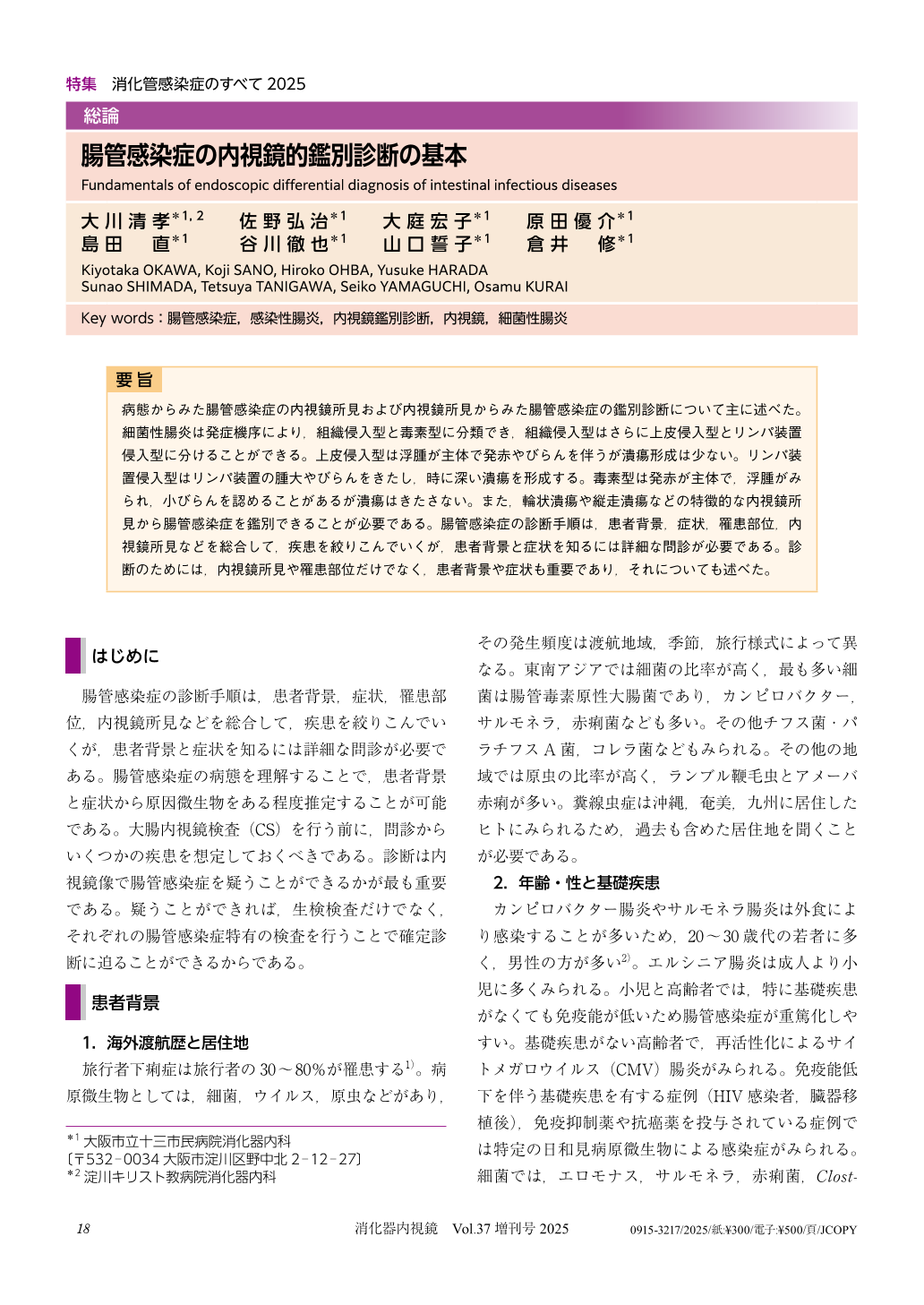
病態からみた腸管感染症の内視鏡所見および内視鏡所見からみた腸管感染症の鑑別診断について主に述べた。細菌性腸炎は発症機序により,組織侵入型と毒素型に分類でき,組織侵入型はさらに上皮侵入型とリンパ装置侵入型に分けることができる。上皮侵入型は浮腫が主体で発赤やびらんを伴うが潰瘍形成は少ない。リンパ装置侵入型はリンパ装置の腫大やびらんをきたし,時に深い潰瘍を形成する。毒素型は発赤が主体で,浮腫がみられ,小びらんを認めることがあるが潰瘍はきたさない。また,輪状潰瘍や縦走潰瘍などの特徴的な内視鏡所見から腸管感染症を鑑別できることが必要である。腸管感染症の診断手順は,患者背景,症状,罹患部位,内視鏡所見などを総合して,疾患を絞りこんでいくが,患者背景と症状を知るには詳細な問診が必要である。診断のためには,内視鏡所見や罹患部位だけでなく,患者背景や症状も重要であり,それについても述べた。
This paper mainly discusses endoscopic findings of intestinal infectious diseases from the viewpoint of patho-physiology and differential diagnosis. Bacterial enterocolitis can be classified into tissue invasive type and toxin type based on the onset mechanism, and tissue invasive type can be further divided into epithelial invasive type and lymphatic invasive type. Epithelial invasive type is characterized by edema, redness, and erosion; ulcer formation is rare. Lymphatic invasive type causes swelling and erosion of the lymphatic system, and sometimes deep ulcers. Toxin type is characterized by redness, edema, and small erosions, but no ulcers. It is also necessary to be able to differentiate intestinal infectious diseases from characteristic endoscopic findings such as annular ulcers and longitudinal ulcers. The diagnostic procedure for intestinal infectious diseases involves narrowing down the disease by comprehensively considering the patient’s background, symptoms, affected area, endoscopic findings, etc., but detailed interviews are necessary to understand the patient’s background and symptoms. For diagnosis, not only endoscopic findings and examination of the affected area but also the patient’s background and symptoms are important, and this is also discussed.
© tokyo-igakusha.co.jp. All right reserved.