Japanese
English
- 有料閲覧
- Abstract 文献概要
- 1ページ目 Look Inside
- 参考文献 Reference
はじめに
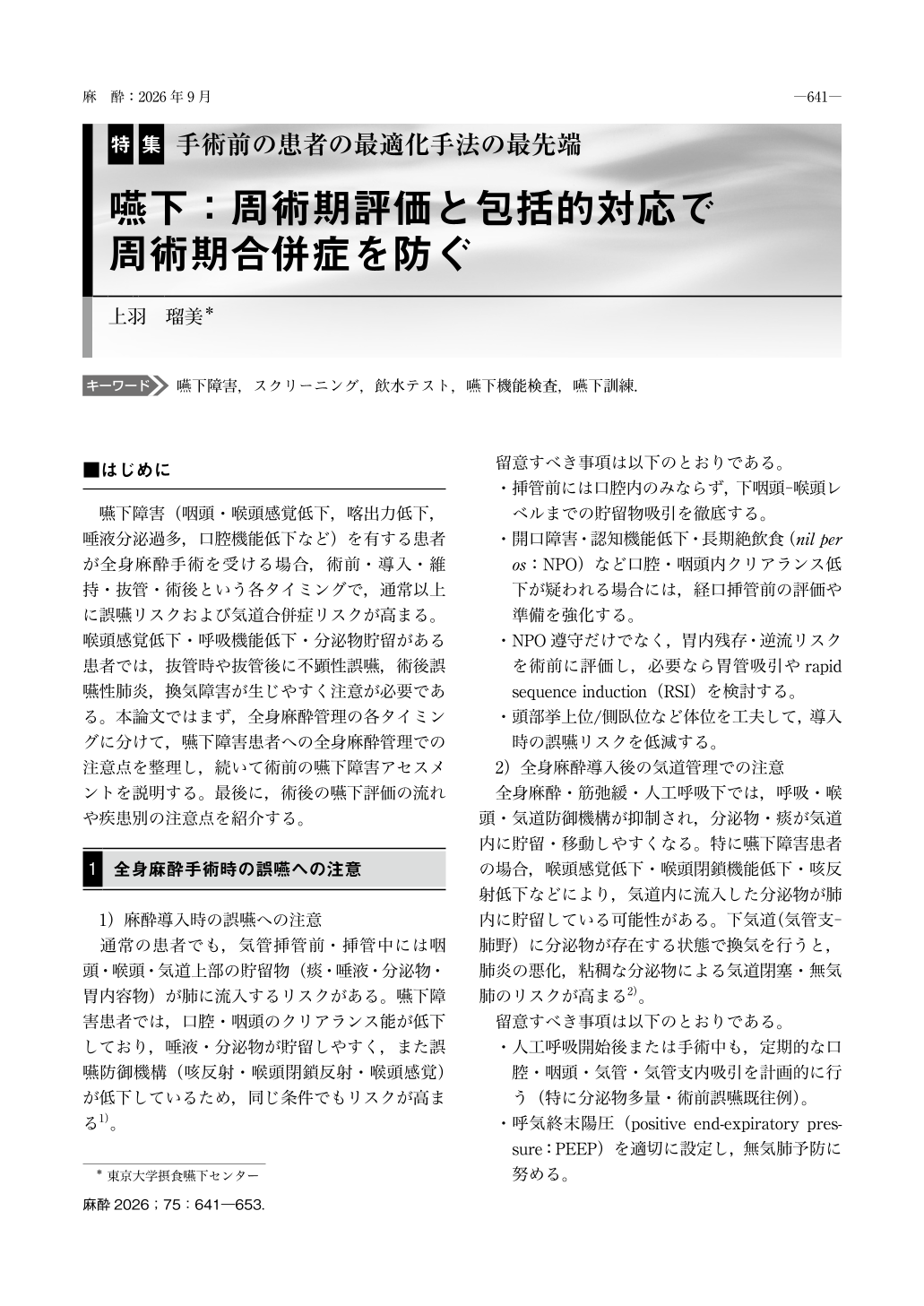
嚥下障害(咽頭・喉頭感覚低下,喀出力低下,唾液分泌過多,口腔機能低下など)を有する患者が全身麻酔手術を受ける場合,術前・導入・維持・抜管・術後という各タイミングで,通常以上に誤嚥リスクおよび気道合併症リスクが高まる。喉頭感覚低下・呼吸機能低下・分泌物貯留がある患者では,抜管時や抜管後に不顕性誤嚥,術後誤嚥性肺炎,換気障害が生じやすく注意が必要である。本論文ではまず,全身麻酔管理の各タイミングに分けて,嚥下障害患者への全身麻酔管理での注意点を整理し,続いて術前の嚥下障害アセスメントを説明する。最後に,術後の嚥下評価の流れや疾患別の注意点を紹介する。
Patients with dysphagia who undergo surgery under general anesthesia are at heightened risk of aspiration pneumonia and respiratory complications throughout all perioperative phases. Individuals with reduced pharyngo-laryngeal sensation, diminished cough strength, or marked pooling of secretions are particularly vulnerable to silent aspiration during anesthetic induction, emergence, and the early postoperative phase, requiring meticulous airway management. This review summarizes key perioperative strategies for managing dysphagia in patients under general anesthesia, including airway clearance techniques and the assessment of airway protective reflexes before and after extubation. Preoperative screening methods such as the repetitive saliva swallowing test, water-swallow test, and questionnaires along with specialized evaluations of patients’ swallowing ability by a fiberoptic endoscopic evaluation and videofluoroscopic studies are outlined. The principles for selecting appropriate texture-modified diets and practical swallowing rehabilitation approaches that can be initiated soon after surgery are also described. Clinical characteristics and perioperative considerations for high-risk populations are discussed, including patients with stroke or neuromuscular disease and those undergoing head/neck, esophageal, cardiac, or thoracic surgeries. Effective perioperative dysphagia management requires close multidisciplinary collaboration. The establishment of systematic screening and evaluation protocols is expected to reduce perioperative complications and improve patients’ quality of life.
Copyright © 2026 KOKUSEIDO CO., LTD. All Rights Reserved.