Japanese
English
- 有料閲覧
- Abstract 文献概要
- 1ページ目 Look Inside
- 参考文献 Reference
はじめに
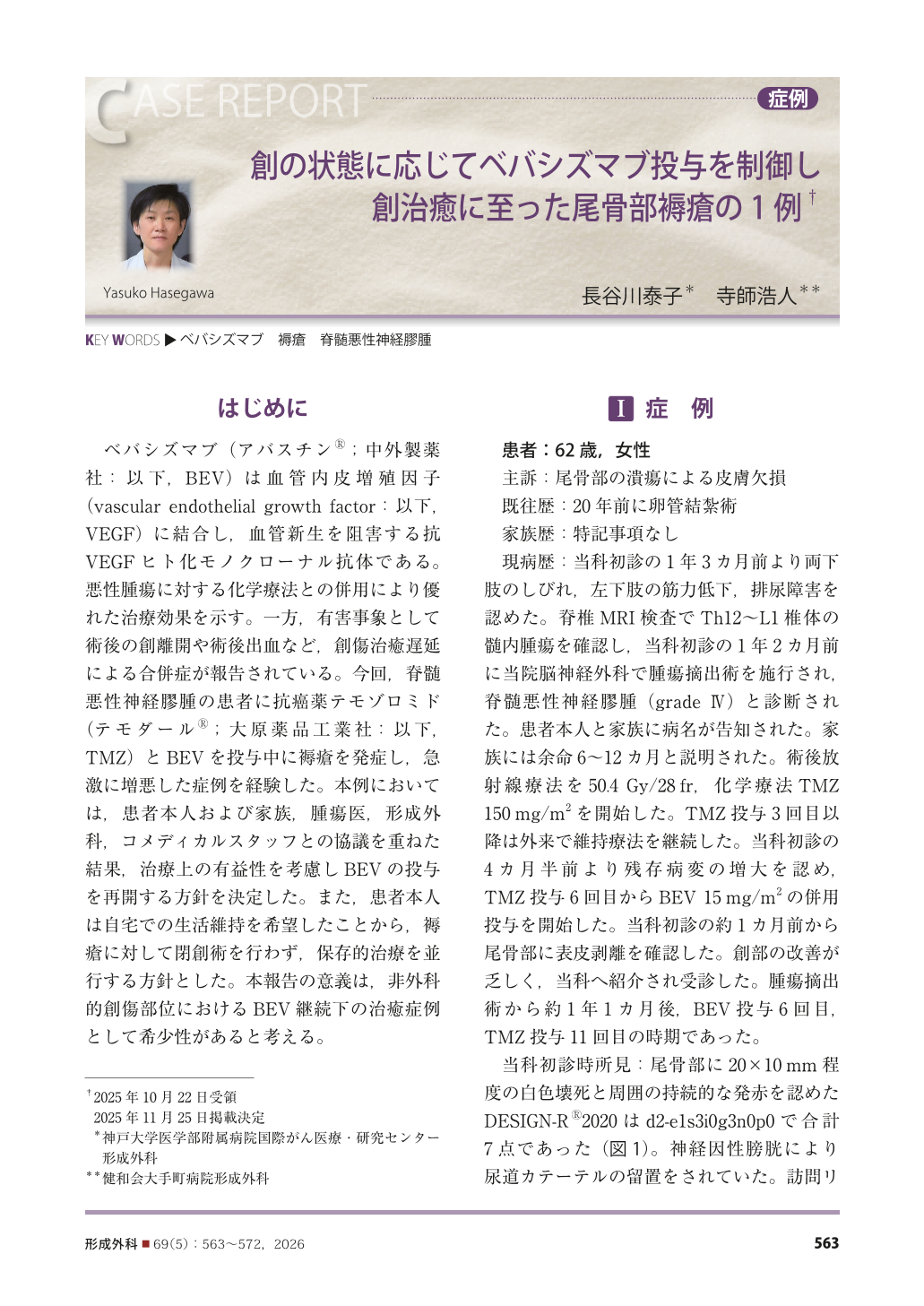
ベバシズマブ(アバスチン Ⓡ;中外製薬社:以下,BEV)は血管内皮増殖因子(vascular endothelial growth factor:以下,VEGF)に結合し,血管新生を阻害する抗VEGFヒト化モノクローナル抗体である。悪性腫瘍に対する化学療法との併用により優れた治療効果を示す。一方,有害事象として術後の創離開や術後出血など,創傷治癒遅延による合併症が報告されている。今回,脊髄悪性神経膠腫の患者に抗癌薬テモゾロミド(テモダール Ⓡ;大原薬品工業社:以下,TMZ)とBEVを投与中に褥瘡を発症し,急激に増悪した症例を経験した。本例においては,患者本人および家族,腫瘍医,形成外科,コメディカルスタッフとの協議を重ねた結果,治療上の有益性を考慮しBEVの投与を再開する方針を決定した。また,患者本人は自宅での生活維持を希望したことから,褥瘡に対して閉創術を行わず,保存的治療を並行する方針とした。本報告の意義は,非外科的創傷部位におけるBEV継続下の治癒症例として希少性があると考える。
A 62-year-old woman underwent tumor resection for a malignant glioma of the spinal cord. Because residual tumor remained, she was informed that her life expectancy was approximately one year. Postoperative radiochemotherapy with temozolomide (TMZ) was initiated, but the residual lesion increased after more than six months of treatment. Bevacizumab (BEV) was added, and two and a half months later, the patient developed a pressure ulcer in the coccygeal region. Two weeks thereafter, the ulcer progressed to the sacral and dorsal areas, complicated by necrotizing soft tissue infection (NSTI). TMZ and BEV were withheld for one month and then resumed, as tumor progression had been controlled. Wound management consisted of skin incision and subsequent maintenance debridement, without wound closure, to reduce the patientʼs burden. After chemotherapy was resumed, febrile neutropenia occurred. On the second resumption, the patient was hospitalized electively for systemic and wound management. Thereafter, outpatient treatment was continued without further wound exacerbation, and complete healing of the pressure ulcer was achieved.
This case demonstrates that wound management can be successfully performed while continuing chemotherapy including BEV, provided that careful monitoring is undertaken to detect delayed wound healing and secondary infection, and that prompt drug withdrawal is considered when wound deterioration is suspected.
Copyright© 2026 KOKUSEIDO CO., LTD. All Rights Reserved.