Japanese
English
- 有料閲覧
- Abstract 文献概要
- 1ページ目 Look Inside
- 参考文献 Reference
はじめに
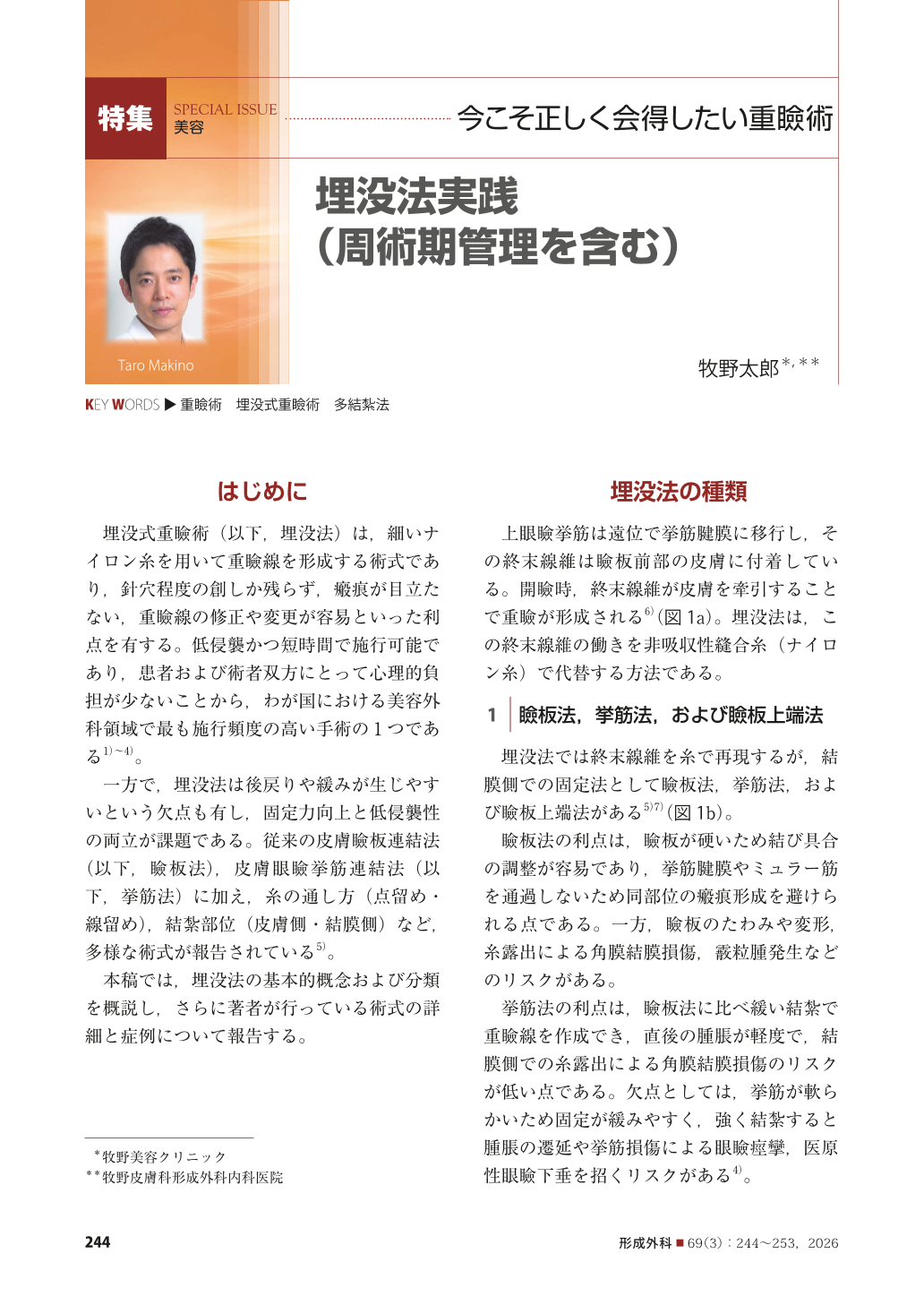
埋没式重瞼術(以下,埋没法)は,細いナイロン糸を用いて重瞼線を形成する術式であり,針穴程度の創しか残らず,瘢痕が目立たない,重瞼線の修正や変更が容易といった利点を有する。低侵襲かつ短時間で施行可能であり,患者および術者双方にとって心理的負担が少ないことから,わが国における美容外科領域で最も施行頻度の高い手術の1つである 1)~4)。
一方で,埋没法は後戻りや緩みが生じやすいという欠点も有し,固定力向上と低侵襲性の両立が課題である。従来の皮膚瞼板連結法(以下,瞼板法),皮膚眼瞼挙筋連結法(以下,挙筋法)に加え,糸の通し方(点留め・線留め),結紮部位(皮膚側・結膜側)など,多様な術式が報告されている 5)。
本稿では,埋没法の基本的概念および分類を概説し,さらに著者が行っている術式の詳細と症例について報告する。
As a minimally invasive procedure that is widely performed in Japan, buried-suture blepharoplasty offers minimal scarring, reversibility, and ease of revision. Despite these advantages, recurrence and loosening remain concerns associated with this technique, necessitating a balance between fixation strength and low invasiveness. Suture fixation to the conjunctival side is typically achieved via the tarsal plate method or the levator muscle method, each of which has specific strengths and drawbacks.
The author employs a “tarsal plate superior end” approach for blepharoplasties, targeting a flexible yet durable portion of the tarsus in order to reduce the risk of injuring the cornea while maintaining secure fixation. This is combined with square-type suture fixation and a multiple-knot technique in which several knots are placed within a single suture to improve stability and distribute tension evenly.
Preoperatively, the intended crease height and shape are confirmed using ʻthe bougie test,ʼ with markings made accordingly. The procedure is performed under local anesthesia, and the postoperative care includes topical antibiotics, eyelid cooling, and head elevation.
Potential complications include hematoma, asymmetry, suture visibility, infection, and exposure; these can be minimized performing the procedure meticulously and then providing prompt postoperative management. This combined method offers a stable, aesthetically natural outcome and represents a valuable option in buried-suture blepharoplasty.
Copyright© 2026 KOKUSEIDO CO., LTD. All Rights Reserved.