Japanese
English
- 有料閲覧
- Abstract 文献概要
- 1ページ目 Look Inside
- 参考文献 Reference
はじめに
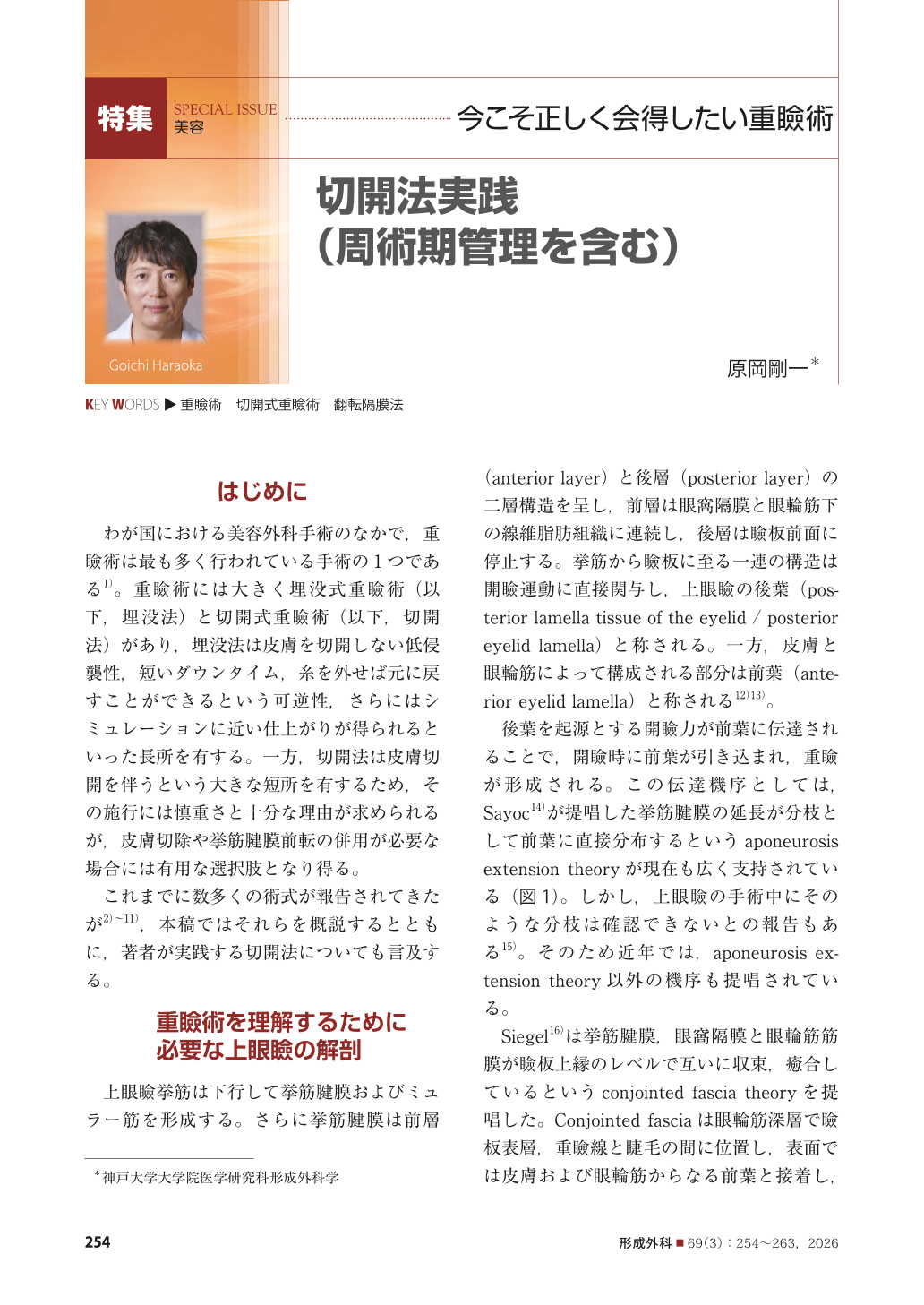
わが国における美容外科手術のなかで,重瞼術は最も多く行われている手術の1つである 1)。重瞼術には大きく埋没式重瞼術(以下,埋没法)と切開式重瞼術(以下,切開法)があり,埋没法は皮膚を切開しない低侵襲性,短いダウンタイム,糸を外せば元に戻すことができるという可逆性,さらにはシミュレーションに近い仕上がりが得られるといった長所を有する。一方,切開法は皮膚切開を伴うという大きな短所を有するため,その施行には慎重さと十分な理由が求められるが,皮膚切除や挙筋腱膜前転の併用が必要な場合には有用な選択肢となり得る。
これまでに数多くの術式が報告されてきたが 2)~11),本稿ではそれらを概説するとともに,著者が実践する切開法についても言及する。
Double-eyelid blepharoplasty is one of the most frequently performed aesthetic surgical procedures in Japan, and the methods that are used to conduct such blepharoplasties can be broadly categorized into the non-incisional (suture) and incisional methods. The suture technique is minimally invasive and reversible, but its long-term stability is limited. In contrast, the incisional technique requires a skin incision and therefore careful patient selection; however, it serves as a valuable option in cases requiring levator aponeurosis advancement or a skin excision.
Several mechanisms have been proposed to explain the formation of the upper eyelid crease in incisional double-eyelid blepharoplasty, including the widely accepted aponeurosis extension theory, the conjoined fascia theory, and the buffering-conduction theory. Despite the differences among these theories, they share the fundamental idea that crease formation depends on the efficient transfer of levator forces to the anterior eyelid lamella.
Numerous modifications of the incisional technique used in a double-eyelid blepharoplasty have been described, and the appropriate indications, design, and technical refinement require a solid understanding of upper-eyelid anatomy and sufficient surgical experience. In other words, an incisional double-eyelid blepharoplasty is a technically demanding procedure that must be performed based on meticulous surgical planning grounded in detailed anatomical knowledge, and stable outcomes can be achieved only through extensive clinical experience.
Revision surgery requires even deeper anatomical insight and a higher level of technical proficiency. Surgeons must recognize that once a revision becomes difficult, patients may face long-term functional and aesthetic burdens.
This article reviews previously reported incisional double-eyelid blepharoplasty techniques and explains the method currently employed by the author.
Copyright© 2026 KOKUSEIDO CO., LTD. All Rights Reserved.