Japanese
English
- 有料閲覧
- Abstract 文献概要
- 1ページ目 Look Inside
- 参考文献 Reference
はじめに
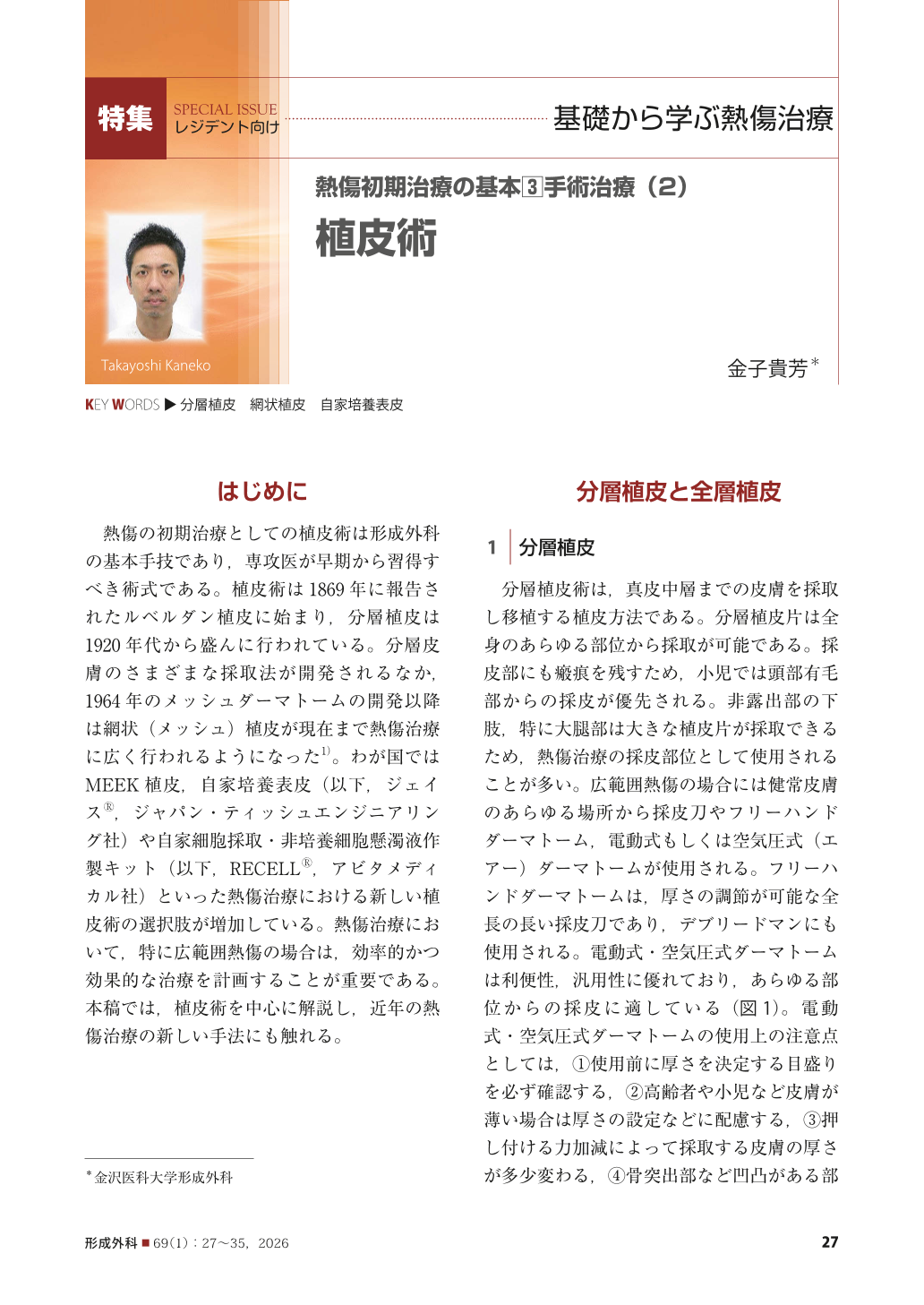
熱傷の初期治療としての植皮術は形成外科の基本手技であり,専攻医が早期から習得すべき術式である。植皮術は1869年に報告されたルベルダン植皮に始まり,分層植皮は1920年代から盛んに行われている。分層皮膚のさまざまな採取法が開発されるなか,1964年のメッシュダーマトームの開発以降は網状(メッシュ)植皮が現在まで熱傷治療に広く行われるようになった 1)。わが国ではMEEK植皮,自家培養表皮(以下,ジェイス Ⓡ,ジャパン・ティッシュエンジニアリング社)や自家細胞採取・非培養細胞懸濁液作製キット(以下,RECELL Ⓡ,アビタメディカル社)といった熱傷治療における新しい植皮術の選択肢が増加している。熱傷治療において,特に広範囲熱傷の場合は,効率的かつ効果的な治療を計画することが重要である。本稿では,植皮術を中心に解説し,近年の熱傷治療の新しい手法にも触れる。
Skin grafting as an initial treatment of burns is a basic procedure in plastic surgery and should be mastered by residents from an early stage. Skin grafting began with the Reverdin skin graft reported in 1869, and split-thickness skin grafting has been performed since the 1920s. Although a variety of methods for harvesting the skin layers have been developed, mesh skin grafts have been widely used to treat burns since the development of the mesh dermatome in 1964. In Japan, newer options for skin grafting in burn treatment are increasing, including MEEK skin grafts, autologous cultured epidermis (JACE Ⓡ), and autologous cell harvesting and non-cultured cell suspension kits (RECELL Ⓡ). In burn treatment, especially in the case of extensive burns, it is important to plan efficient and effective treatment. This paper focuses on skin grafting and discusses new methods of burn treatment that have been introduced in recent years.
Copyright© 2026 KOKUSEIDO CO., LTD. All Rights Reserved.