Japanese
English
- 有料閲覧
- Abstract 文献概要
- 1ページ目 Look Inside
- 参考文献 Reference
はじめに
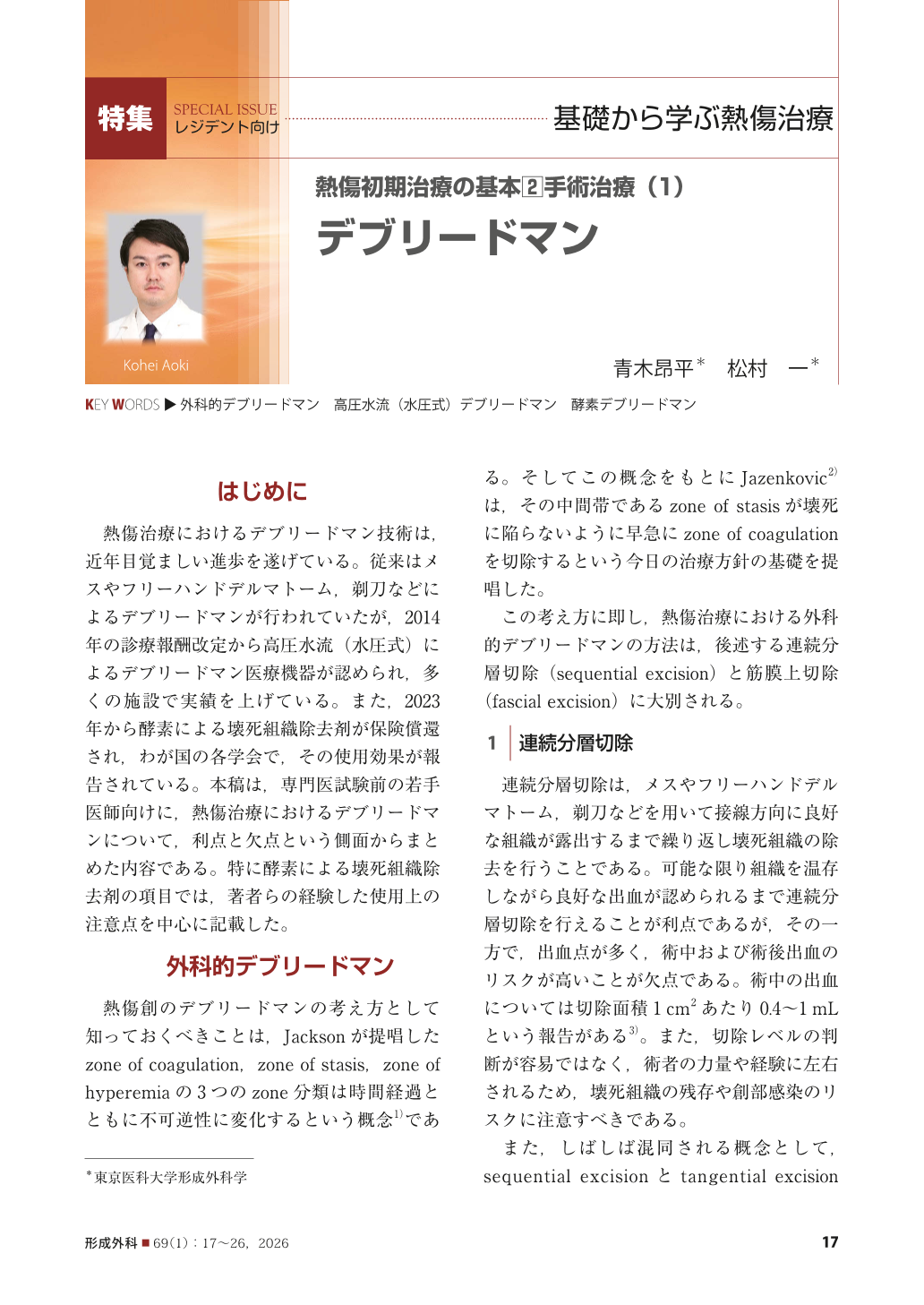
熱傷治療におけるデブリードマン技術は,近年目覚ましい進歩を遂げている。従来はメスやフリーハンドデルマトーム,剃刀などによるデブリードマンが行われていたが,2014年の診療報酬改定から高圧水流(水圧式)によるデブリードマン医療機器が認められ,多くの施設で実績を上げている。また,2023年から酵素による壊死組織除去剤が保険償還され,わが国の各学会で,その使用効果が報告されている。本稿は,専門医試験前の若手医師向けに,熱傷治療におけるデブリードマンについて,利点と欠点という側面からまとめた内容である。特に酵素による壊死組織除去剤の項目では,著者らの経験した使用上の注意点を中心に記載した。
Debridement techniques in burn treatment have made remarkable progress in recent years. Traditionally, debridement was performed using scalpels, freehand dermatomes, or razors. However, since the 2014 revision of medical reimbursement guidelines, devices that emit a high-speed jet stream of saline solution (e.g., Versajet TM, Smith & Nephew, Hull, UK) enabling the precise debridement of tissue have been approved, and many facilities have reported successful outcomes with these devices. In addition, a pineapple stem-derived bromelain-based proteolytic enzyme concentrate for debridement use (NexoBrid Ⓡ, MediWound, Yavne, Israel) has been covered by health insurance since 2023; its efficacy has been reported by various academic societies in Japan. The intended audience for this article is physicians who have not yet undergone specialty training, and the advantages and disadvantages of the various debridement techniques are summarized. Our own experiences using NexoBrid Ⓡ and the associated practical considerations are also described.
Copyright© 2026 KOKUSEIDO CO., LTD. All Rights Reserved.