Japanese
English
- 有料閲覧
- Abstract 文献概要
- 1ページ目 Look Inside
- 参考文献 Reference
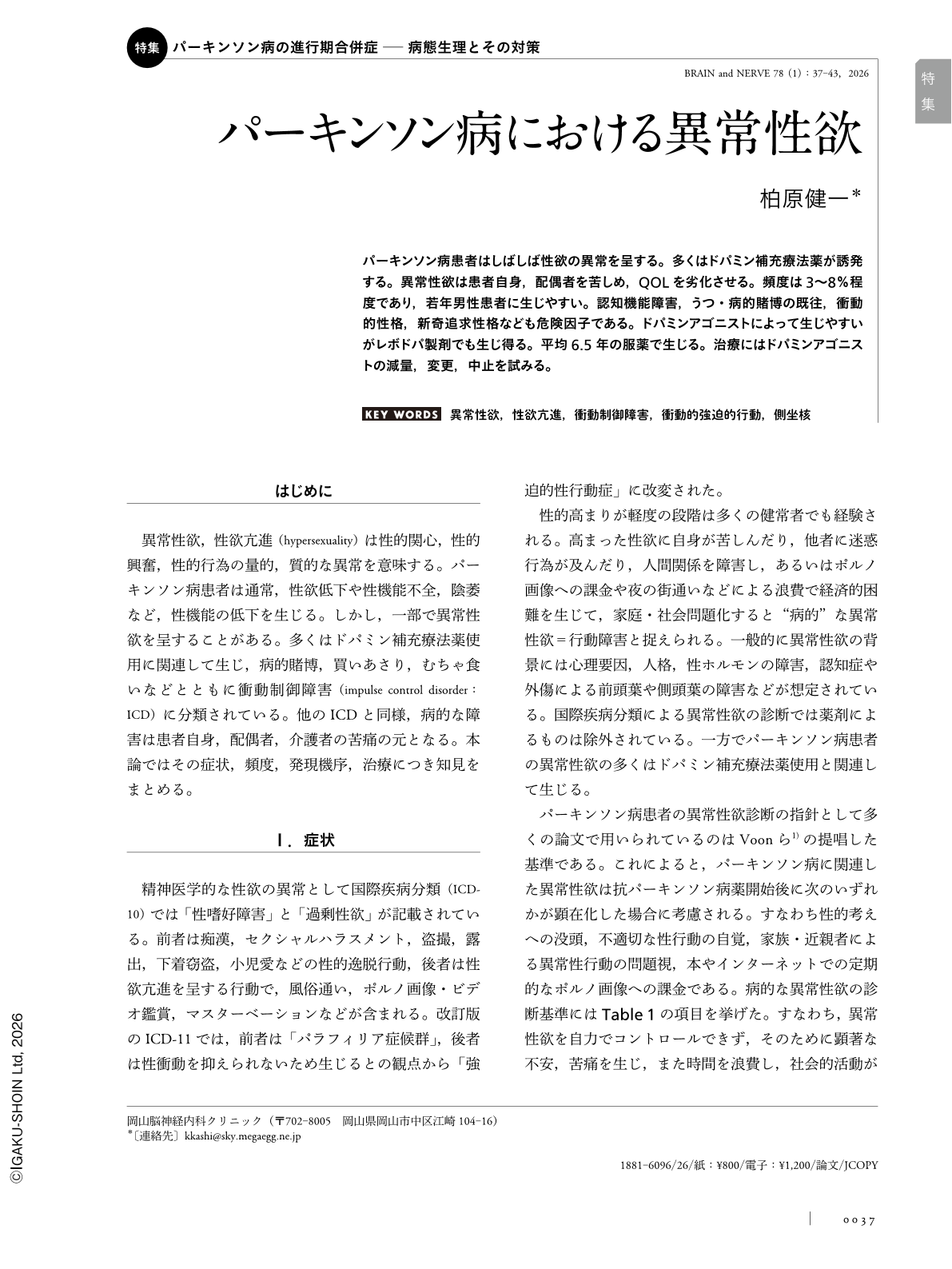
パーキンソン病患者はしばしば性欲の異常を呈する。多くはドパミン補充療法薬が誘発する。異常性欲は患者自身,配偶者を苦しめ,QOLを劣化させる。頻度は3〜8%程度であり,若年男性患者に生じやすい。認知機能障害,うつ・病的賭博の既往,衝動的性格,新奇追求性格なども危険因子である。ドパミンアゴニストによって生じやすいがレボドパ製剤でも生じ得る。平均6.5年の服薬で生じる。治療にはドパミンアゴニストの減量,変更,中止を試みる。
Abstract
Patients with Parkinson's disease (PD) often develop hypersexuality. Hypersexuality occurs in impulse control disorders (ICD), which are caused by dopamine replacement therapy. Hypersexuality becomes a burden for patients, their spouses, and caregivers and worsens their quality of life. Hypersexuality occurs in approximately 3-8% of patients with PD and tends to occur in young male patients. Other risk factors for hypersexuality in PD include cognitive impairment, a history of depression or pathological gambling, and impulsive or novelty-seeking personality traits. Dopamine agonists are more likely to cause hypersexuality; however, levodopa can also cause hypersexuality. The average duration of medication use in patients with PD with hypersexuality is 6.5years. Treatment for hypersexuality involves reducing, switching, or discontinuing dopamine replacement therapy, particularly dopamine agonists. Drugs must be carefully selected for young male patients at high risk of developing hypersexuality.
Copyright © 2026, Igaku-Shoin Ltd. All rights reserved.