Japanese
English
- 販売していません
- Abstract 文献概要
- 1ページ目 Look Inside
- 参考文献 Reference
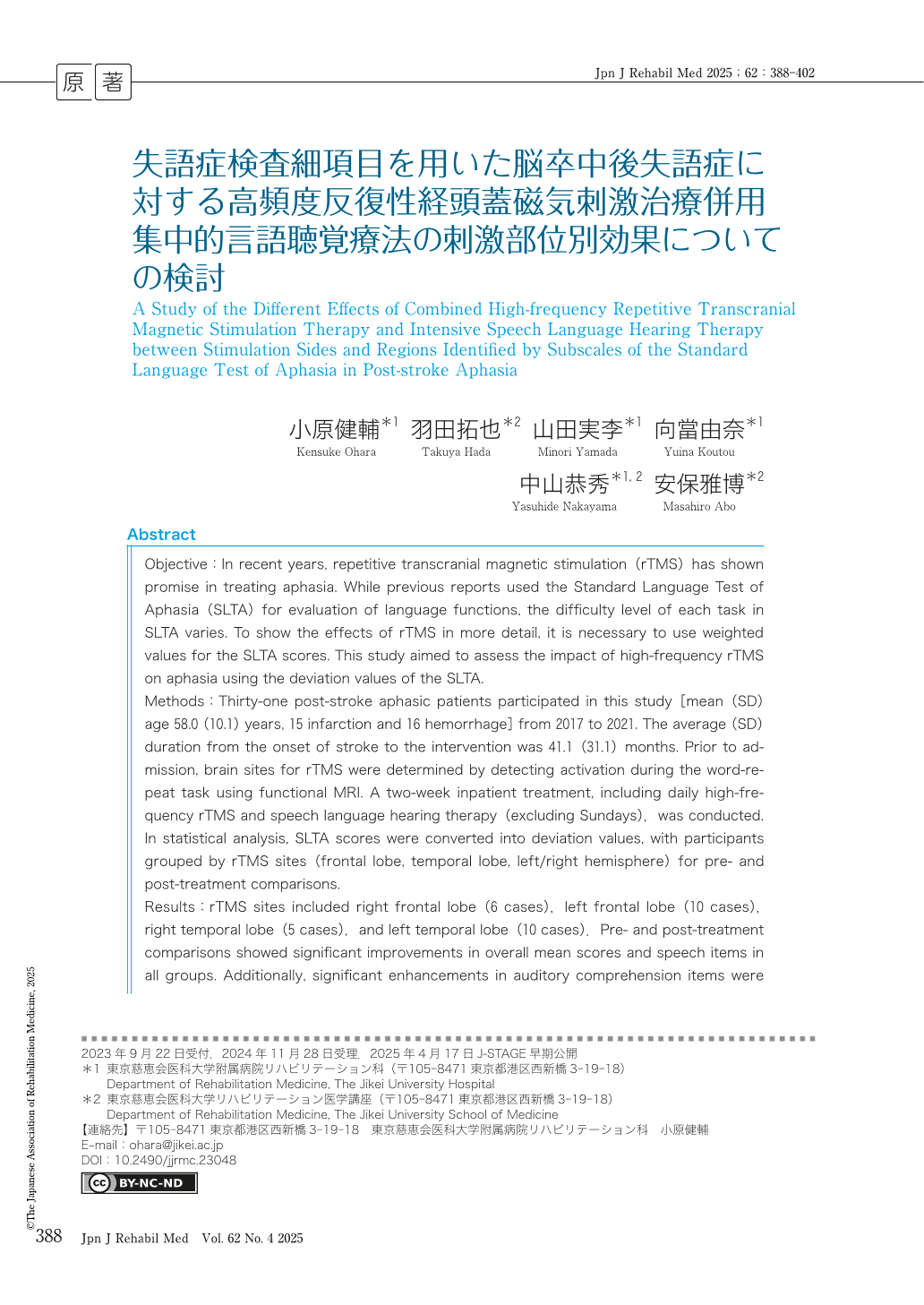
要旨 目的:近年,失語症に対して反復性経頭蓋磁気刺激(rTMS)が応用され,良好な結果が報告されている.本邦ではアウトカムとして標準失語症検査(SLTA)が使用されているが,各課題の難易度が異なることが問題点であるため,rTMSの効果をより詳細に示すためにはSLTAスコアに重みづけのある値を用いる必要がある.本研究の目的は高頻度rTMSの部位別効果について,SLTA細項目の偏差スコアを用いて検討することである.
方法:2017年から2021年に高頻度rTMSを施行した31例[58.0(10.1)歳,脳梗塞15名,脳出血16名]を対象とした.脳卒中発症後の期間は41.1(31.1)カ月であった[平均(標準偏差)].プロトコールとして,入院前に磁気共鳴機能画像(fMRI)を施行し,言語賦活部位およびrTMS刺激部位を決定し2週間の入院治療を行った.入院治療では高頻度rTMSと言語聴覚療法を日曜日を除く連日実施した.統計解析として入院時,退院3カ月後で得られたSLTA細項目の結果を偏差スコアに変換し,rTMS刺激部位に応じて前頭葉,側頭葉,左右半球の4群に群分けし前後比較を行った.
結果:高頻度rTMS刺激部位は右前頭葉6例,左前頭葉10例,右側頭葉5例,左側頭葉10例であった.前後比較の結果,全ての群において全項目平均,発話項目に有意な向上を認めた.また,右半球刺激群,左前頭葉刺激群において聴覚的理解項目で有意な向上を認めた.
結論:本結果より,高頻度rTMSによって刺激部位に関わらず言語機能に効果が得られること,また,右半球,左前頭葉刺激では,聴覚的理解がより改善する可能性が推察された.
Abstract Objective: In recent years, repetitive transcranial magnetic stimulation (rTMS) has shown promise in treating aphasia. While previous reports used the Standard Language Test of Aphasia (SLTA) for evaluation of language functions, the difficulty level of each task in SLTA varies. To show the effects of rTMS in more detail, it is necessary to use weighted values for the SLTA scores. This study aimed to assess the impact of high-frequency rTMS on aphasia using the deviation values of the SLTA.
Methods: Thirty-one post-stroke aphasic patients participated in this study [mean (SD) age 58.0 (10.1) years, 15 infarction and 16 hemorrhage] from 2017 to 2021. The average (SD) duration from the onset of stroke to the intervention was 41.1 (31.1) months. Prior to admission, brain sites for rTMS were determined by detecting activation during the word-repeat task using functional MRI. A two-week inpatient treatment, including daily high-frequency rTMS and speech language hearing therapy (excluding Sundays), was conducted. In statistical analysis, SLTA scores were converted into deviation values, with participants grouped by rTMS sites (frontal lobe, temporal lobe, left/right hemisphere) for pre- and post-treatment comparisons.
Results: rTMS sites included right frontal lobe (6 cases), left frontal lobe (10 cases), right temporal lobe (5 cases), and left temporal lobe (10 cases). Pre- and post-treatment comparisons showed significant improvements in overall mean scores and speech items in all groups. Additionally, significant enhancements in auditory comprehension items were observed in the right hemisphere and frontal lobe stimulation groups.
Conclusion: High-frequency rTMS shows promise that it can improve language function regardless of the stimulation site, and auditory comprehension may be improved specifically by the right hemisphere and left frontal lobe stimulation. This suggests its potential as a valuable therapeutic intervention.
Copyright © 2025, The Japanese Association of Rehabilitation Medicine. All rights reserved.