Japanese
English
- 販売していません
- Abstract 文献概要
- 1ページ目 Look Inside
- 参考文献 Reference
要旨 目的:予後不良とされる高齢者や重症例の急性期くも膜下出血(subarachnoid hemorrhage:SAH)に対する早期離床が歩行再獲得の要因となるかを明らかにする.
方法:研究デザインは多施設共同による後ろ向き観察研究とした.対象はSAHと診断され,リハビリテーション治療が実施された471例(Group 1)である.さらにGroup 1のうち65歳以上の高齢者(Group 2)とWorld Federation of Neurological Societies(WFNS)グレードⅣまたはⅤの重症例(Group 3)に対象を分けた.主な調査項目は年齢,性別,破裂動脈瘤部位,modified Fisher scale,WFNSグレード,破裂動脈瘤に対する治療法,脳脊髄液ドレーンの留置日数,人工呼吸器の装着日数,脳内出血,症候性脳血管攣縮,肺炎や深部静脈血栓症などの合併症,シャント術,離床開始までの日数,発症後30日以内の歩行再獲得状況とした.統計解析は,すべてのGroupで歩行再獲得状況を回復群と未回復群の2群に分けてその他の調査項目の群間比較を行った.さらにすべてのGroupにおいて従属変数を発症後30日以内の歩行再獲得状況,独立変数をその他の項目として多重ロジスティック回帰分析を行った.
結果:すべてのGroupに共通して早期離床は歩行再獲得の独立した因子であった.さらに前方循環系の破裂動脈瘤,合併症およびシャント術の有無はすべてのGroupに共通して歩行再獲得の独立した因子であった.
結論:高齢者や重症例においても急性期SAHに対する早期離床は,発症後30日以内の歩行再獲得の要因になることが示唆された.
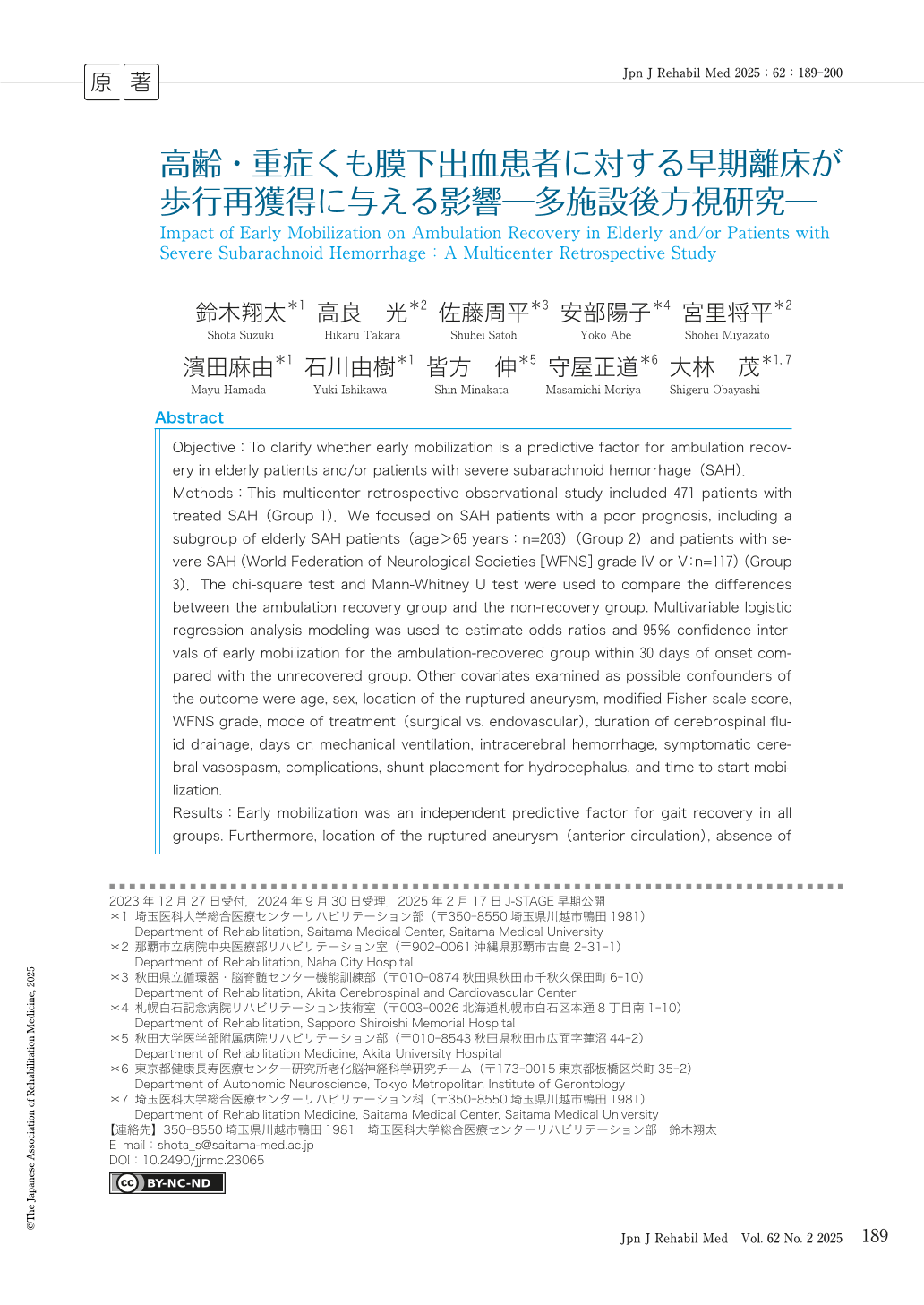
Abstract Objective: To clarify whether early mobilization is a predictive factor for ambulation recovery in elderly patients and/or patients with severe subarachnoid hemorrhage (SAH).
Methods: This multicenter retrospective observational study included 471 patients with treated SAH (Group 1). We focused on SAH patients with a poor prognosis, including a subgroup of elderly SAH patients (age>65 years: n=203) (Group 2) and patients with severe SAH (World Federation of Neurological Societies [WFNS] grade IV or V: n=117) (Group 3). The chi-square test and Mann-Whitney U test were used to compare the differences between the ambulation recovery group and the non-recovery group. Multivariable logistic regression analysis modeling was used to estimate odds ratios and 95% confidence intervals of early mobilization for the ambulation-recovered group within 30 days of onset compared with the unrecovered group. Other covariates examined as possible confounders of the outcome were age, sex, location of the ruptured aneurysm, modified Fisher scale score, WFNS grade, mode of treatment (surgical vs. endovascular), duration of cerebrospinal fluid drainage, days on mechanical ventilation, intracerebral hemorrhage, symptomatic cerebral vasospasm, complications, shunt placement for hydrocephalus, and time to start mobilization.
Results: Early mobilization was an independent predictive factor for gait recovery in all groups. Furthermore, location of the ruptured aneurysm (anterior circulation), absence of complications, and absence of shunt placement were independent factors for ambulation recovery in all groups.
Conclusion: Early mobilization in elder or/and sever patients with SAH may be a predictive factor for ambulation recovery within 30 days of onset.
Copyright © 2025, The Japanese Association of Rehabilitation Medicine. All rights reserved.