Japanese
English
- 有料閲覧
PPV購入案内
1,320円 (1,200円+税10%) こちらは、535ページから541ページの文献です。購入には医書.jp本会員登録が必要です。
会員登録完了後に改めて上記「購入サイトへ」を選択してください。
または「購入サイトへ」選択後に「購入ログイン」、「新規会員登録」の順に進んでください。
会員登録について詳しくはをご確認ください。
- Abstract 文献概要
- 1ページ目 Look Inside
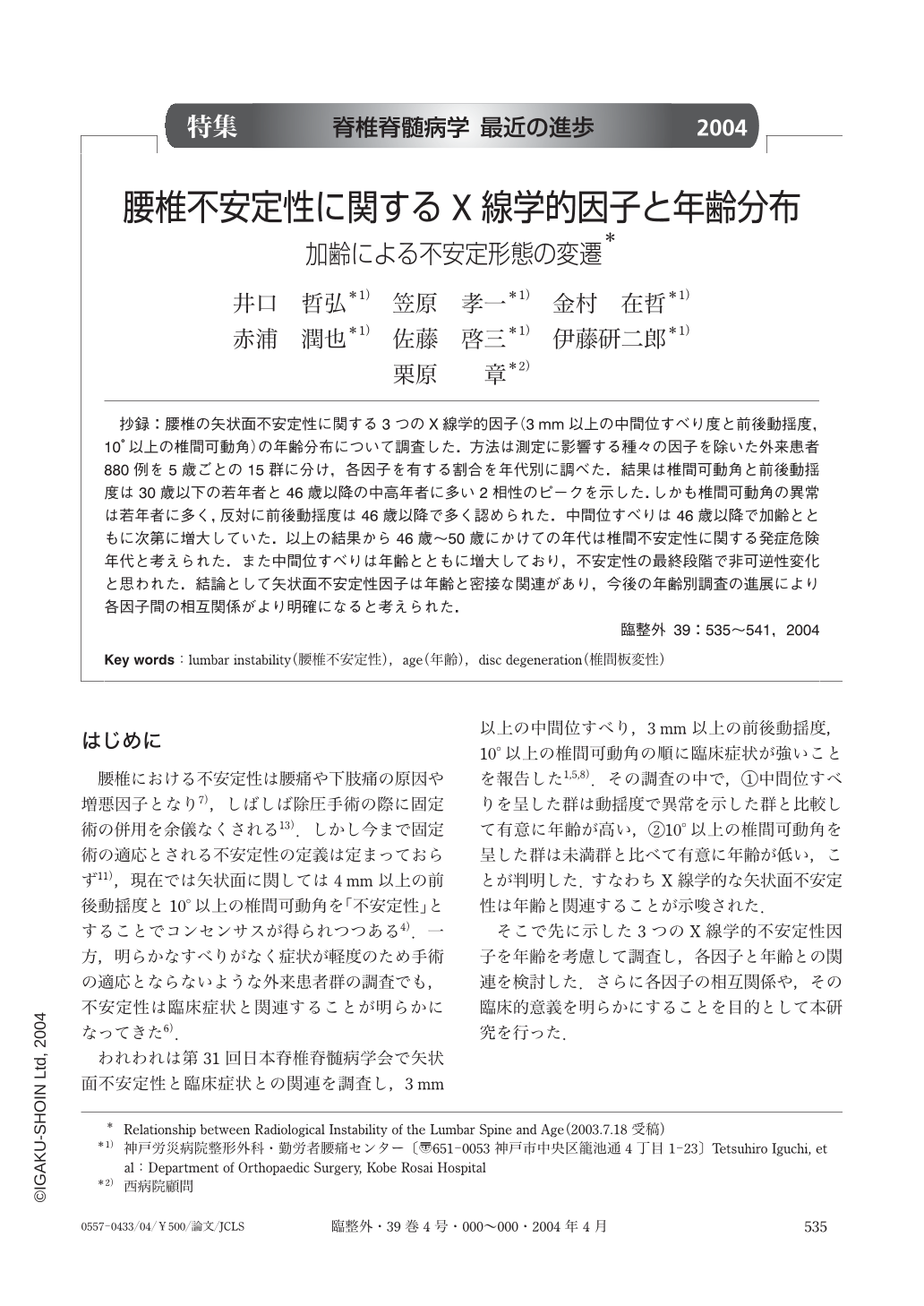
抄録:腰椎の矢状面不安定性に関する3つのX線学的因子(3mm以上の中間位すべり度と前後動揺度,10°以上の椎間可動角)の年齢分布について調査した.方法は測定に影響する種々の因子を除いた外来患者880例を5歳ごとの15群に分け,各因子を有する割合を年代別に調べた.結果は椎間可動角と前後動揺度は30歳以下の若年者と46歳以降の中高年者に多い2相性のピークを示した.しかも椎間可動角の異常は若年者に多く,反対に前後動揺度は46歳以降で多く認められた.中間位すべりは46歳以降で加齢とともに次第に増大していた.以上の結果から46歳~50歳にかけての年代は椎間不安定性に関する発症危険年代と考えられた.また中間位すべりは年齢とともに増大しており,不安定性の最終段階で非可逆性変化と思われた.結論として矢状面不安定性因子は年齢と密接な関連があり,今後の年齢別調査の進展により各因子間の相互関係がより明確になると考えられた.
Purpose:Little is known about the relationship between radiological instability and age except in regard to degenerative spondylolisthesis. The purpose of this study was to clarify the relationships between radiological factors of lumbar instability in the sagittal plane and age in a multi-generation study.
Methods:More than 3 mm slip in the neutral position, more than 3 mm sagittal translation, and more than 10 degrees of segmental angulation were defined as excessive motion at the L4/5 segment. In the 1647 patients visited our institute because of low back or leg pain during 1996-97, patients with conditions which might impede accurate measurement of instability at the L4/5 segment were excluded. Remained 880 patients (389 men and 491 women) with an average age:of 49±18 years. ranged 14 to 84 were divided into 15 groups at 5-year intervals and the proportion of patients with excessive motion in the each group was determined.
Results:The mean age of the patients with excessive angulation, translation, and slip in neutral position was 42, 50, and 63 years, respectively. Both the proportion with excessive angulation and translation showed two-peak pattern with one peak in the teen and twenties groups and the other in the over 46 age groups, but angulation was predominant in the younger age groups and translation was predominant in the older age groups. Slip in neutral position was more common in the age groups over 46 years, and the proportion increased with age.
Conclusion:The existence of patients with excessive angulation and translation in the younger age groups suggests that they have a hypermobile segment with less disc degeneration. Because the proportion with the slip in the neutral position increased with age, this pathology was considered to be irreversible. Different patterns of these radiological factors may be caused by the progression of the aging process of the instability.
Copyright © 2004, Igaku-Shoin Ltd. All rights reserved.