Japanese
English
- 有料閲覧
- Abstract 文献概要
- 1ページ目 Look Inside
- 参考文献 Reference
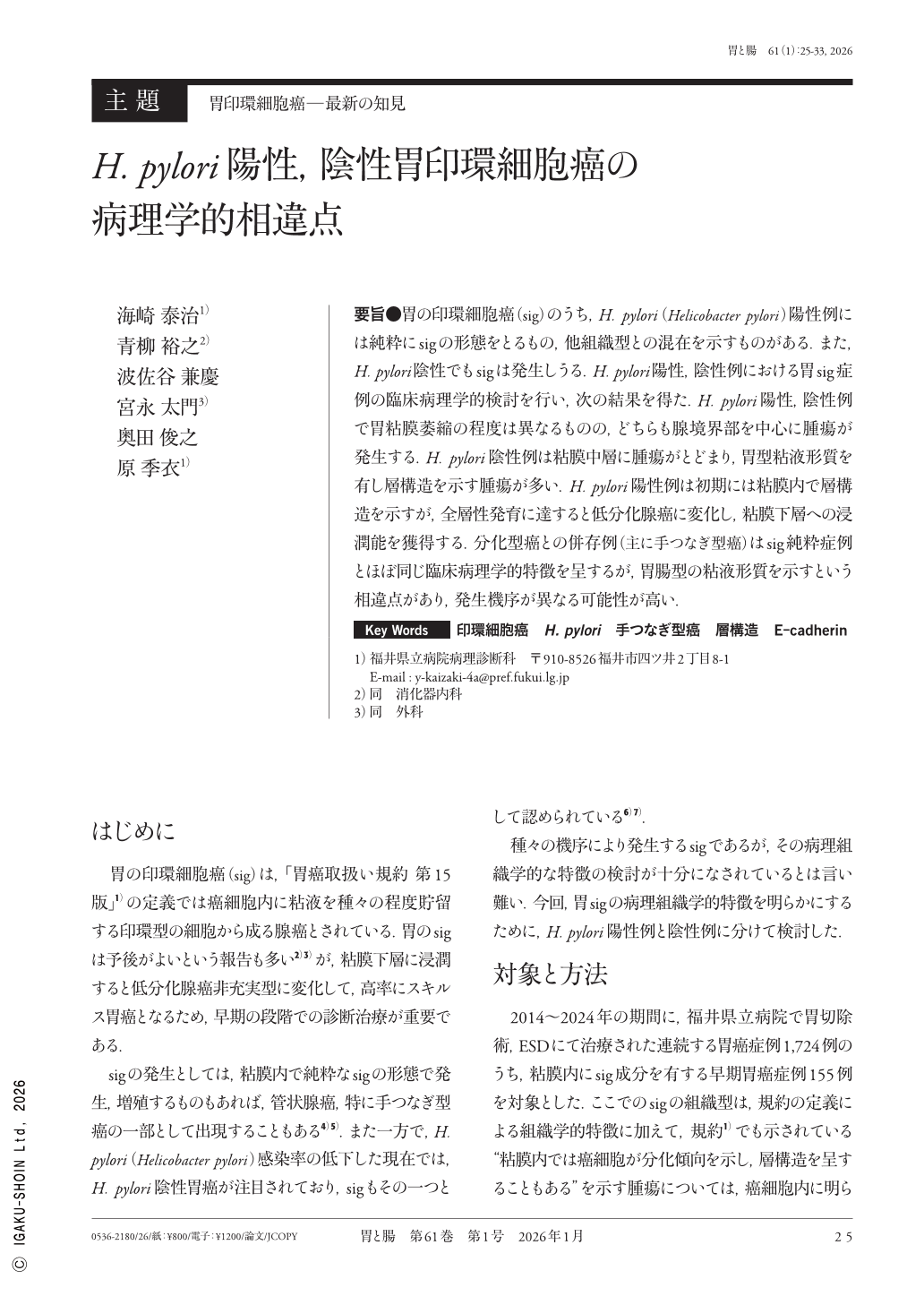
要旨●胃の印環細胞癌(sig)のうち,H. pylori(Helicobacter pylori)陽性例には純粋にsigの形態をとるもの,他組織型との混在を示すものがある.また,H. pylori陰性でもsigは発生しうる.H. pylori陽性,陰性例における胃sig症例の臨床病理学的検討を行い,次の結果を得た.H. pylori陽性,陰性例で胃粘膜萎縮の程度は異なるものの,どちらも腺境界部を中心に腫瘍が発生する.H. pylori陰性例は粘膜中層に腫瘍がとどまり,胃型粘液形質を有し層構造を示す腫瘍が多い.H. pylori陽性例は初期には粘膜内で層構造を示すが,全層性発育に達すると低分化腺癌に変化し,粘膜下層への浸潤能を獲得する.分化型癌との併存例(主に手つなぎ型癌)はsig純粋症例とほぼ同じ臨床病理学的特徴を呈するが,胃腸型の粘液形質を示すという相違点があり,発生機序が異なる可能性が高い.
In patients with gastric signet-ring cell carcinoma(sig), Helicobacter pylori(H. Pylori)positivity is observed in both purely sig-type tumors and those mixed with other histological types. Additionally, H. Pylori-negative patients can develop sig. We conducted a clinicopathological study of gastric sig cases in both H. Pylori-positive and H. Pylori-negative patients. Our findings showed that, although the degree of gastric mucosal atrophy differs between the H. Pylori-positive and H. Pylori-negative patients, the tumors in both groups tend to arise around the atrophic border. In H. Pylori-negative patients, the tumors often remain confined to the middle mucosal layer, exhibit gastric-type mucin phenotypes, and display a layered structure. In H. Pylori-positive patients, the tumors initially showed a layered structure within the mucosa, but as they grew to full thickness, they transformed into poorly differentiated adenocarcinomas with submucosal invasive potential. Tumors coexisting with differentiated adenocarcinomas, mainly the “hand-shaking” type, share clinicopathological features nearly identical to those of pure sig cases. However, they differ in terms of mucin phenotype, showing an intestinal-type pattern indicative of a different tumorigenic mechanism.
Copyright © 2026, Igaku-Shoin Ltd. All rights reserved.