Japanese
English
- 有料閲覧
- Abstract 文献概要
- 1ページ目 Look Inside
- 参考文献 Reference
Point
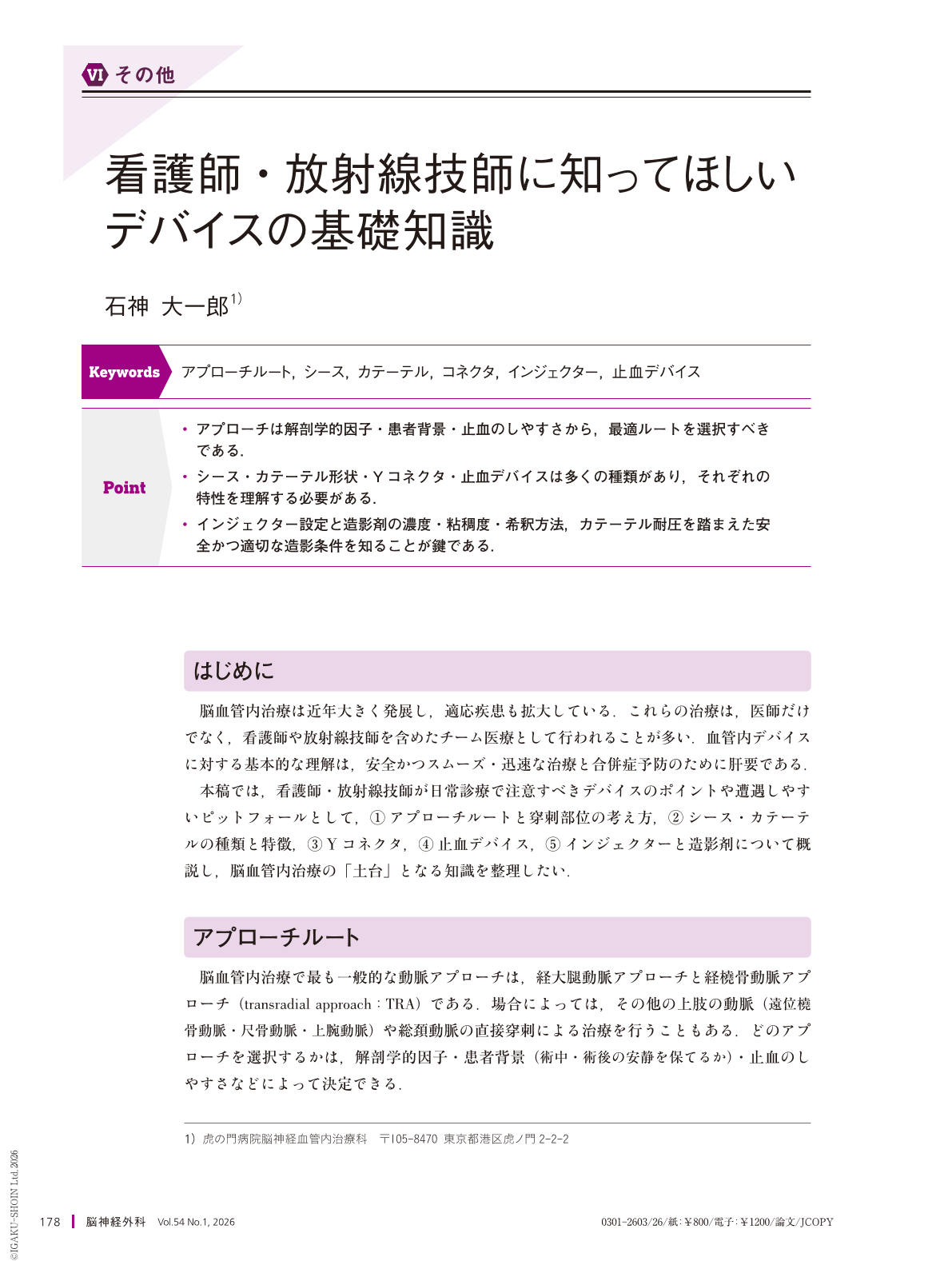
・アプローチは解剖学的因子・患者背景・止血のしやすさから,最適ルートを選択すべきである.
・シース・カテーテル形状・Yコネクタ・止血デバイスは多くの種類があり,それぞれの特性を理解する必要がある.
・インジェクター設定と造影剤の濃度・粘稠度・希釈方法,カテーテル耐圧を踏まえた安全かつ適切な造影条件を知ることが鍵である.
Endovascular treatment for cerebrovascular disease relies on close collaboration among physicians, nurses, and radiologic technologists. A basic understanding of devices is essential for safe and efficient procedures. This review summarizes key concepts of vascular access routes and commonly used devices from the perspective of nurses and technologists working in neuroangiography suites. First, we outline the selection of arterial and venous access, including transfemoral and transradial approaches, with attention to aortic arch variants, upper-extremity arterial anatomy, and patient factors that influence the puncture site and postprocedural care. Next, we describe the structure and roles of introducer sheaths, guiding and intermediate catheters, high-flow microcatheters, and rotating or push-type hemostatic valves, highlighting how coaxial and triaxial systems support device stability. Finally, we review hemostatic devices for access-site closure and practical aspects of contrast injectors, such as pressure limits, contrast dilution, and selection of contrast media to balance image quality with pain reduction and contrast load. The goal of organizing these foundational topics is to support team-based neuroendovascular practice and facilitate communication among all staff involved in these increasingly complex procedures.
Copyright © 2026, Igaku-Shoin Ltd. All rights reserved.