Japanese
English
- 販売していません
- Abstract 文献概要
- 1ページ目 Look Inside
- 参考文献 Reference
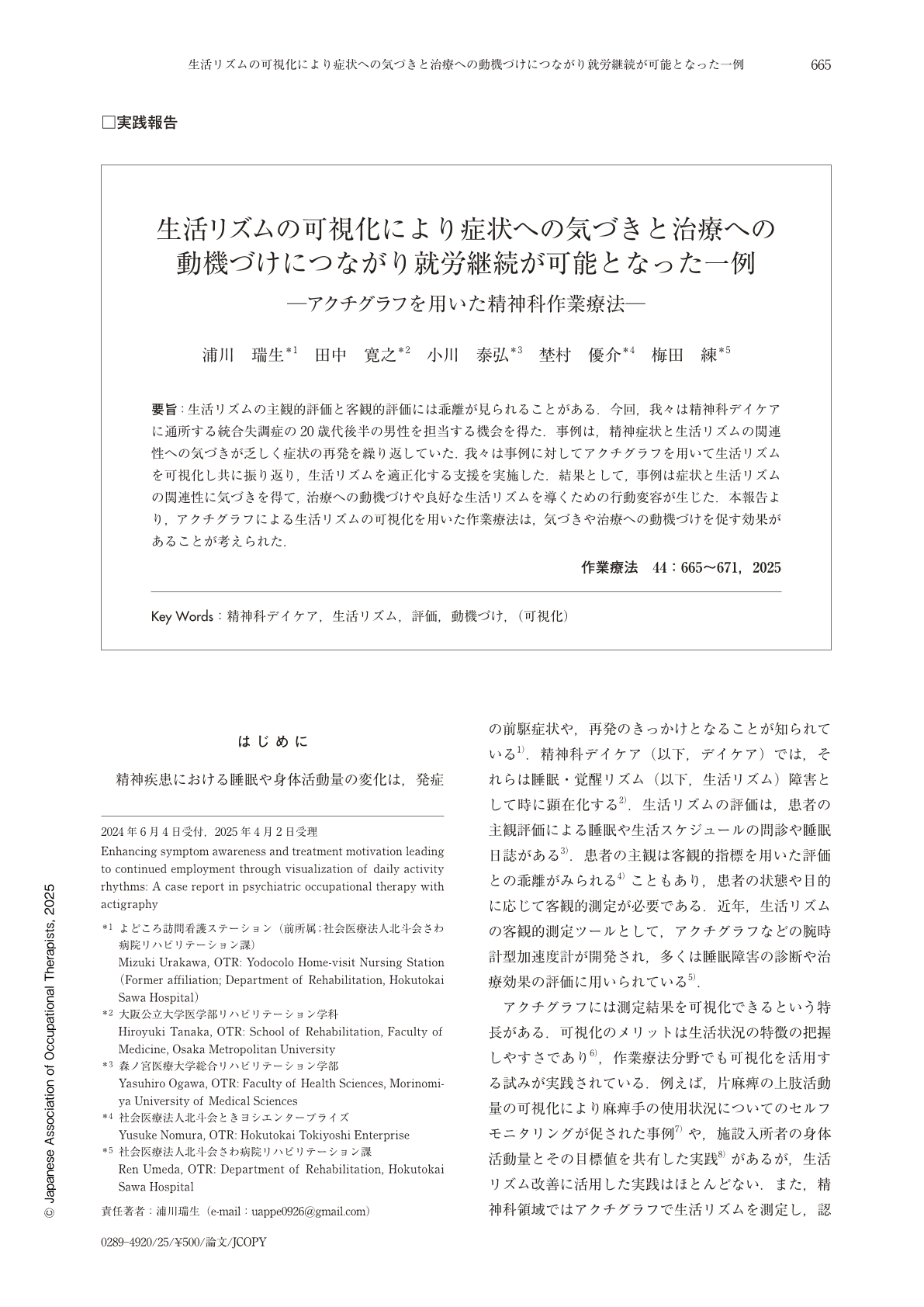
要旨:生活リズムの主観的評価と客観的評価には乖離が見られることがある.今回,我々は精神科デイケアに通所する統合失調症の20歳代後半の男性を担当する機会を得た.事例は,精神症状と生活リズムの関連性への気づきが乏しく症状の再発を繰り返していた.我々は事例に対してアクチグラフを用いて生活リズムを可視化し共に振り返り,生活リズムを適正化する支援を実施した.結果として,事例は症状と生活リズムの関連性に気づきを得て,治療への動機づけや良好な生活リズムを導くための行動変容が生じた.本報告より,アクチグラフによる生活リズムの可視化を用いた作業療法は,気づきや治療への動機づけを促す効果があることが考えられた.
Discrepancies can be found between subjective and objective assessments of daily activity rhythm. We had the opportunity to do occupational therapy for a male in his late twenties diagnosed with schizophrenia who attended a psychiatric day care center. The case had experienced repeated interruptions in employment due to a lack of awareness regarding the relationship between psychiatric symptoms and daily activity rhythms. We utilized an actigraph to visualize his daily activity rhythm and shared the results with him. Fuirthermore, we coached him to improve his daily rhythms. Consequently, the case gained awareness of the relationship between symptoms and daily activity rhythm, leading to behavioral changes conducive to motivation for treatment and the establishment of a correct daily activity rhythm, enabling continued employment. Incorporating actigraph visualization of daily activity rhythms into occupational therapy may effectively enhance awareness and motivation for treatment in such cases.
Copyright © 2025, Japanese Association of Occupational Therapists. All rights reserved.