Japanese
English
- 有料閲覧
PPV購入案内
1,320円 (1,200円+税10%) こちらは、257ページから260ページの文献です。購入には医書.jp本会員登録が必要です。
会員登録完了後に改めて上記「購入サイトへ」を選択してください。
または「購入サイトへ」選択後に「購入ログイン」、「新規会員登録」の順に進んでください。
会員登録について詳しくはをご確認ください。
- Abstract 文献概要
- 1ページ目 Look Inside
- 参考文献 Reference
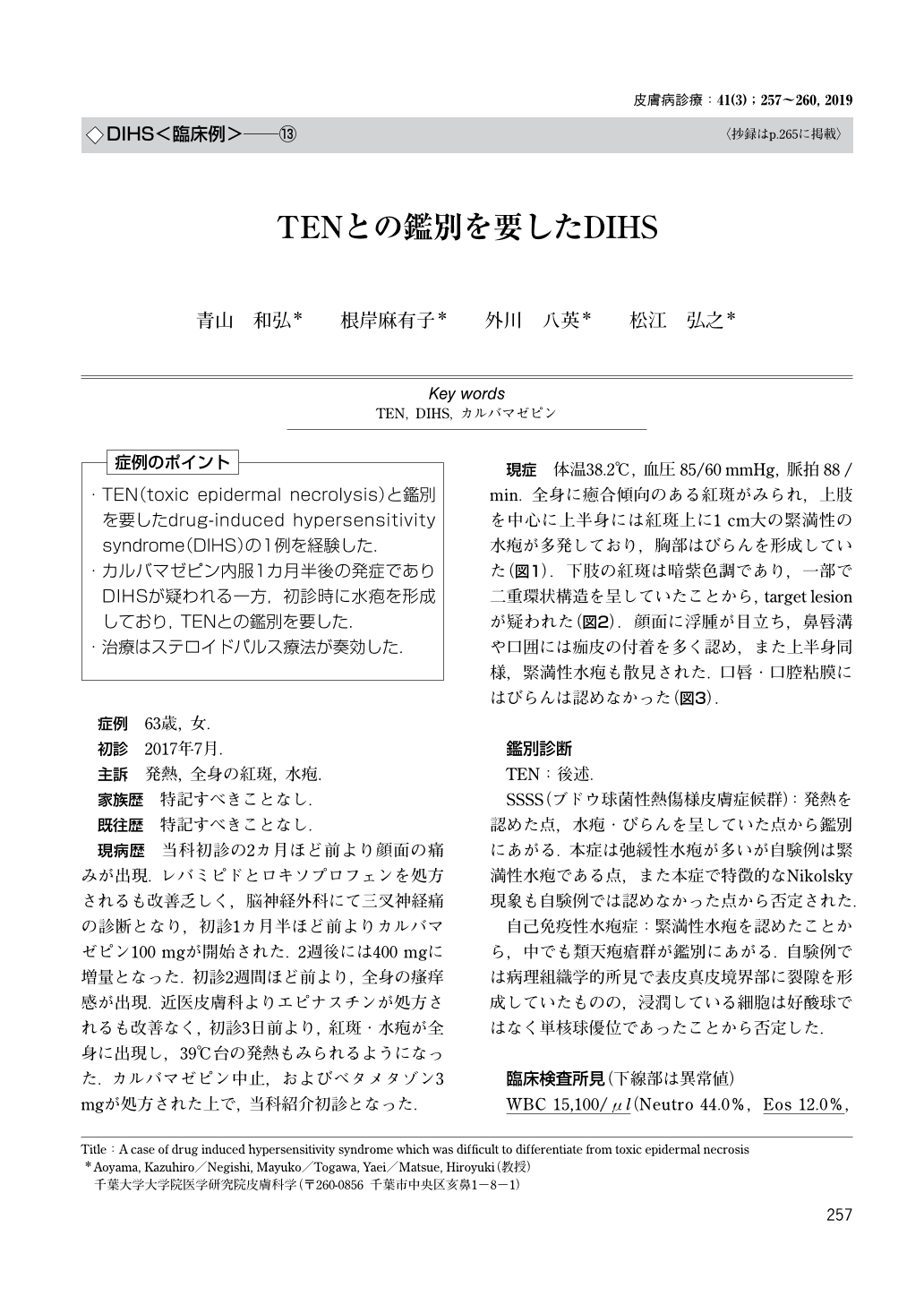
・TEN(toxic epidermal necrolysis)と鑑別を要したdrug-induced hypersensitivity syndrome(DIHS)の1例を経験した.
・カルバマゼピン内服1カ月半後の発症でありDIHSが疑われる一方,初診時に水疱を形成しており,TENとの鑑別を要した.
・治療はステロイドパルス療法が奏効した.
(「症例のポイント」より)
A case of drug-induced hypersensitivity syndrome which was difficult to differentiate from toxic epidermal necrosis
Aoyama, Kazuhiro1)Negishi, Mayuko1)Togawa, Yaei1)Matsue, Hiroyuki1) 1)Department of Dermatology, Chiba University Graduate School of Medicine
A 63-year-old female referred to our hospital because of whole body erythema and multiple tense blister accompanied by fever after starting administration of carbamazepine for trigeminal neuralgia from a month ago. The Nikolsky phenomenon could not be elicited unlike toxic epidermal necrosis. She had swelling of the cervical lymph node but no mucosal rash. Blood tests showed liver dysfunction, increased lymphocytes and eosinophils counts. The index of serum HHV-6 IgG level increased 4-fold after 14 weeks compared with base line. Pathological findings showed no necrosis in the epidermis, meanwhile edema in the dermal papilla layer was observed at the blistering area. We diagnosed it as a typical DIHS. Steroid pulse therapy was effective, and her symptoms improved.
Copyright © 2019, KYOWA KIKAKU Ltd. All rights reserved.