Japanese
English
- 有料閲覧
PPV購入案内
1,320円 (1,200円+税10%) こちらは、145ページから151ページの文献です。購入には医書.jp本会員登録が必要です。
会員登録完了後に改めて上記「購入サイトへ」を選択してください。
または「購入サイトへ」選択後に「購入ログイン」、「新規会員登録」の順に進んでください。
会員登録について詳しくはをご確認ください。
- Abstract 文献概要
- 1ページ目 Look Inside
- 参考文献 Reference
はじめに
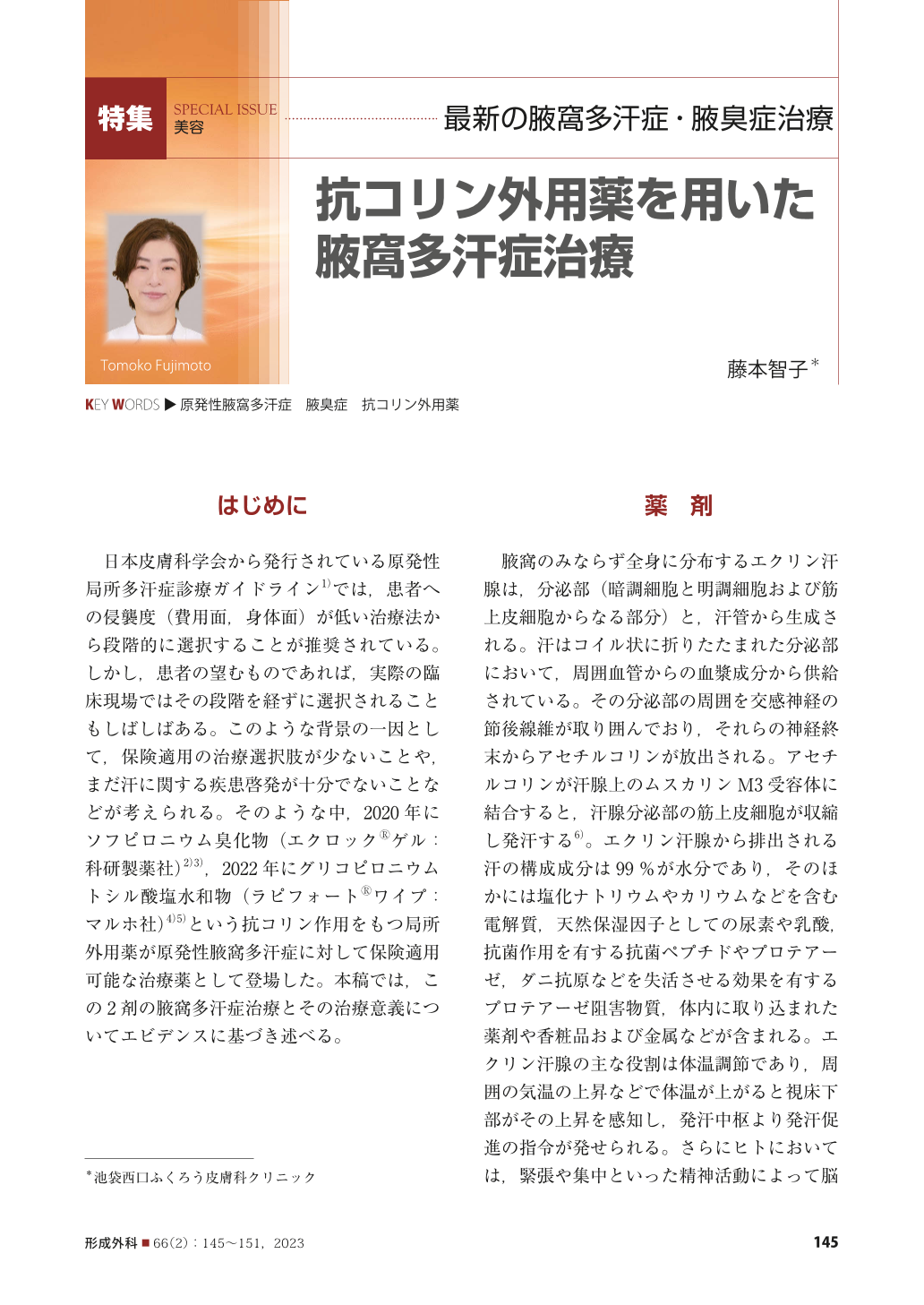
日本皮膚科学会から発行されている原発性局所多汗症診療ガイドライン 1)では,患者への侵襲度(費用面,身体面)が低い治療法から段階的に選択することが推奨されている。しかし,患者の望むものであれば,実際の臨床現場ではその段階を経ずに選択されることもしばしばある。このような背景の一因として,保険適用の治療選択肢が少ないことや,まだ汗に関する疾患啓発が十分でないことなどが考えられる。そのような中,2020年にソフピロニウム臭化物(エクロック Ⓡゲル:科研製薬社) 2)3),2022年にグリコピロニウムトシル酸塩水和物(ラピフォート Ⓡワイプ:マルホ社) 4)5)という抗コリン作用をもつ局所外用薬が原発性腋窩多汗症に対して保険適用可能な治療薬として登場した。本稿では,この2剤の腋窩多汗症治療とその治療意義についてエビデンスに基づき述べる。
Among hyperhidrosis treatments, those for axillary hyperhidrosis are the most abundant. Axillary hyperhidrosis treatments include over-the-counter deodorants and other self-funded options, but health insurance may cover treatment for severe cases. The treatment algorithm in the guidelines for primary axillary hyperhidrosis published by the Japanese Dermatological Association recommends that patients be treated in a stepwise fashion, starting with the least invasive option in terms of cost and physical impact, but in actual clinical practice, treatment may be performed as the patient wishes, regardless of the steps. Two reasons for this situation may be that (i) few treatments for hyperhidrosis covered by insurance, and (ii) the awareness of sweat-related diseases is still not widespread, even among clinicians. Against this backdrop, two topical anticholinergic agents have emerged as insurance-covered treatments for primary axillary hyperhidrosis: sofpironium bromide (ECCLOCK Ⓡ Gel 5 %)introduced in 2020 and glycopyrronium tosylate (Rapifort Ⓡ Wipes 2.5 %) introduced in 2022. This paper reviews the results of the first two studies of these two drugs and discusses the evidence-based treatment of axillary hyperhidrosis with these agents and their therapeutic implications.
Copyright© 2023 KOKUSEIDO CO., LTD. All Rights Reserved.