Japanese
English
- 有料閲覧
PPV購入案内
1,650円 (1,500円+税10%) こちらは、293ページから296ページの文献です。購入には医書.jp本会員登録が必要です。
会員登録完了後に改めて上記「購入サイトへ」を選択してください。
または「購入サイトへ」選択後に「購入ログイン」、「新規会員登録」の順に進んでください。
会員登録について詳しくはをご確認ください。
- Abstract 文献概要
- 1ページ目 Look Inside
- 参考文献 Reference
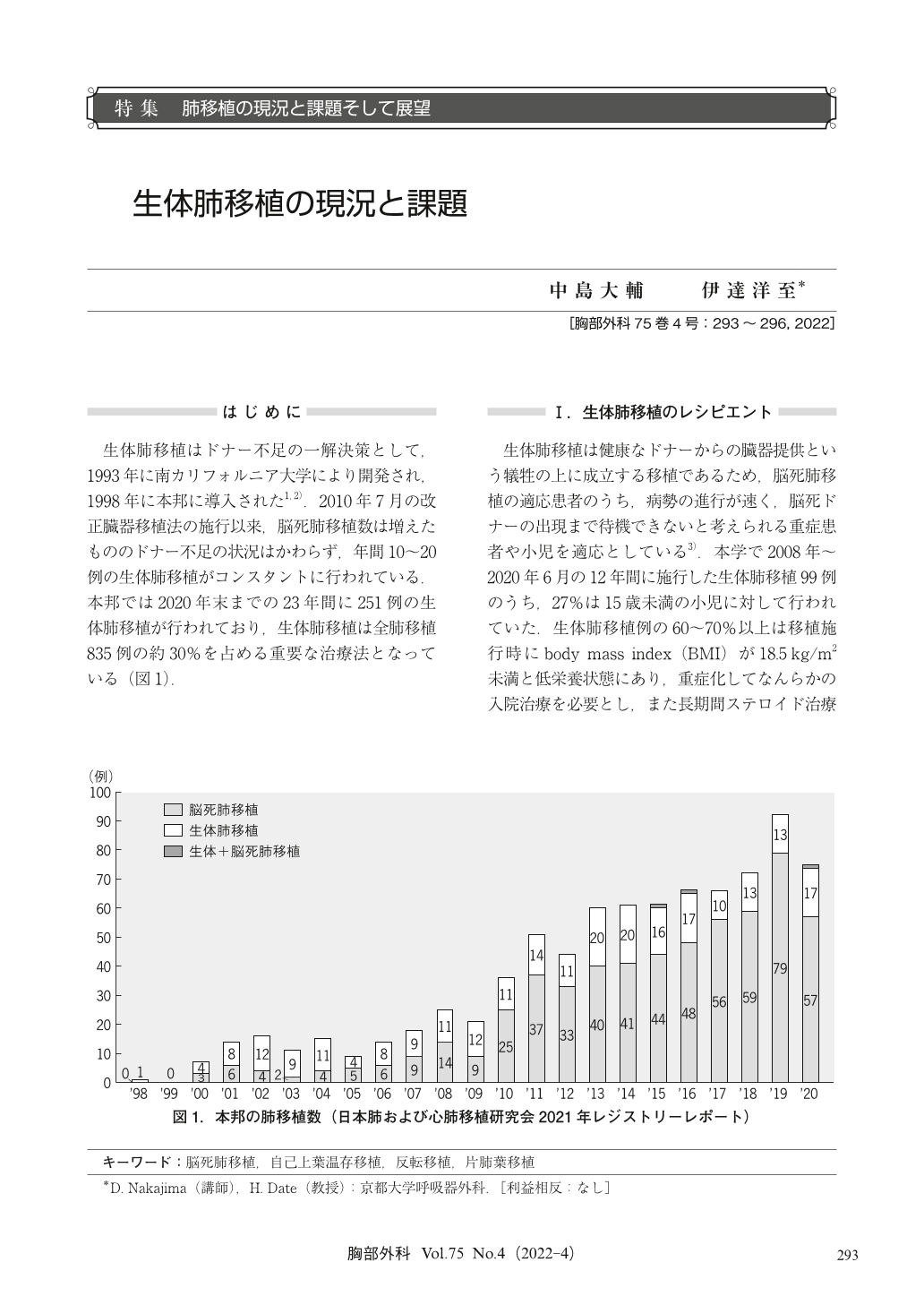
生体肺移植はドナー不足の一解決策として,1993年に南カリフォルニア大学により開発され,1998年に本邦に導入された1,2).2010年7月の改正臓器移植法の施行以来,脳死肺移植数は増えたもののドナー不足の状況はかわらず,年間10〜20例の生体肺移植がコンスタントに行われている.本邦では2020年末までの23年間に251例の生体肺移植が行われており,生体肺移植は全肺移植835例の約30%を占める重要な治療法となっている(図1).
Living-donor lobar lung transplantation (LDLLT) has become an important life-saving option for patients with severe respiratory disorders in order to address the current severe shortage of brain-dead donor organs. Although LDLLT candidates were basically limited to critically ill patients who would require hospitalization, the long-term use of steroids, and/or mechanical respiratory support before transplantation, LDLLT provided good post-transplant outcomes, comparable to brain-dead donor lung transplantation (BDLT). In Kyoto University, the 1-, 5- and 10-year survival rates were 91%, 79% and 62% after LDLLT and 92%, 72% and 65% after BDLT, respectively. Various transplant procedures have recently been developed in LDLLT in order to deal with the issue of graft size mismatching. Native upper lobe-sparing and/or right-to-left inverted transplantation have been performed for undersized grafts, while single-lobe transplantation has been employed for oversized grafts. These new transplant procedures have provided favorable post-transplant outcomes.
© Nankodo Co., Ltd., 2022