Japanese
English
- 有料閲覧
PPV購入案内
1,650円 (1,500円+税10%) こちらは、244ページから251ページの文献です。購入には医書.jp本会員登録が必要です。
会員登録完了後に改めて上記「購入サイトへ」を選択してください。
または「購入サイトへ」選択後に「購入ログイン」、「新規会員登録」の順に進んでください。
会員登録について詳しくはをご確認ください。
- Abstract 文献概要
- 1ページ目 Look Inside
- 参考文献 Reference
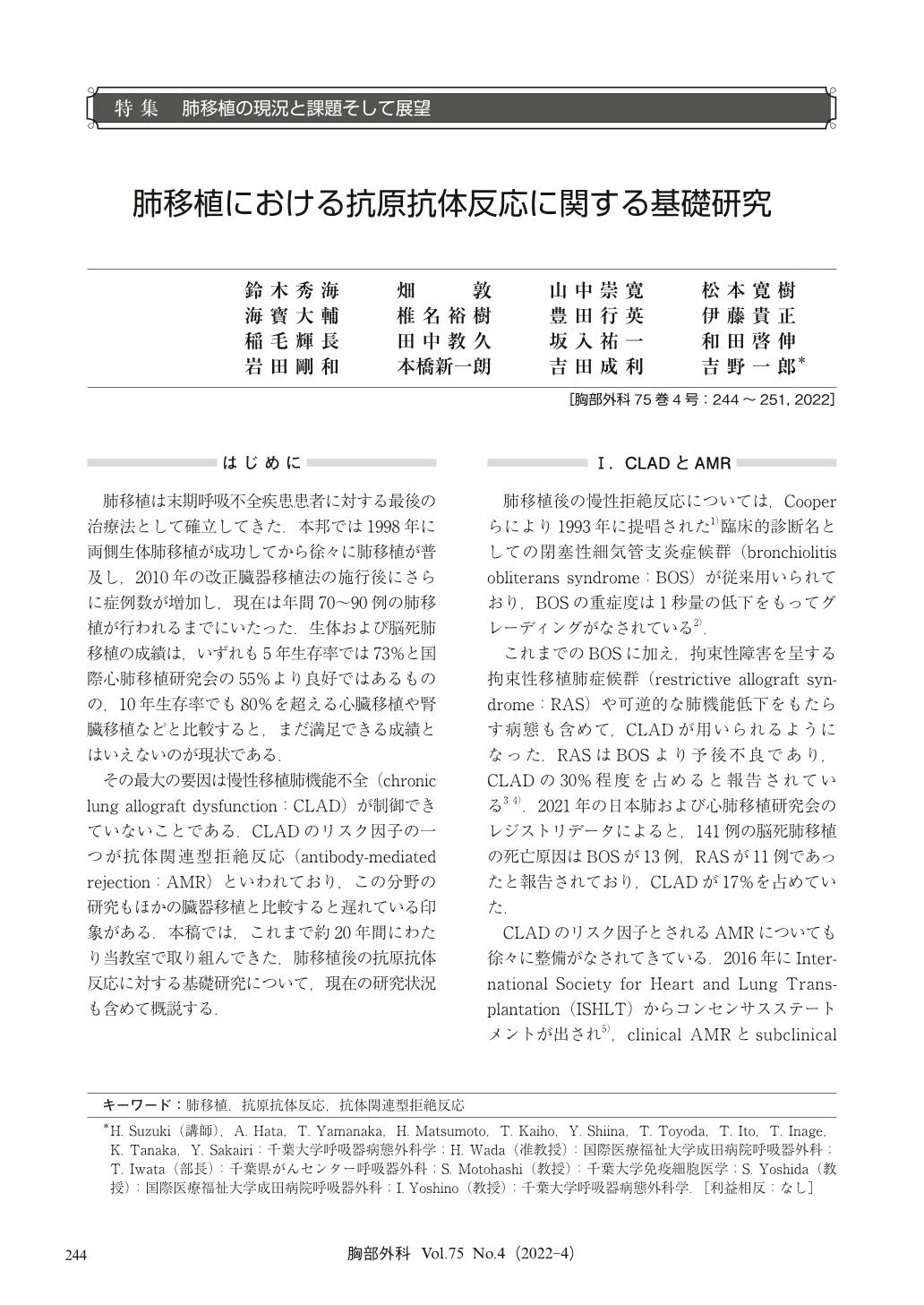
肺移植は末期呼吸不全疾患患者に対する最後の治療法として確立してきた.本邦では1998年に両側生体肺移植が成功してから徐々に肺移植が普及し,2010年の改正臓器移植法の施行後にさらに症例数が増加し,現在は年間70~90例の肺移植が行われるまでにいたった.生体および脳死肺移植の成績は,いずれも5年生存率では73%と国際心肺移植研究会の55%より良好ではあるものの,10年生存率でも80%を超える心臓移植や腎臓移植などと比較すると,まだ満足できる成績とはいえないのが現状である.
Lung transplantation has become popular in Japan, showing better survival rate than other countries. However, the results are still not satisfactory compared with other solid organ transplantation. One of the reasons for this might be that knowledge on donor-specific antibodies or antibody-related rejection, which has been attracting attention these days, is less than that of kidney or liver transplantation. Our laboratory has continued basic research in this field using rodent lung transplantation model. We have previously shown that type V collagen is associated in chronic rejection as an autoimmune, and that oral administration of type V collagen induces tolerance. The murine chronic rejection model of the minor antigen mismatch was developed, and involvement of the humoral immunity and role of the complement activation were shown. We are now studying the effects of immune checkpoint molecules, which play a central role in the field of cancer therapy, on rejection after lung transplantation. We are also working to verify the effects of anti-complement drugs and molecular targeted drugs in the future treatment on rejection.
© Nankodo Co., Ltd., 2022