Japanese
English
- 有料閲覧
- Abstract 文献概要
- 1ページ目 Look Inside
- 参考文献 Reference
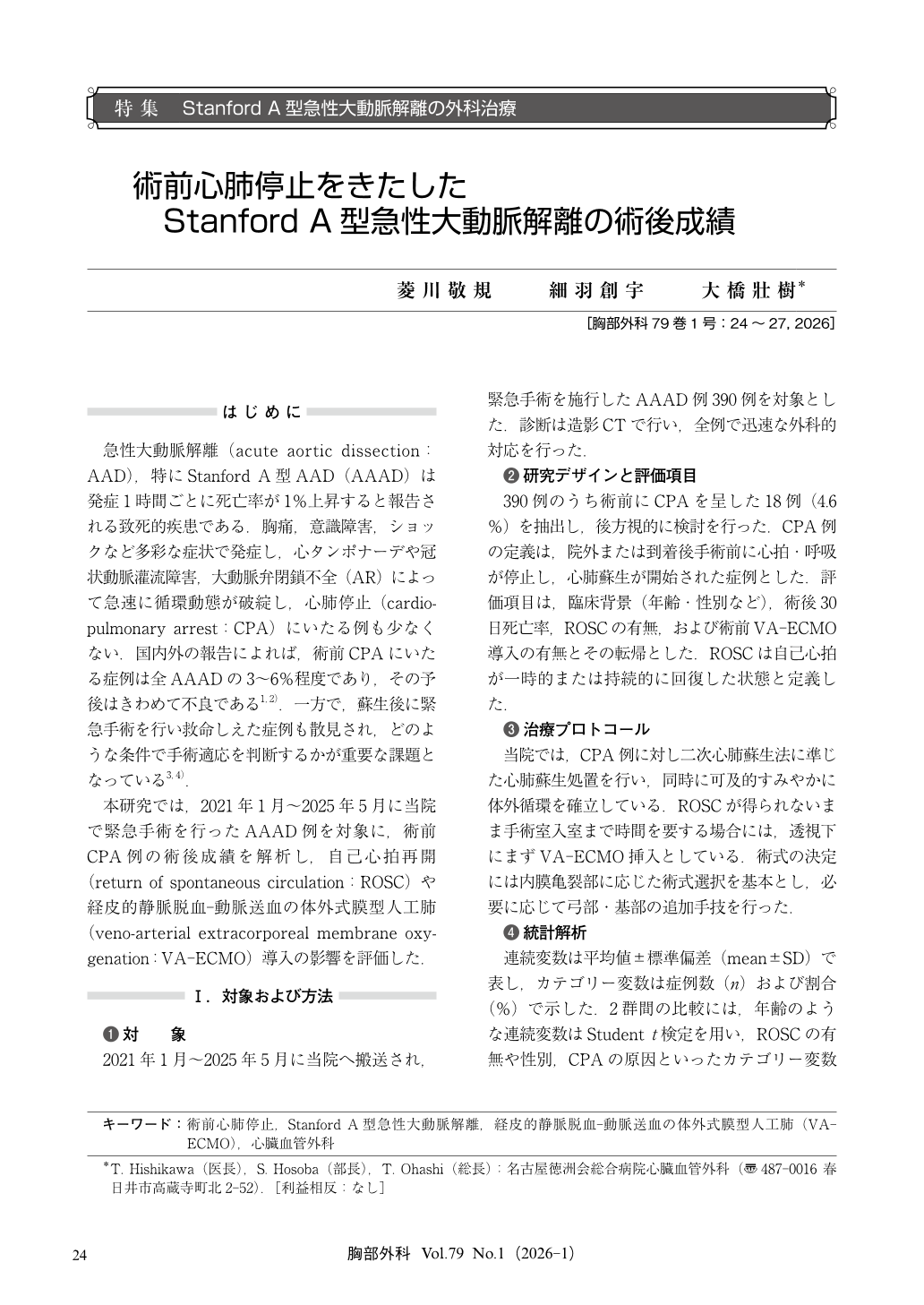
急性大動脈解離(acute aortic dissection:AAD),特にStanford A型AAD(AAAD)は発症1時間ごとに死亡率が1%上昇すると報告される致死的疾患である.胸痛,意識障害,ショックなど多彩な症状で発症し,心タンポナーデや冠状動脈灌流障害,大動脈弁閉鎖不全(AR)によって急速に循環動態が破綻し,心肺停止(cardiopulmonary arrest:CPA)にいたる例も少なくない.国内外の報告によれば,術前CPAにいたる症例は全AAADの3〜6%程度であり,その予後はきわめて不良である1,2).一方で,蘇生後に緊急手術を行い救命しえた症例も散見され,どのような条件で手術適応を判断するかが重要な課題となっている3,4).
Objective:This single-center retrospective study evaluated postoperative outcomes in Stanford type A acute aortic dissection (AAAD) patients presenting with preoperative cardiopulmonary arrest (CPA) between January 2021 and May 2025.
Methods:Among 390 consecutive AAAD cases undergoing emergency surgery, 18 (4.6%) presented with CPA. We assessed 30-day mortality, return of spontaneous circulation (ROSC), and use of preoperative veno-arterial extracorporeal membrane oxygenation (VA-ECMO).
Results:The 30-day mortality was 72.2%. ROSC occurred in 4 cases (22.2%), and ROSC-positive patients had significantly lower mortality (p=0.022). Preoperative VA-ECMO was used in 7 cases (38.9%), none of whom survived (p=0.013).
Conclusions:AAAD with preoperative CPA carries extremely high mortality, but patients achieving ROSC may benefit from urgent surgical intervention. VA-ECMO appears to confer no survival advantage. Early survivors often achieve favorable long-term outcomes, in line with prior literature.
© Nankodo Co., Ltd., 2026