Japanese
English
- 有料閲覧
PPV購入案内
1,650円 (1,500円+税10%) こちらは、1003ページから1006ページの文献です。購入には医書.jp本会員登録が必要です。
会員登録完了後に改めて上記「購入サイトへ」を選択してください。
または「購入サイトへ」選択後に「購入ログイン」、「新規会員登録」の順に進んでください。
会員登録について詳しくはをご確認ください。
- Abstract 文献概要
- 1ページ目 Look Inside
- 参考文献 Reference
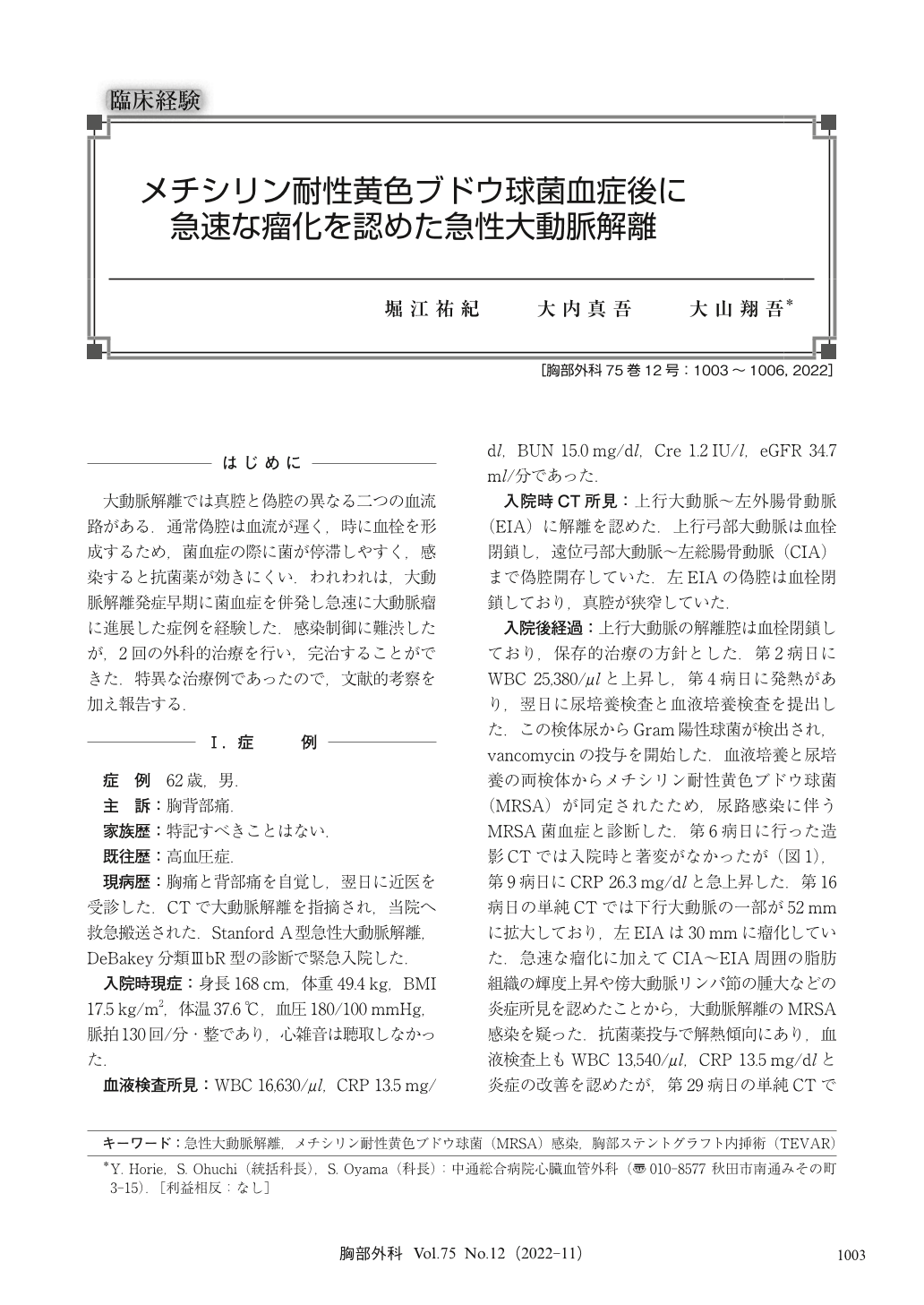
大動脈解離では真腔と偽腔の異なる二つの血流路がある.通常偽腔は血流が遅く,時に血栓を形成するため,菌血症の際に菌が停滞しやすく,感染すると抗菌薬が効きにくい.われわれは,大動脈解離発症早期に菌血症を併発し急速に大動脈瘤に進展した症例を経験した.感染制御に難渋したが,2回の外科的治療を行い,完治することができた.特異な治療例であったので,文献的考察を加え報告する.
The patient is a 62-year-old man. He was referred to our hospital from a nearby clinic with a complaint of chest and back pain, and was urgently admitted with a diagnosis of Stanford type A (Debakey typeⅢbR) acute aortic dissection. During the course of his treatment, he developed a urinary tract infection caused by methicillin-resistant Staphylococcus aureus (MRSA). Thereafter, the patient developed bacteremia, and follow-up computed tomography (CT) showed a rapidly enlarging descending aortic aneurysm and a left external iliac artery (EIA) aneurysm. On day 49 after admission, thoracic endovascular aortic repair, left EIA resection, and right EIA-left femoral artery bypass were performed. However, a contrast-enhanced CT scan on day 70 of hospitalization revealed a type Ia endoleak and enlargement of the descending aortic aneurysm, so the patient underwent replacement of the descending aorta on day 84. Postoperatively, the patient needed time for recovery, but was discharged on day 158. Three years after discharge, there has been no recurrence of infection, and the patient has been visiting our outpatient clinic. We report a case of acute aortic dissection with rapidly enlarged aneurysm after MRSA bacteremia. This serious condition was succesfully cured with continued antibiotic treatment, two surgical resections and revascularization.
© Nankodo Co., Ltd., 2022