Japanese
English
- 有料閲覧
PPV購入案内
1,650円 (1,500円+税10%) こちらは、550ページから553ページの文献です。購入には医書.jp本会員登録が必要です。
会員登録完了後に改めて上記「購入サイトへ」を選択してください。
または「購入サイトへ」選択後に「購入ログイン」、「新規会員登録」の順に進んでください。
会員登録について詳しくはをご確認ください。
- Abstract 文献概要
- 1ページ目 Look Inside
- 参考文献 Reference
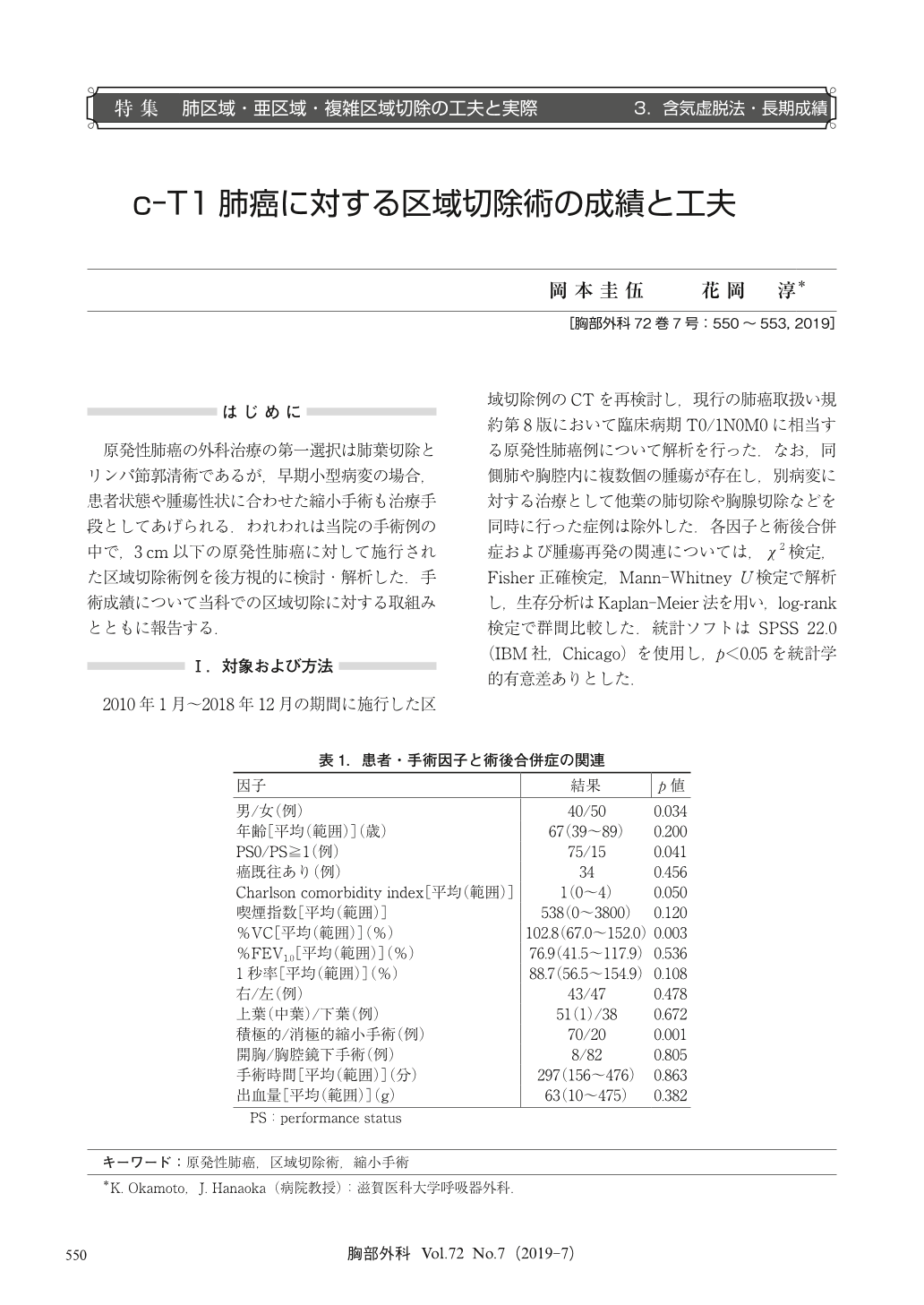
原発性肺癌の外科治療の第一選択は肺葉切除とリンパ節郭清術であるが,早期小型病変の場合,患者状態や腫瘍性状に合わせた縮小手術も治療手段としてあげられる.われわれは当院の手術例の中で,3 cm以下の原発性肺癌に対して施行された区域切除術例を後方視的に検討・解析した.手術成績について当科での区域切除に対する取組みとともに報告する.
Objectives:Segmentectomy has been performed as an alternative surgical procedure for small-size lung cancer, while its benefits and risks are still unclear. This retrospective study aimed to examine the outcomes of patients undergoing segmentectomy for early stage lung cancer.
Patients and methods:From 2010 to 2018, 90 patients with clinical-T0/1N0M0 lung cancer who underwent segmentectomy were enrolled. We analyzed the postoperative morbidity, tumor recurrence and survival rate after surgery.
Results:Postoperative complications were observed in 9 patients, and significant difference was found in passive limited surgery (p=0.003). Recurrence was observed in 4 patients, and pathological vessel invasion was a significant risk factor (p=0.035), but there was no local recurrence. The 5-year overall survival rate for all patients, active and passive limited surgery group were 90.7%, 91.5% and 58.0%, respectively. There was significant difference in surgical indication (p<0.001).
Conclusions:Active segmentectomy which had considered the tumor characteristics was able to obtain a good tumor control effect by combining adjacent lung resection. Passive segmentectomy should be determined after careful consideration of the effects on comorbidities.
© Nankodo Co., Ltd., 2019