Japanese
English
- 有料閲覧
PPV購入案内
1,320円 (1,200円+税10%) こちらは、55ページから62ページの文献です。購入には医書.jp本会員登録が必要です。
会員登録完了後に改めて上記「購入サイトへ」を選択してください。
または「購入サイトへ」選択後に「購入ログイン」、「新規会員登録」の順に進んでください。
会員登録について詳しくはをご確認ください。
- Abstract 文献概要
- 1ページ目 Look Inside
- 参考文献 Reference
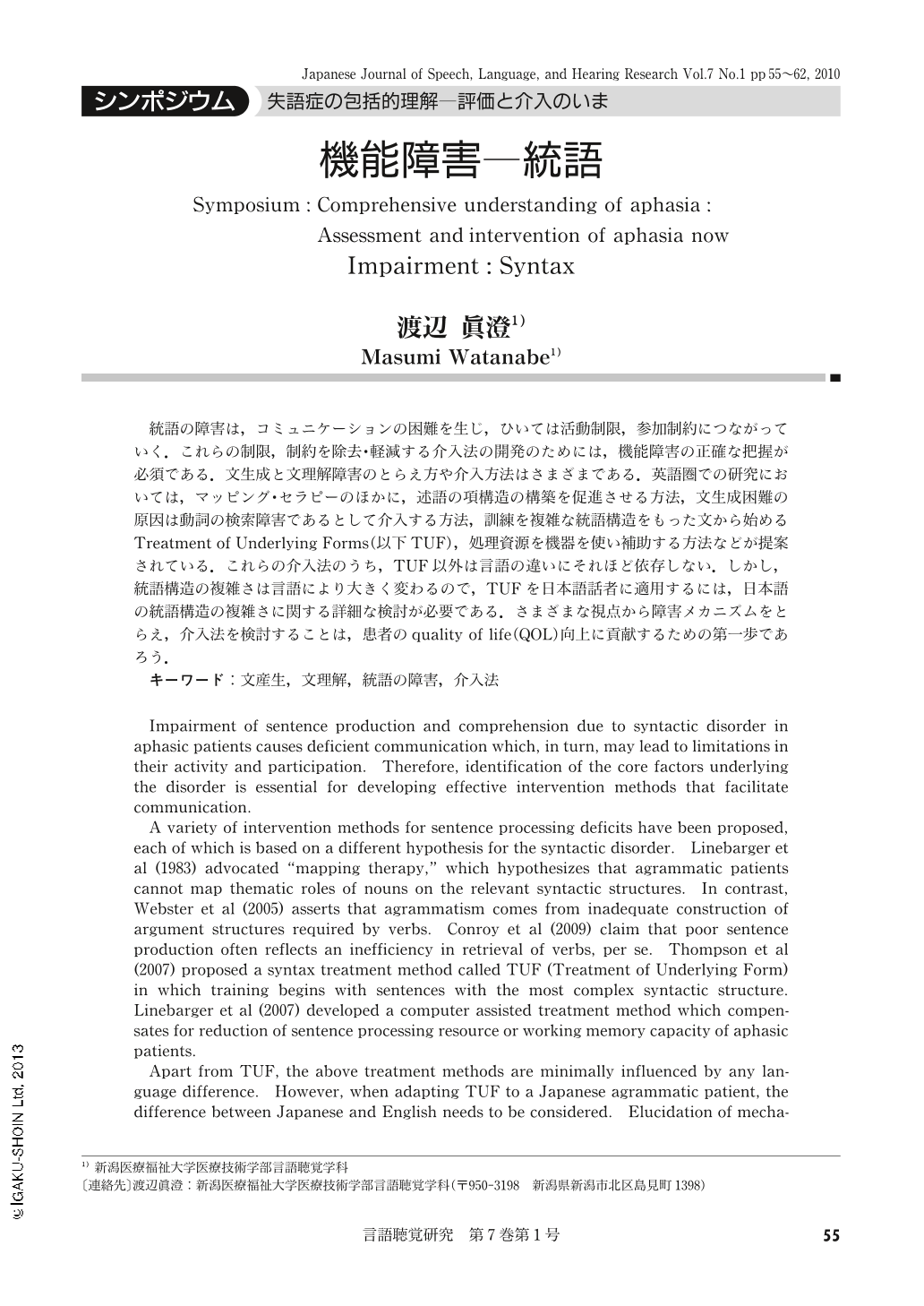
統語の障害は,コミュニケーションの困難を生じ,ひいては活動制限,参加制約につながっていく.これらの制限,制約を除去・軽減する介入法の開発のためには,機能障害の正確な把握が必須である.文生成と文理解障害のとらえ方や介入方法はさまざまである.英語圏での研究においては,マッピング・セラピーのほかに,述語の項構造の構築を促進させる方法,文生成困難の原因は動詞の検索障害であるとして介入する方法,訓練を複雑な統語構造をもった文から始めるTreatment of Underlying Forms(以下TUF),処理資源を機器を使い補助する方法などが提案されている.これらの介入法のうち,TUF以外は言語の違いにそれほど依存しない.しかし,統語構造の複雑さは言語により大きく変わるので,TUFを日本語話者に適用するには,日本語の統語構造の複雑さに関する詳細な検討が必要である.さまざまな視点から障害メカニズムをとらえ,介入法を検討することは,患者のquality of life(QOL)向上に貢献するための第一歩であろう.
Impairment of sentence production and comprehension due to syntactic disorder in aphasic patients causes deficient communication which, in turn, may lead to limitations in their activity and participation. Therefore, identification of the core factors underlying the disorder is essential for developing effective intervention methods that facilitate communication.
A variety of intervention methods for sentence processing deficits have been proposed, each of which is based on a different hypothesis for the syntactic disorder. Linebarger et al (1983) advocated "mapping therapy," which hypothesizes that agrammatic patients cannot map thematic roles of nouns on the relevant syntactic structures. In contrast, Webster et al (2005) asserts that agrammatism comes from inadequate construction of argument structures required by verbs. Conroy et al (2009) claim that poor sentence production often reflects an inefficiency in retrieval of verbs, per se. Thompson et al (2007) proposed a syntax treatment method called TUF (Treatment of Underlying Form) in which training begins with sentences with the most complex syntactic structure. Linebarger et al (2007) developed a computer assisted treatment method which compensates for reduction of sentence processing resource or working memory capacity of aphasic patients.
Apart from TUF, the above treatment methods are minimally influenced by any language difference. However, when adapting TUF to a Japanese agrammatic patient, the difference between Japanese and English needs to be considered. Elucidation of mechanisms underlying impaired sentence processing is a first step to improve the QOL of agrammatic patients.
Copyright © 2010, Japanese Association of Speech-Language-Hearing Therapists. All rights reserved.