Japanese
English
- 有料閲覧
PPV購入案内
1,320円 (1,200円+税10%) こちらは、243ページから246ページの文献です。購入には医書.jp本会員登録が必要です。
会員登録完了後に改めて上記「購入サイトへ」を選択してください。
または「購入サイトへ」選択後に「購入ログイン」、「新規会員登録」の順に進んでください。
会員登録について詳しくはをご確認ください。
- Abstract 文献概要
- 1ページ目 Look Inside
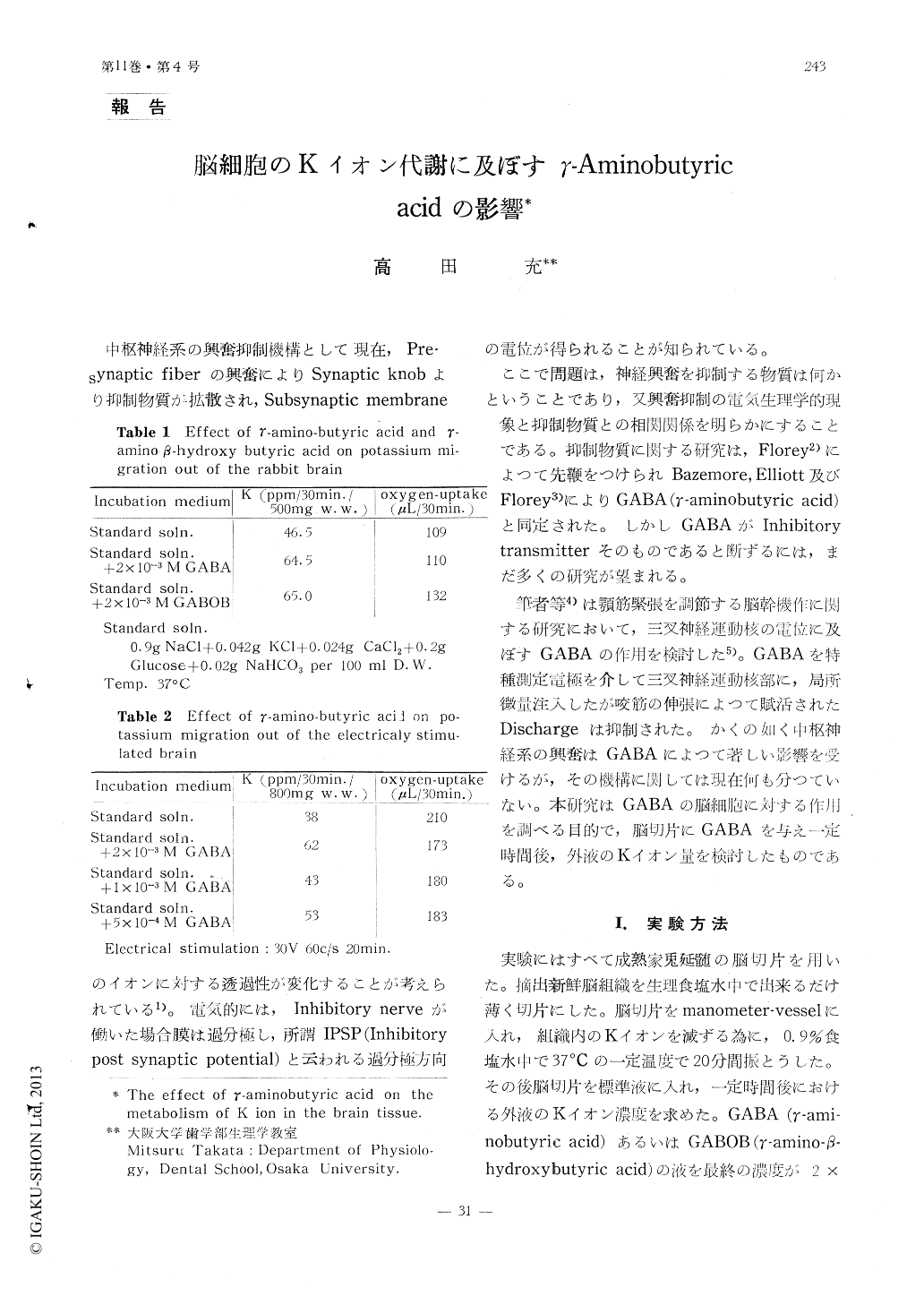
中枢神経系の興奮抑制機構として現在,Pre-synaptic fiberの興奮によりSynaptic knobより抑制物質が拡散され,Subsynaptic membraneのイオンに対する透過性が変化することが考えられている1)。電気的には,Inhibitory nerveが働いた場合膜は過分極し,所謂IPSP(Inhibitory post synaptic potential)と云われる過分極方向の電位が得られることが知られている。
ここで問題は,神経興奮を抑制する物質は何かということであり,又興奮抑制の電気生理学的現象と抑制物質との相関関係を明らかにすることである。抑制物質に関する研究は,Florey2)によつて先鞭をつけられBazemore, Elliott及びFlorey3)によりGABA(γ-aminobutyric acid)と同定された。しかしGABAがInhibitory transmitterそのものであると断ずるには,まだ多くの研究が望まれる。
The migration of potassium ions from the isolated rabbit's brain, which was immersedin modified Krebs-Ringer bicarbonate buffer with GABA (γ-aminobutyric acid) or GABOB (γ-amino-β-hydroxybutyric acid) at 37℃, was examined in this experiment.
Incubation of slices with GABA or GABOB caused an increase of outside 〔K+〕. In the case of electrically stimulated brain tissue (60cps. 30V, 20min.) the net flux of potassium ions across the membrane into the outer medium was accelerated by the addition of GABA or GABOB. Moreover, GABA or GABOB revealed the activation of oxygen uptake of the brain tissue to some extent.
Copyright © 1960, THE ICHIRO KANEHARA FOUNDATION. All rights reserved.