Japanese
English
- 有料閲覧
PPV購入案内
1,320円 (1,200円+税10%) こちらは、443ページから453ページの文献です。購入には医書.jp本会員登録が必要です。
会員登録完了後に改めて上記「購入サイトへ」を選択してください。
または「購入サイトへ」選択後に「購入ログイン」、「新規会員登録」の順に進んでください。
会員登録について詳しくはをご確認ください。
- Abstract 文献概要
- 1ページ目 Look Inside
- サイト内被引用 Cited by
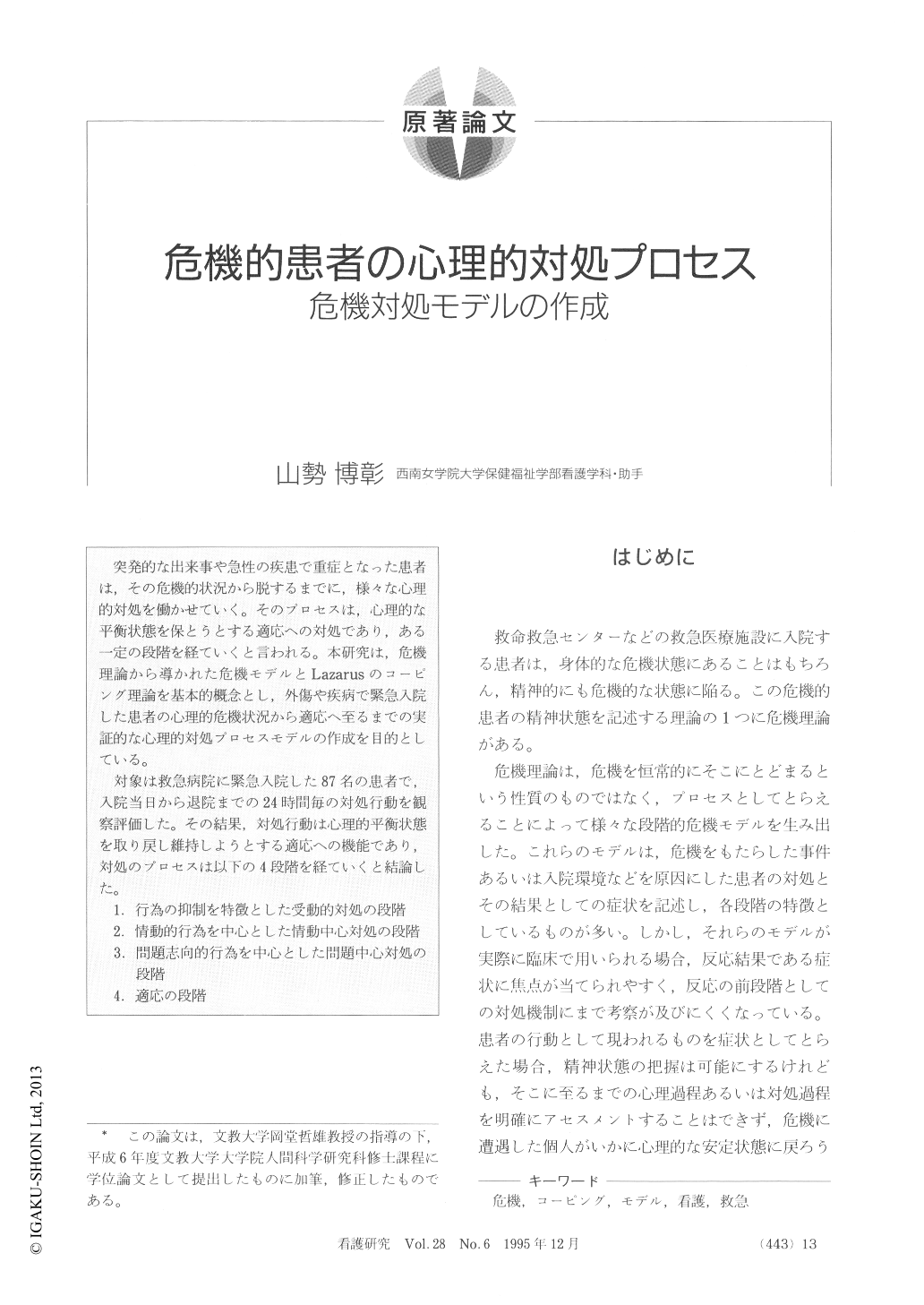
突発的な出来事や急性の疾患で重症となった患者は,その危機的状況から脱するまでに,様々な心理的対処を働かせていく。そのプロセスは,心理的な平衡状態を保とうとする適応への対処であり,ある一定の段階を経ていくと言われる。本研究は,危機理論から導かれた危機モデルとLazarusのコーピング理論を基本的概念とし,外傷や疾病で緊急入院した患者の心理的危機状況から適応へ至るまでの実証的な心理的対処プロセスモデルの作成を目的としている。
対象は救急病院に緊急入院した87名の患者で,入院当日から退院までの24時間毎の対処行動を観察評価した。その結果,対処行動は心理的平衡状態を取り戻し維持しようとする適応への機能であり,対処のプロセスは以下の4段階を経ていくと結論した。
1.行為の抑制を特徴とした受動的対処の段階
2.情動的行為を中心とした情動中心対処の段階
3.問題志向的行為を中心とした問題中心対処の段階
4.適応の段階
Admission to the critical care unit signals a threat to life and well-being to all who are admitted. The patient is not only in a biological crisis but also in a psychological crisis. Coping processes with a psychological crisis pass through sequential phases for adaptation that is a psychological equilibrium.
The purpose of this study is constructing a model of the coping processes of adaptation that follow certain kinds of psychological crisis which occur in people's emergency admission. The theoretical coping processes based on crisis theory and Lazarus' stress-coping theory were postulated, and the four modes of coping were assessed for 87 patients on critical care.
Results indicated that the coping processes passed through four sequential phases.
The four phases are the following :
(1) Passive coping, the period that the mode of coping is inhibition of action.
(2) Emotion-focused coping, the period that the mode of coping is emotional.
(3) Problem-focused coping, the period that the mode of coping is problem-solving.
(4) Adaptation.
Copyright © 1995, Igaku-Shoin Ltd. All rights reserved.