Japanese
English
- 有料閲覧
PPV購入案内
1,320円 (1,200円+税10%) こちらは、122ページから134ページの文献です。購入には医書.jp本会員登録が必要です。
会員登録完了後に改めて上記「購入サイトへ」を選択してください。
または「購入サイトへ」選択後に「購入ログイン」、「新規会員登録」の順に進んでください。
会員登録について詳しくはをご確認ください。
- Abstract 文献概要
- 1ページ目 Look Inside
- 参考文献 Reference
- サイト内被引用 Cited by
Abstract
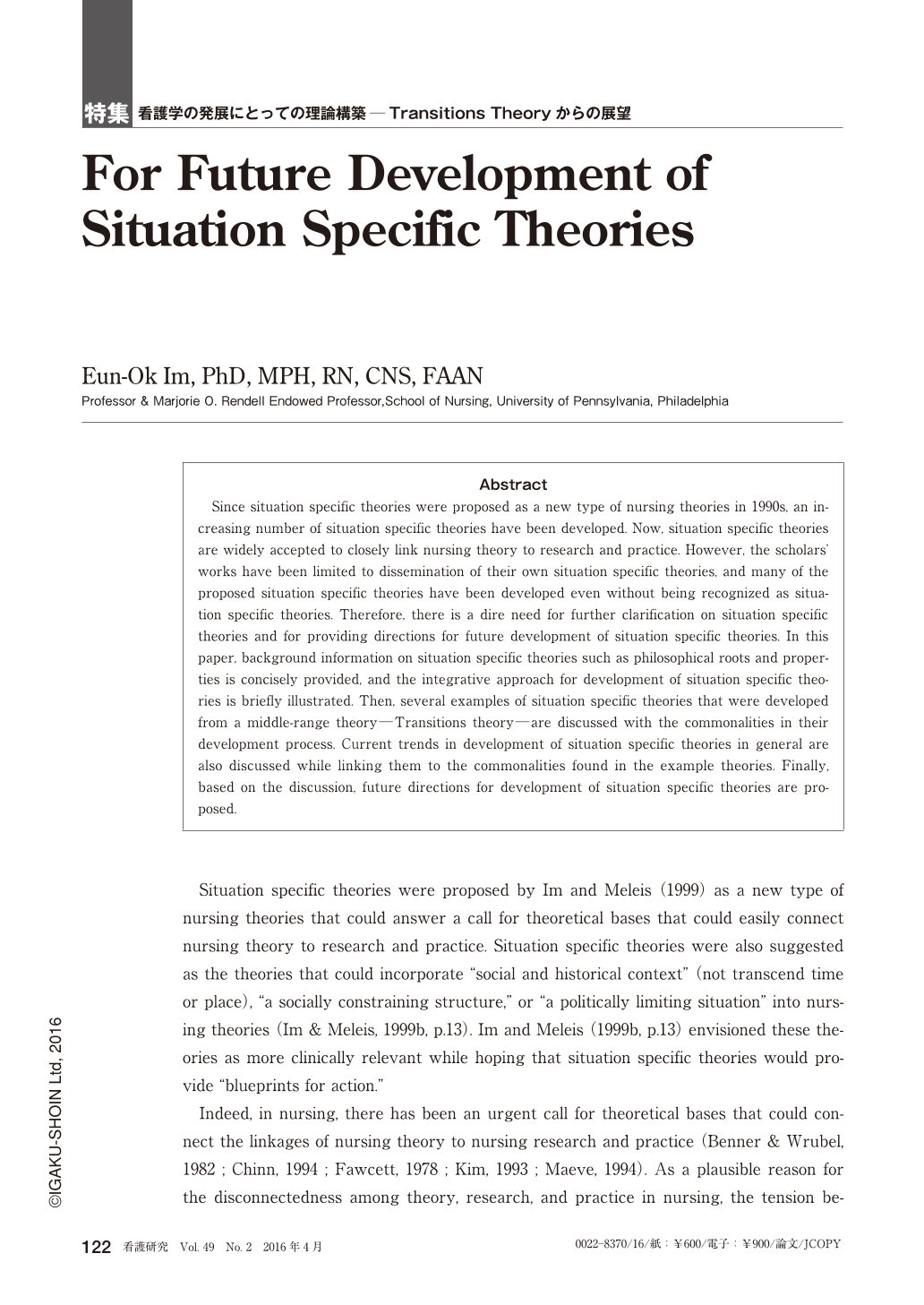
Since situation specific theories were proposed as a new type of nursing theories in 1990s, an increasing number of situation specific theories have been developed. Now, situation specific theories are widely accepted to closely link nursing theory to research and practice. However, the scholars’ works have been limited to dissemination of their own situation specific theories, and many of the proposed situation specific theories have been developed even without being recognized as situation specific theories. Therefore, there is a dire need for further clarification on situation specific theories and for providing directions for future development of situation specific theories. In this paper, background information on situation specific theories such as philosophical roots and properties is concisely provided, and the integrative approach for development of situation specific theories is briefly illustrated. Then, several examples of situation specific theories that were developed from a middle-range theory─Transitions theory─are discussed with the commonalities in their development process. Current trends in development of situation specific theories in general are also discussed while linking them to the commonalities found in the example theories. Finally, based on the discussion, future directions for development of situation specific theories are proposed.
Abstract
Since situation specific theories were proposed as a new type of nursing theories in 1990s, an increasing number of situation specific theories have been developed. Now, situation specific theories are widely accepted to closely link nursing theory to research and practice. However, the scholars’ works have been limited to dissemination of their own situation specific theories, and many of the proposed situation specific theories have been developed even without being recognized as situation specific theories. Therefore, there is a dire need for further clarification on situation specific theories and for providing directions for future development of situation specific theories. In this paper, background information on situation specific theories such as philosophical roots and properties is concisely provided, and the integrative approach for development of situation specific theories is briefly illustrated. Then, several examples of situation specific theories that were developed from a middle-range theory─Transitions theory─are discussed with the commonalities in their development process. Current trends in development of situation specific theories in general are also discussed while linking them to the commonalities found in the example theories. Finally, based on the discussion, future directions for development of situation specific theories are proposed.
Copyright © 2016, Igaku-Shoin Ltd. All rights reserved.