Japanese
English
- 有料閲覧
PPV購入案内
1,320円 (1,200円+税10%) こちらは、763ページから765ページの文献です。購入には医書.jp本会員登録が必要です。
会員登録完了後に改めて上記「購入サイトへ」を選択してください。
または「購入サイトへ」選択後に「購入ログイン」、「新規会員登録」の順に進んでください。
会員登録について詳しくはをご確認ください。
- Abstract 文献概要
- 1ページ目 Look Inside
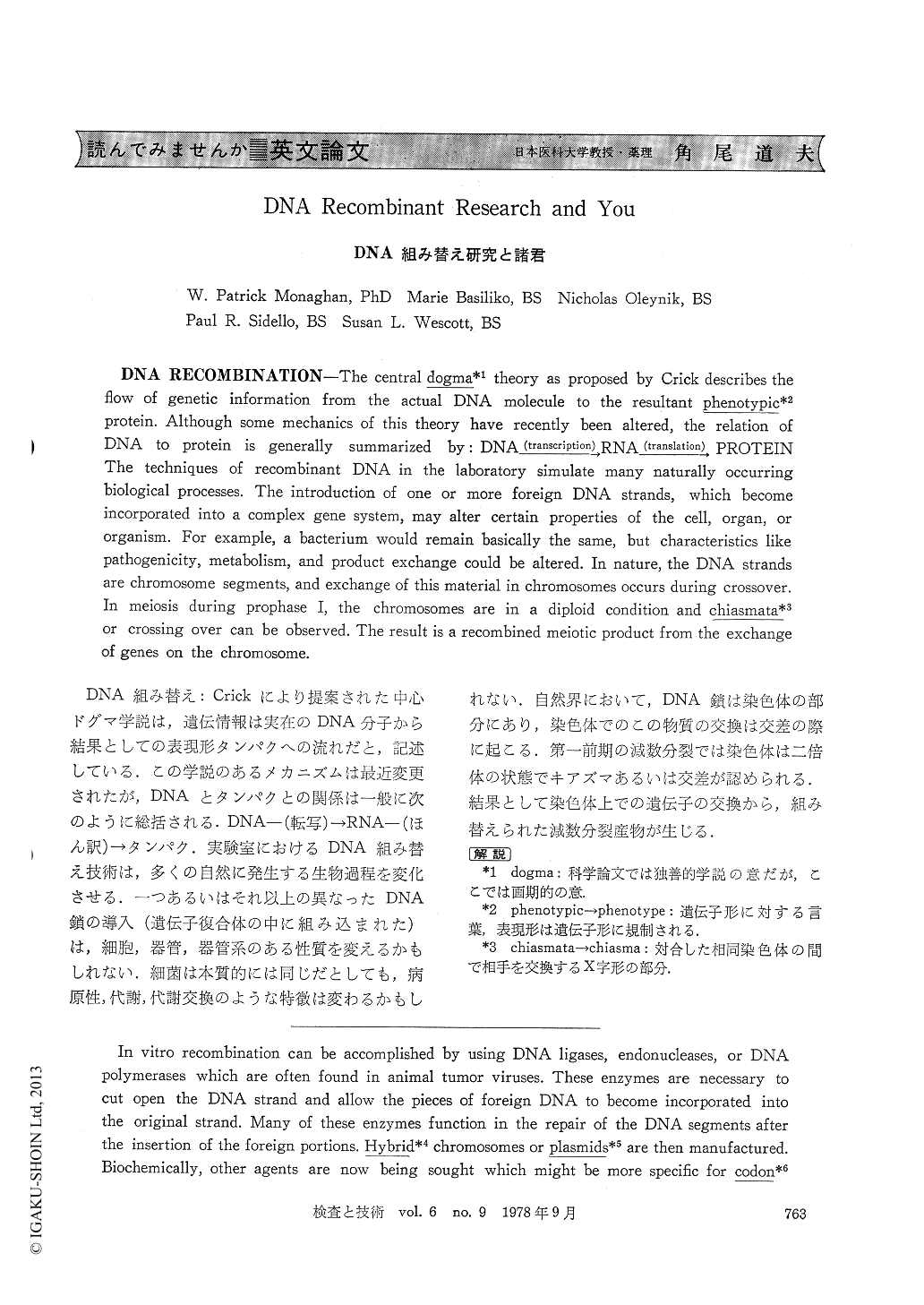
DNA組み替え:Crickにより提案された中心ドグマ学説は,遺伝情報は実在のDNA分子から結果としての表現形タンパクへの流れだと,記述している.この学説のあるメカニズムは最近変更されたが,DNAとタンパクとの関係は一般に次のように総括される.DNA-(転写)→RNA-(ほん訳)→タンパク.実験室におけるDNA組み替え技術は,多くの自然に発生する生物過程を変化させる.一つあるいはそれ以上の異なったDNA鎖の導入(遺伝子復合体の中に組み込まれた)は,細胞,器管,器管系のある性質を変えるかもしれない.細菌は本質的には同じだとしても,病原性,代謝,代謝交換のような特徴は変わるかもしれない.自然界において,DNA鎖は染色体の部分にあり,染色体でのこの物質の交換は交差の際に起こる.第一前期の減数分裂では染色体は二倍体の状態でキアズマあるいは交差が認められる.結果として染色体上での遺伝子の交換から,組み替えられた減数分裂産物が生じる.
DNA RECOMBINATION-the central dogma theory as proposed by Crick describes the flow of genetic information from the actual DNA molecule to the resultant phenotypic protein. Although some mechanics of this theory have recently been altered, the relation of DNA to protein is generally summarized by : DNA (transcription) RNA (translation) PROTEIN The techniques of recombinant DNA in the laboratory simulate many naturally occurring biological processes. The introduction of one or more foreign DNA strands, which become incorporated into a complex gene system, may alter certain properties of the cell, organ, or organism. For example, a bacterium would remain basically the same, but characteristics like pathogenicity, metabolism, and product exchange could be altered. In nature, the DNA strands are chromosome segments, and exchange of this material in chromosomes occurs during crossover. In meiosis during prophase I, the chromosomes are in a diploid condition and chiasmata or crossing over can be observed. The result is a recombined meiotic product from the exchange of genes on the chromosome.
Copyright © 1978, Igaku-Shoin Ltd. All rights reserved.