Japanese
English
- 有料閲覧
PPV購入案内
1,320円 (1,200円+税10%) こちらは、57ページから64ページの文献です。購入には医書.jp本会員登録が必要です。
会員登録完了後に改めて上記「購入サイトへ」を選択してください。
または「購入サイトへ」選択後に「購入ログイン」、「新規会員登録」の順に進んでください。
会員登録について詳しくはをご確認ください。
- Abstract 文献概要
- 1ページ目 Look Inside
- 参考文献 Reference
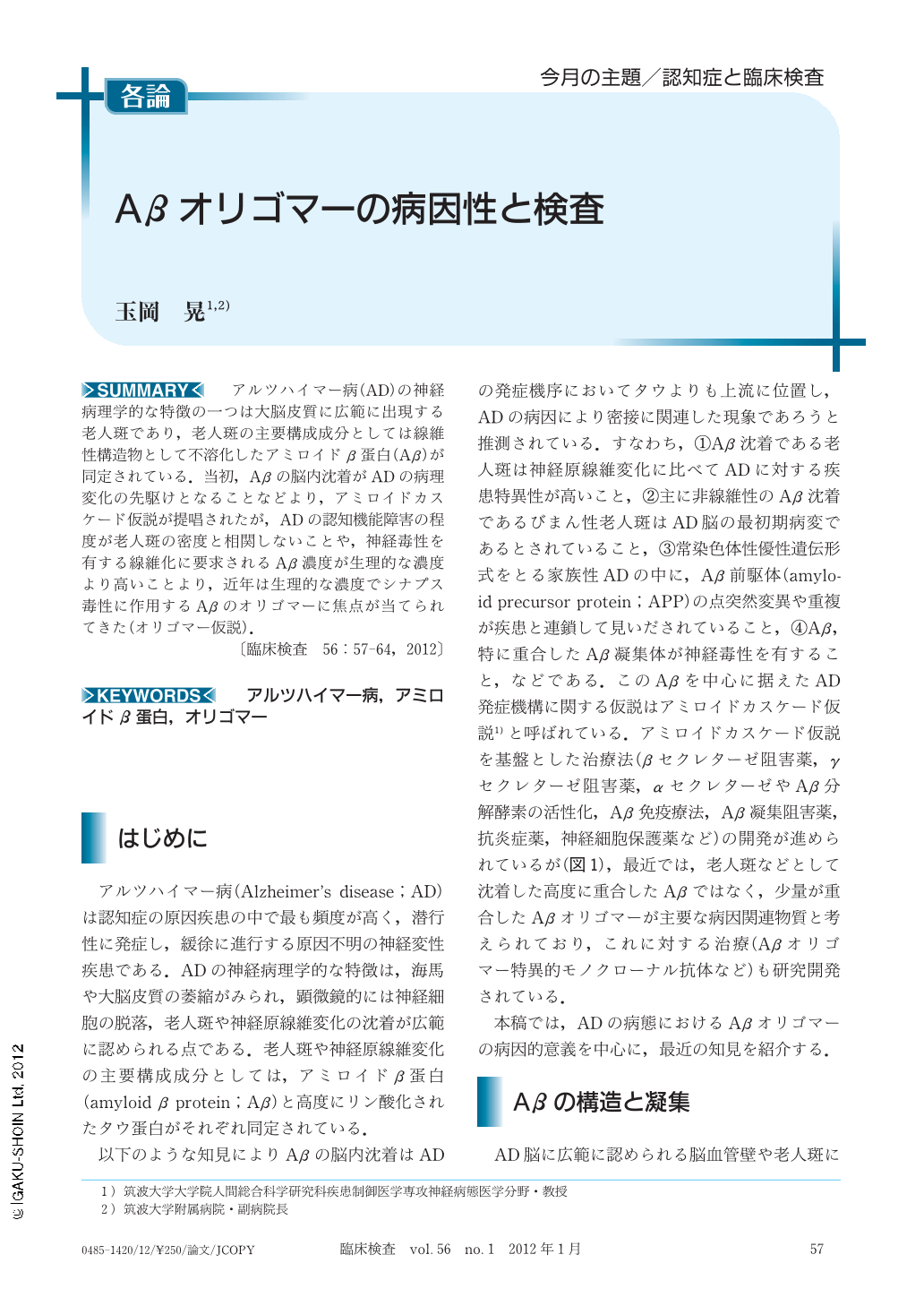
アルツハイマー病(AD)の神経病理学的な特徴の一つは大脳皮質に広範に出現する老人斑であり,老人斑の主要構成成分としては線維性構造物として不溶化したアミロイドβ蛋白(Aβ)が同定されている.当初,Aβの脳内沈着がADの病理変化の先駆けとなることなどより,アミロイドカスケード仮説が提唱されたが,ADの認知機能障害の程度が老人斑の密度と相関しないことや,神経毒性を有する線維化に要求されるAβ濃度が生理的な濃度より高いことより,近年は生理的な濃度でシナプス毒性に作用するAβのオリゴマーに焦点が当てられてきた(オリゴマー仮説).
Amyloid β protein (Aβ) deposition in senile plaques was earlier considered to begin the pathological cascade of Alzheimer's disease (AD), suggesting that the aggregation of Aβ into insoluble Aβ fibrils plays an important role in its neurotoxicity ('amyloid cascade hypothesis'). However, the concentrations of Aβ required for fibrillization with neurotoxicity are higher than its physiological concentrations. In addition, cognitive decline in AD patients is not correlated with the levels of senile plaque formation. Currently, AD is believed to begin with synaptic dysfunction caused by soluble Aβ oligomers, playing a more important role in the etiology of AD than insoluble Aβ fibrils ('oligomer hypothesis').
Copyright © 2012, Igaku-Shoin Ltd. All rights reserved.