Japanese
English
- 有料閲覧
PPV購入案内
1,320円 (1,200円+税10%) こちらは、767ページから773ページの文献です。購入には医書.jp本会員登録が必要です。
会員登録完了後に改めて上記「購入サイトへ」を選択してください。
または「購入サイトへ」選択後に「購入ログイン」、「新規会員登録」の順に進んでください。
会員登録について詳しくはをご確認ください。
- Abstract 文献概要
- 1ページ目 Look Inside
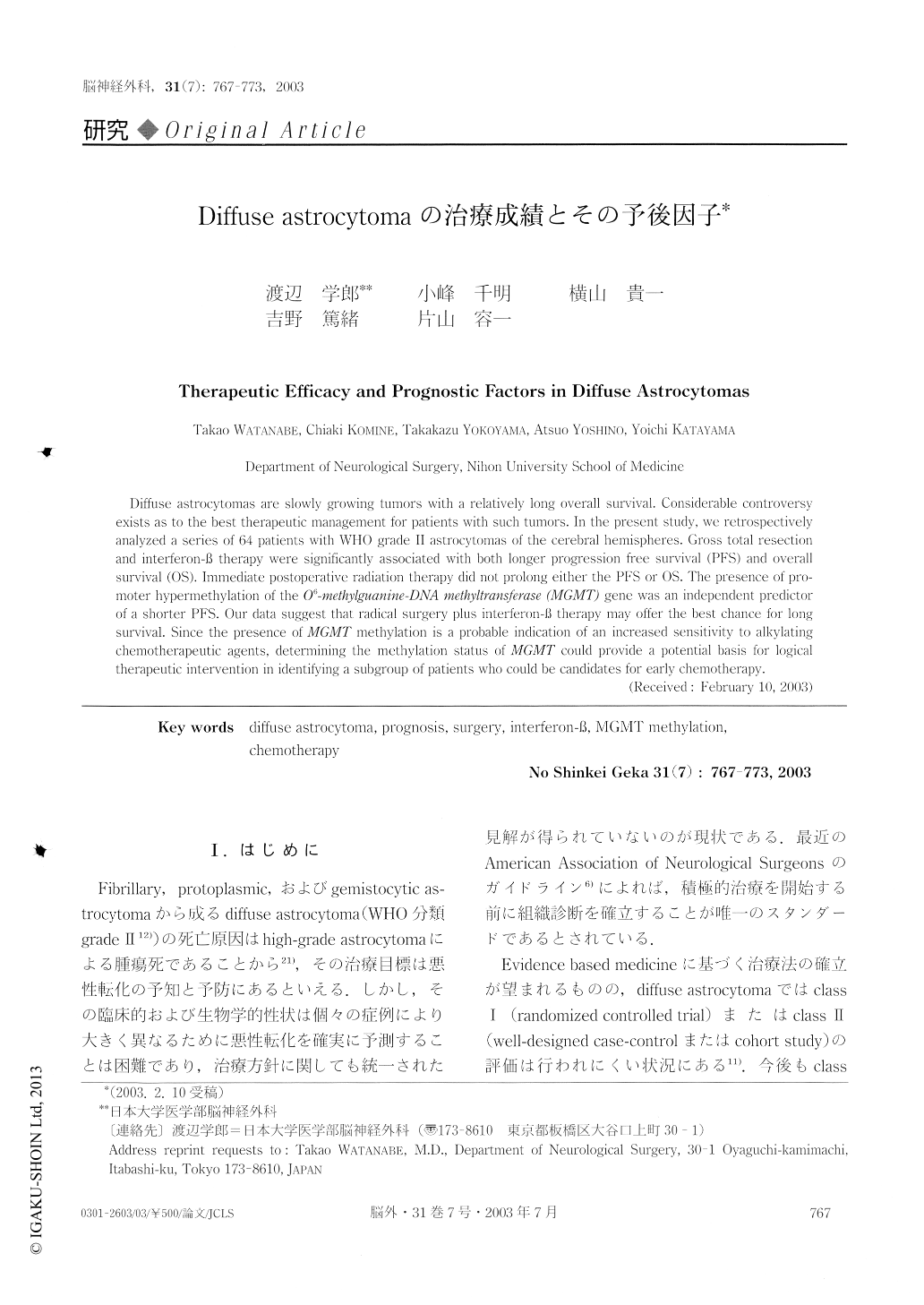
Ⅰ.はじめに
Fibrillary,protoplasmic,およびgemistocytic as-trocytomaから成るdiffuse astrocytoma(WHO分類grade Ⅱ12))の死亡原因はhigh-grade astrocytomaによる腫瘍死であることから21),その治療目標は悪性転化の予知と予防にあるといえる.しかし,その臨床的および生物学的性状は個々の症例により大きく異なるために悪性転化を確実に予測することは困難であり,治療方針に関しても統一された見解が得られていないのが現状である.最近のAmerican Association of Neurological Surgeonsのガイドライン6)によれば,積極的治療を開始する前に組織診断を確立することが唯一のスタンダードであるとされている.
Evidencc based medicineに基づく治療法の確立が望まれるものの,diffuse astrocytomaではclassⅠ(randomized controlled trial)またはclass Ⅱ(well-designed case-controlまたはcohort study)の評価は行われにくい状況にある11).今後もclassⅢ(retrospective study)evidenceを積み重ねていくことが治療方針を確立するうえで重要な意義を持つものと考えられる.
Diffuse astrocvtomas are slowly growing tumors with a relatively long overall survival. Considerable controversy exists as to the best therapeutic management for patients with such tumors. In the present study. we retrospectively analyzed a series of 64 patients with WHO grade II astrocytomas of the cerebral hemispheres. Gross total resection and interferon-β therapy were significantly associated with both longer progression free survival (PFS) and overall survival (OS). Immediate postoperative radiation therapy did not prolong either the PFS or OS.
Copyright © 2003, Igaku-Shoin Ltd. All rights reserved.