Japanese
English
- 有料閲覧
PPV購入案内
1,320円 (1,200円+税10%) こちらは、735ページから741ページの文献です。購入には医書.jp本会員登録が必要です。
会員登録完了後に改めて上記「購入サイトへ」を選択してください。
または「購入サイトへ」選択後に「購入ログイン」、「新規会員登録」の順に進んでください。
会員登録について詳しくはをご確認ください。
- Abstract 文献概要
- 1ページ目 Look Inside
I.はじめに
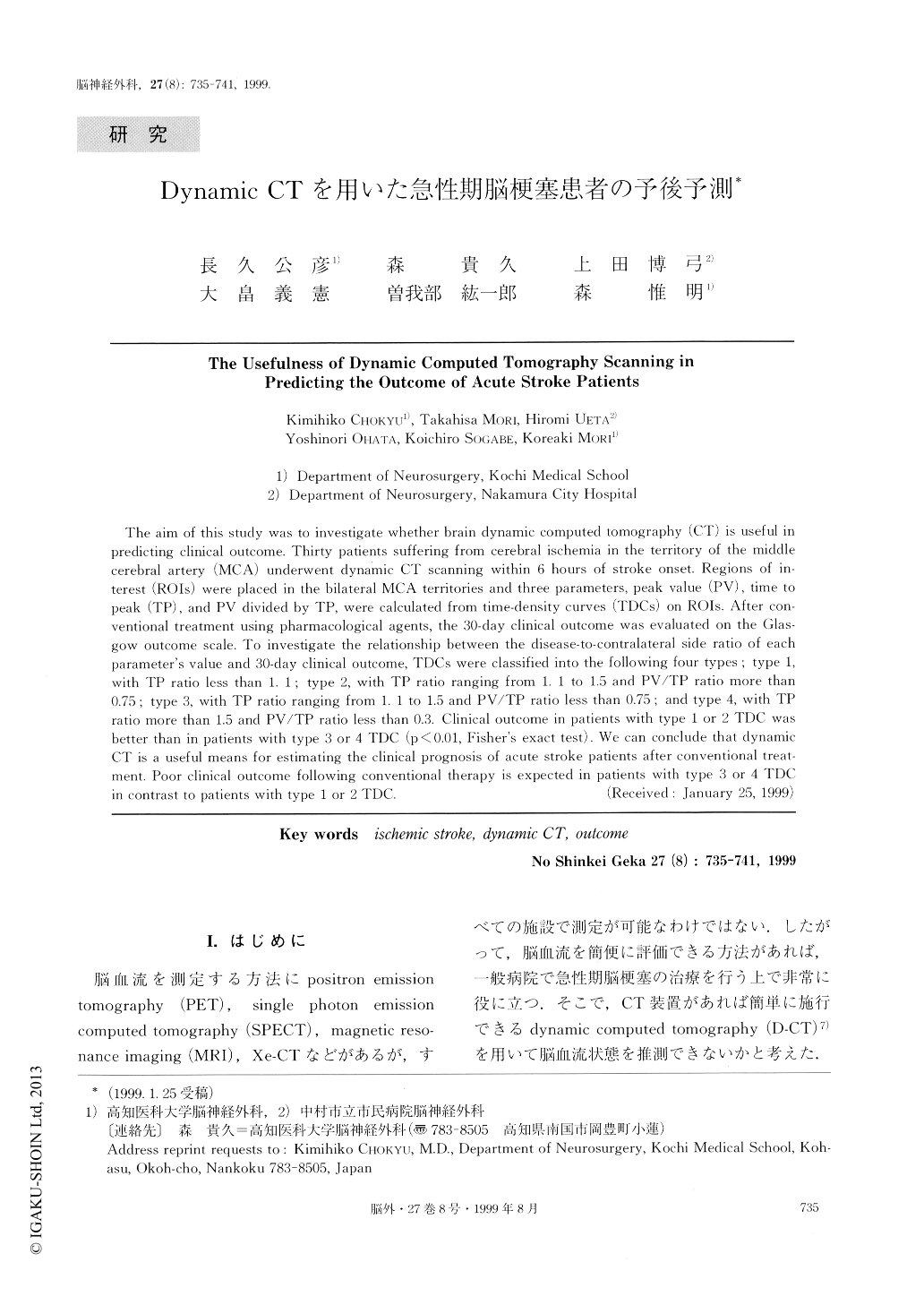
脳血流を測定する方法にpositron emissiontomography(PET),single photon emissioncomputed tomography(SPECT),magnetic reso-nance imaging(MRI),Xe-CTなどがあるが,すべての施設で測定が可能なわけではない.したがって,脳血流を簡便に評価できる方法があれば,一般病院で急性期脳梗塞の治療を行う上で非常に役に立つ.そこで,CT装置があれば簡単に施行できるdynamic computed tomography(D-CT)7)を用いて脳血流状態を推測できないかと考えた.CTで大きな低吸収域がまだ出現していない急性期脳梗塞患者に対してD-CTを施行し,その時間濃度曲線(time-density-curve:TDC)の特徴と予後との関係を調べることで,来院時TDCから予後を予測できないか検討した.
The aim of this study was to investigate whether brain dynamic computed tomography (CT) is useful inpredicting clinical outcome. Thirty patients suffering from cerebral ischemia in the territory of the middlecerebral artery (MCA) underwent dynamic CT scanning within 6 hours of stroke onset. Regions of in-terest (ROIs) were placed in the bilateral MCA territories and three parameters, peak value (PV), time topeak (TP), and PV divided by TP, were calculated from time-density curves (TDCs) on ROIs. After con-ventional treatment using pharmacological agents, the 30-day clinical outcome was evaluated on the Glas-gow outcome scale. To investigate the relationship between the disease-to-contralateral side ratio of eachparameter's value and 30-day clinical outcome, TDCs were classified into the following four types ; type 1,with TP ratio less than 1. 1 ; type 2, with TP ratio ranging from 1. 1 to 1.5 and PV/TP ratio more than0.75 ; type 3, with TP ratio ranging from 1. 1 to 1.5 and PV/TP ratio less than 0.75 ; and type 4, with TPratio more than 1.5 and PV/TP ratio less than 0.3. Clinical outcome in patients with type 1 or 2 TDC wasbetter than in patients with type 3 or 4 TDC (p< 0.01, Fisher's exact test). We can conclude that dynamicCT is a useful means for estimating the clinical prognosis of acute stroke patients after conventional treat-ment. Poor clinical outcome following conventional therapy is expected in patients with type 3 or 4 TDCin contrast to patients with type 1 or 2 TDC.
Copyright © 1999, Igaku-Shoin Ltd. All rights reserved.