Japanese
English
- 有料閲覧
PPV購入案内
1,320円 (1,200円+税10%) こちらは、417ページから422ページの文献です。購入には医書.jp本会員登録が必要です。
会員登録完了後に改めて上記「購入サイトへ」を選択してください。
または「購入サイトへ」選択後に「購入ログイン」、「新規会員登録」の順に進んでください。
会員登録について詳しくはをご確認ください。
- Abstract 文献概要
- 1ページ目 Look Inside
I.はじめに
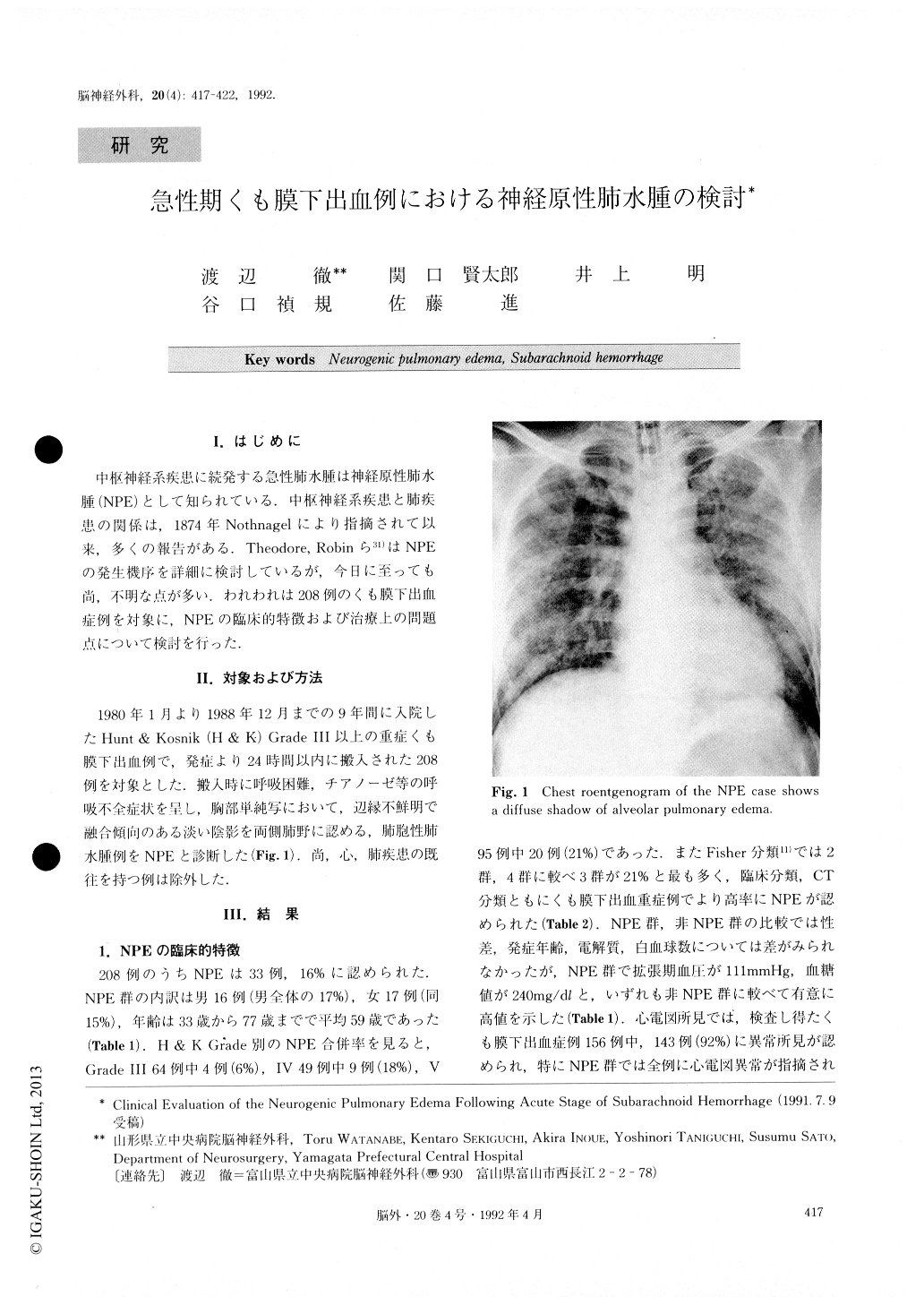
中枢神経系疾患に続発する急性肺水腫は神経原性肺水腫(NPE)として知られている.中枢神経系疾患と肺疾患の関係は,1874年Nothnage1により指摘されて以来,多くの報告がある.Theodore, Robinら31)はNPEの発生機序を詳細に検討しているが,今日に至っても尚,不明な点が多い.われわれは208例のくも膜下出血症例を対象に,NPEの臨床的特徴および治療上の問題点について検討を行った.
Clinical characteristics and therapeutic problems of neurogenic pulmonary edema (NPE) occurring in the acute stage of severe subarachnoid hemorrhage (SAH) were examined. The relationship between SAH and NPE was studied in 208 patients who arrived at the hospital in the acute stage (within 24 hours after the onset) of severe SAH in the past nine years. NPE was observed in four (6%) of 64 Grade III patients, nine (18%) of 49 Grade IV patients and 20 (21%) of 95 Grade V patients. Higher grade patients tended to be complicated by NPE more frequently. CT findings of these 33 patients with NPE belonged to Fisher's Group 3 or 4 (23 of 110 group-3 patients and 10 of 88 group-4 patients). Concerning ECG abnormalities, depression of ST segment, abnormal T waves, sinus tachycardia, and right bundle-branch block were observed more fre-quently in the NPE group than in the non-NPE group. In comparison of the age, blood pressure, PaO2, serum electrolyte, WBC, and blood sugar level on admission between the two groups, significantly higher values of diastolic pressure and blood sugar levels were shown in the NPE group than non-NPE group. The mean inter-val between the onset of SAH and the diagnosis of NPE on chest film was 2.5 hours, while the NPE find-ings disappeared within three days after the onset of SAH (mean 1.2 clays). In all cases, the NPE, findings disappeared after a variety of respiratory managements had been carried out. In three of 17 patients in whom NPE findings could be followed up to the time of its disappearance, oxygen was administered by face mask in a high concentration. Oxygen was also administered through endotracheal tube to two of the patients. Ven-tilatory support with positive end-expiratory pressure (PEEP) was required in three. In the other nine pa-tients, a ventilator had been used under general anes-thesia during operations on aneurysms on the clay of admission. Direct operations of the ruptured aneurysms were carried out in all Grade III and Grade IV patients in the acute stage, and the results were excellent or good in seven (54%), fair in one (8%), but death occur-red in five (38%). All Grade V patients died. However, in none of the cases was NPE considered to be the direct cause of death. We concluded that in cases of ruptured aneurysm with NPE as a complication, aneurysm surgery can be performed in the acute stage if an appropriate respiratory management is main-tained. This is because NPE is treatable and has no ma-ior prognostic effect.
Copyright © 1992, Igaku-Shoin Ltd. All rights reserved.