Japanese
English
- 有料閲覧
PPV購入案内
1,320円 (1,200円+税10%) こちらは、1187ページから1196ページの文献です。購入には医書.jp本会員登録が必要です。
会員登録完了後に改めて上記「購入サイトへ」を選択してください。
または「購入サイトへ」選択後に「購入ログイン」、「新規会員登録」の順に進んでください。
会員登録について詳しくはをご確認ください。
- Abstract 文献概要
- 1ページ目 Look Inside
- 参考文献 Reference
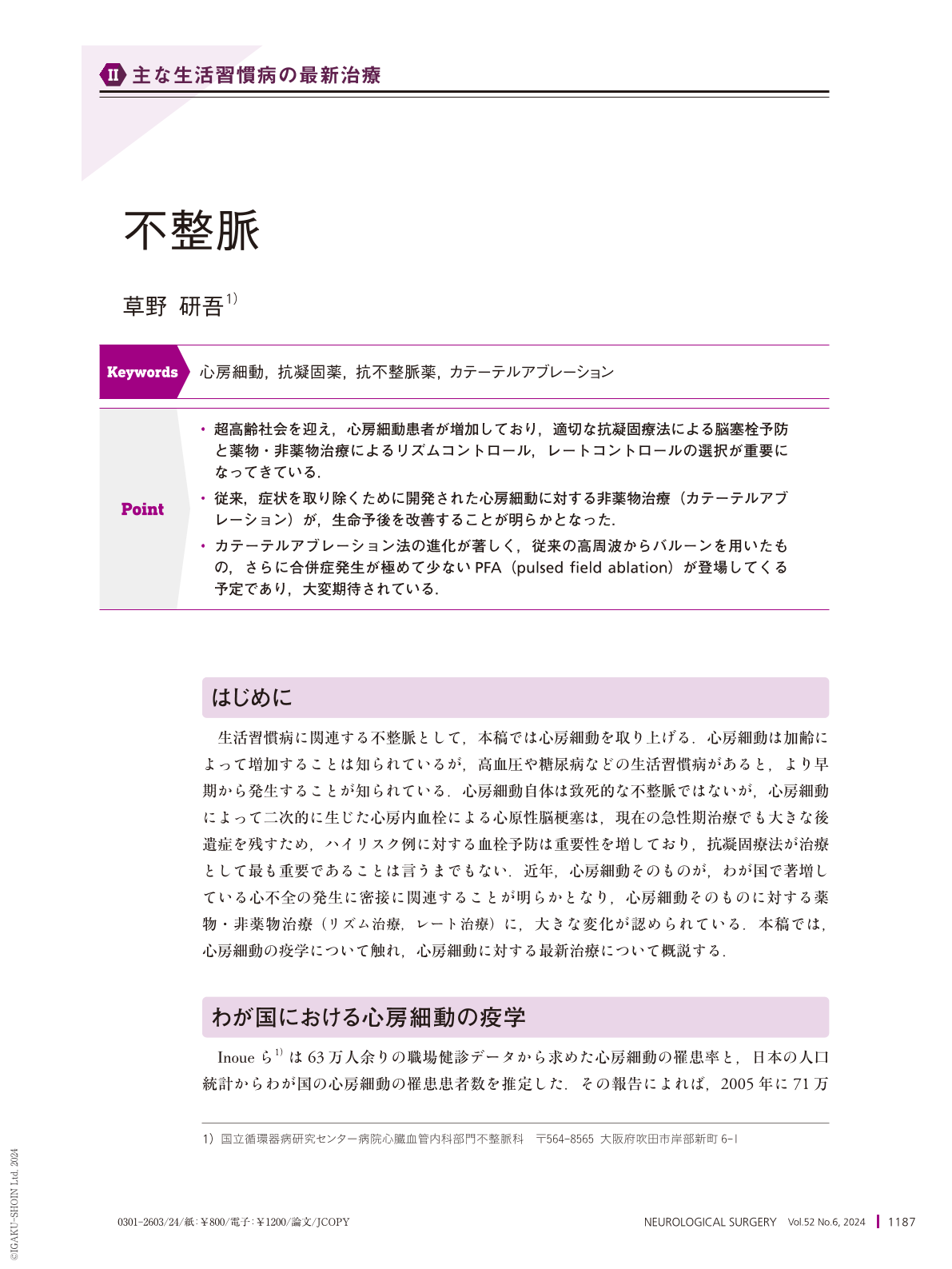
Point
・超高齢社会を迎え,心房細動患者が増加しており,適切な抗凝固療法による脳塞栓予防と薬物・非薬物治療によるリズムコントロール,レートコントロールの選択が重要になってきている.
・従来,症状を取り除くために開発された心房細動に対する非薬物治療(カテーテルアブレーション)が,生命予後を改善することが明らかとなった.
・カテーテルアブレーション法の進化が著しく,従来の高周波からバルーンを用いたもの,さらに合併症発生が極めて少ないPFA(pulsed field ablation)が登場してくる予定であり,大変期待されている.
The basic principles of atrial fibrillation(AF)treatment are stroke prevention with appropriate anticoagulation, rhythm and rate control with drugs, and non-pharmacological therapy.
The current guidelines have been presented. Non-pharmacological treatment(catheter ablation)for AF, originally developed to eliminate motivational symptoms, has been shown to improve life outcomes, and indications for ablation are expanding rapidly.
Catheter ablation has evolved remarkably from conventional radiofrequency to balloon ablation. Minimal complications are expected to occur with pulsed-field ablation. Ablation strategies for paroxysmal AF are almost established and approaches for persistent AF are becoming increasingly important.
Surgical approaches have also evolved significantly, with robotic surgery, the thoracoscopic Wolf-Ohtsuka procedure, and minimally invasive cardiac surgery, becoming less invasive. Future studies should prioritize a system for better function and treatment options for the heart team.
Copyright © 2024, Igaku-Shoin Ltd. All rights reserved.