Japanese
English
- 有料閲覧
PPV購入案内
1,320円 (1,200円+税10%) こちらは、994ページから999ページの文献です。購入には医書.jp本会員登録が必要です。
会員登録完了後に改めて上記「購入サイトへ」を選択してください。
または「購入サイトへ」選択後に「購入ログイン」、「新規会員登録」の順に進んでください。
会員登録について詳しくはをご確認ください。
- Abstract 文献概要
- 1ページ目 Look Inside
- 参考文献 Reference
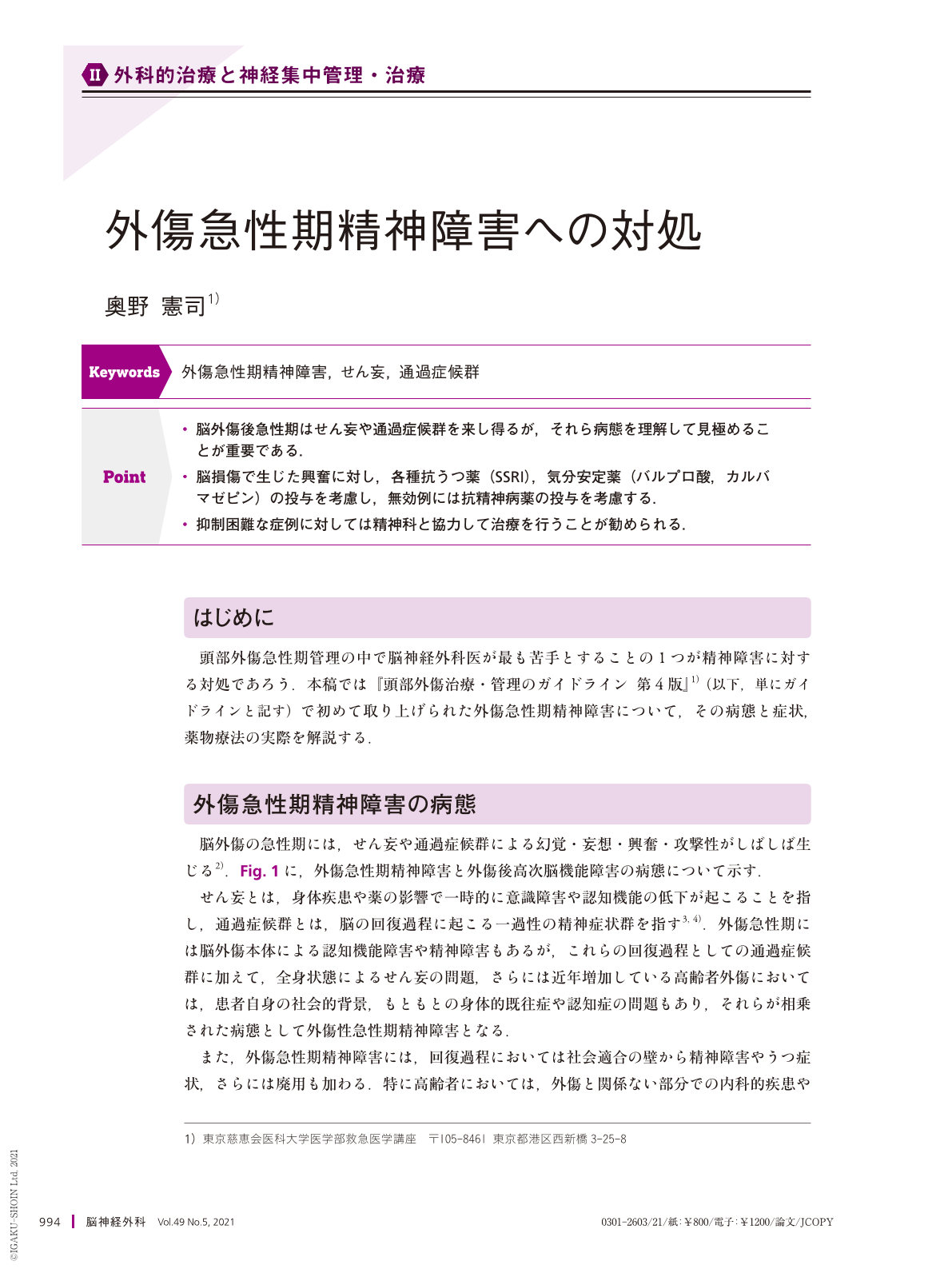
Point
・脳外傷後急性期はせん妄や通過症候群を来し得るが,それら病態を理解して見極めることが重要である.
・脳損傷で生じた興奮に対し,各種抗うつ薬(SSRI),気分安定薬(バルプロ酸,カルバマゼピン)の投与を考慮し,無効例には抗精神病薬の投与を考慮する.
・抑制困難な症例に対しては精神科と協力して治療を行うことが勧められる.
During the acute phase of brain trauma, hallucinations, delusions, agitation, and aggression due to delirium and transit syndrome are common. Transit syndrome due to brain trauma is not treated, instead clinicians simply wait for it to pass, whereas delirium is a pathological condition that can be dealt with by stabilizing the general condition, and it is therefore important to identify.
After brain trauma, transit syndrome may occur during the acute to subacute phase when consciousness disorder improves. If the patient is difficult to control, it is recommended that treatment be performed in cooperation with a psychiatrist.
For agitation caused by brain trauma, administration of mood stabilizers(valproic acid, carbamazepine)and Chinese herbs(yokukansan)may be considered. For depressive symptoms, anxiety, impulsivity, irritability, etc., administration of SSRI as an antidepressant may be considered. Antipsychotics may be considered if antidepressants or mood stabilizers are ineffective against agitation, or if the patient experiences schizophrenia-like symptoms such as delusions.
Copyright © 2021, Igaku-Shoin Ltd. All rights reserved.