Japanese
English
- 有料閲覧
PPV購入案内
1,320円 (1,200円+税10%) こちらは、823ページから834ページの文献です。購入には医書.jp本会員登録が必要です。
会員登録完了後に改めて上記「購入サイトへ」を選択してください。
または「購入サイトへ」選択後に「購入ログイン」、「新規会員登録」の順に進んでください。
会員登録について詳しくはをご確認ください。
- Abstract 文献概要
- 1ページ目 Look Inside
- 参考文献 Reference
Ⅰ.はじめに
従来,虚血型のもやもや病に対する血行再建術の意義は確立されていたが,出血型における再出血予防効果に関しては意見が分かれており,長年議論の的になっていた.近年,Japan Adult Moyamoya(JAM)Trial12)の結果から出血型の成人もやもや病に対しても直接血行再建術の有用性が立証され,成人もやもや病に対する直接血行再建術の意義は高まっている.しかしながら,出血型・虚血型のいずれでも,血行再建術後長期間を経過してから出血を来す症例が問題となっている10,11,13,15).JAM Trialは研究登録後5年の検討であり,その他の文献でも血行再建術後の長期経過についての報告は少ないのが現状である.今回われわれは,血行再建術後5年以上経過した成人もやもや病患者の長期予後について検討を行い,術後経過観察中の遅発性出血に関与する因子について報告する.
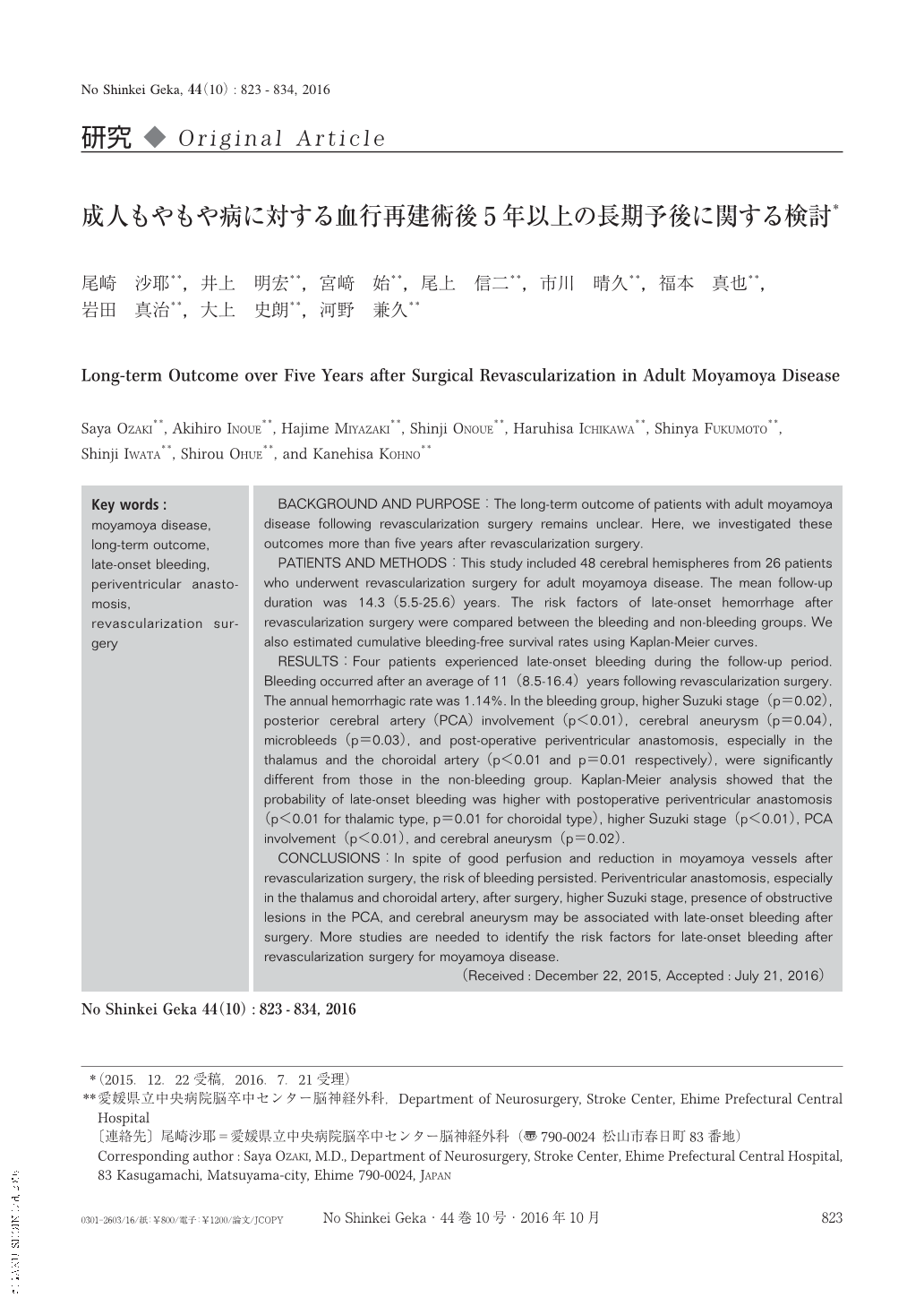
BACKGROUND AND PURPOSE:The long-term outcome of patients with adult moyamoya disease following revascularization surgery remains unclear. Here, we investigated these outcomes more than five years after revascularization surgery.
PATIENTS AND METHODS:This study included 48 cerebral hemispheres from 26 patients who underwent revascularization surgery for adult moyamoya disease. The mean follow-up duration was 14.3(5.5-25.6)years. The risk factors of late-onset hemorrhage after revascularization surgery were compared between the bleeding and non-bleeding groups. We also estimated cumulative bleeding-free survival rates using Kaplan-Meier curves.
RESULTS:Four patients experienced late-onset bleeding during the follow-up period. Bleeding occurred after an average of 11(8.5-16.4)years following revascularization surgery. The annual hemorrhagic rate was 1.14%. In the bleeding group, higher Suzuki stage(p=0.02), posterior cerebral artery(PCA)involvement(p<0.01), cerebral aneurysm(p=0.04), microbleeds(p=0.03), and post-operative periventricular anastomosis, especially in the thalamus and the choroidal artery(p<0.01 and p=0.01 respectively), were significantly different from those in the non-bleeding group. Kaplan-Meier analysis showed that the probability of late-onset bleeding was higher with postoperative periventricular anastomosis(p<0.01 for thalamic type, p=0.01 for choroidal type), higher Suzuki stage(p<0.01), PCA involvement(p<0.01), and cerebral aneurysm(p=0.02).
CONCLUSIONS:In spite of good perfusion and reduction in moyamoya vessels after revascularization surgery, the risk of bleeding persisted. Periventricular anastomosis, especially in the thalamus and choroidal artery, after surgery, higher Suzuki stage, presence of obstructive lesions in the PCA, and cerebral aneurysm may be associated with late-onset bleeding after surgery. More studies are needed to identify the risk factors for late-onset bleeding after revascularization surgery for moyamoya disease.
Copyright © 2016, Igaku-Shoin Ltd. All rights reserved.