Japanese
English
- 有料閲覧
PPV購入案内
1,320円 (1,200円+税10%) こちらは、985ページから989ページの文献です。購入には医書.jp本会員登録が必要です。
会員登録完了後に改めて上記「購入サイトへ」を選択してください。
または「購入サイトへ」選択後に「購入ログイン」、「新規会員登録」の順に進んでください。
会員登録について詳しくはをご確認ください。
- Abstract 文献概要
- 1ページ目 Look Inside
- 参考文献 Reference
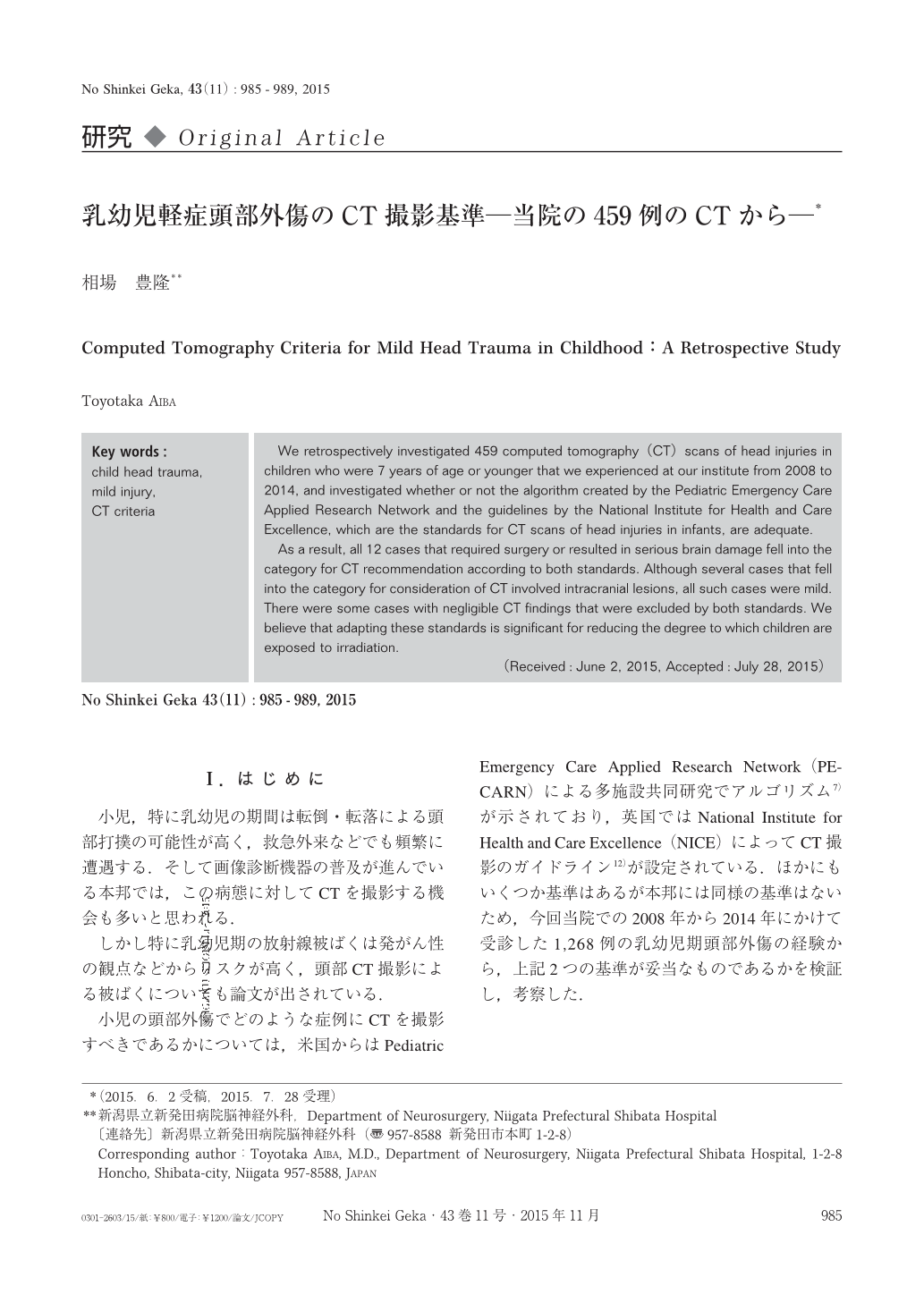
Ⅰ.はじめに
小児,特に乳幼児の期間は転倒・転落による頭部打撲の可能性が高く,救急外来などでも頻繁に遭遇する.そして画像診断機器の普及が進んでいる本邦では,この病態に対してCTを撮影する機会も多いと思われる.
しかし特に乳幼児期の放射線被ばくは発がん性の観点などからリスクが高く,頭部CT撮影による被ばくについても論文が出されている.
小児の頭部外傷でどのような症例にCTを撮影すべきであるかについては,米国からはPediatric Emergency Care Applied Research Network(PECARN)による多施設共同研究でアルゴリズム7)が示されており,英国ではNational Institute for Health and Care Excellence(NICE)によってCT撮影のガイドライン12)が設定されている.ほかにもいくつか基準はあるが本邦には同様の基準はないため,今回当院での2008年から2014年にかけて受診した1,268例の乳幼児期頭部外傷の経験から,上記2つの基準が妥当なものであるかを検証し,考察した.
We retrospectively investigated 459 computed tomography(CT)scans of head injuries in children who were 7 years of age or younger that we experienced at our institute from 2008 to 2014, and investigated whether or not the algorithm created by the Pediatric Emergency Care Applied Research Network and the guidelines by the National Institute for Health and Care Excellence, which are the standards for CT scans of head injuries in infants, are adequate.
As a result, all 12 cases that required surgery or resulted in serious brain damage fell into the category for CT recommendation according to both standards. Although several cases that fell into the category for consideration of CT involved intracranial lesions, all such cases were mild. There were some cases with negligible CT findings that were excluded by both standards. We believe that adapting these standards is significant for reducing the degree to which children are exposed to irradiation.
Copyright © 2015, Igaku-Shoin Ltd. All rights reserved.