Japanese
English
- 有料閲覧
PPV購入案内
1,320円 (1,200円+税10%) こちらは、527ページから532ページの文献です。購入には医書.jp本会員登録が必要です。
会員登録完了後に改めて上記「購入サイトへ」を選択してください。
または「購入サイトへ」選択後に「購入ログイン」、「新規会員登録」の順に進んでください。
会員登録について詳しくはをご確認ください。
- Abstract 文献概要
- 1ページ目 Look Inside
- 参考文献 Reference
Ⅰ.はじめに
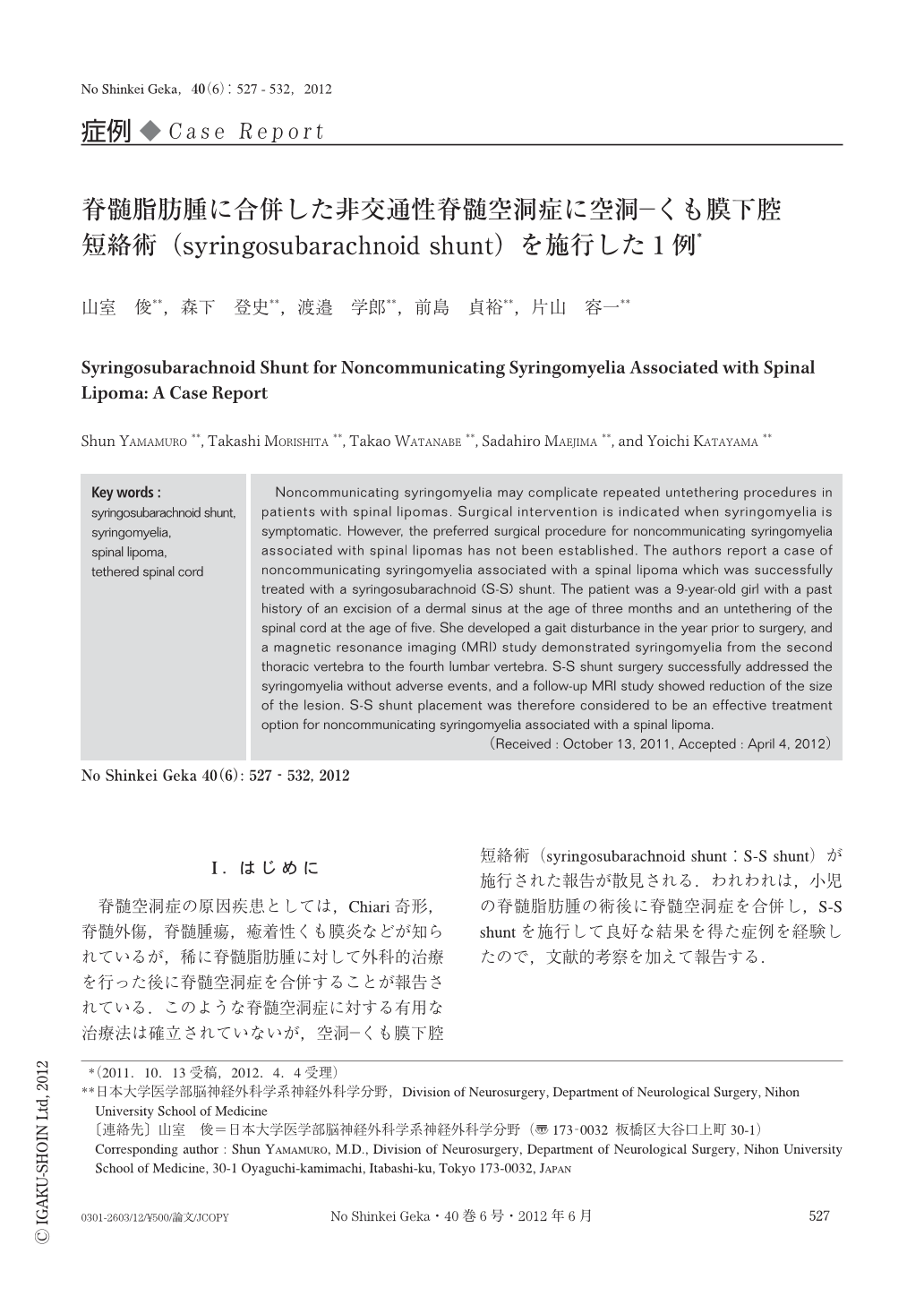
脊髄空洞症の原因疾患としては,Chiari奇形,脊髄外傷,脊髄腫瘍,癒着性くも膜炎などが知られているが,稀に脊髄脂肪腫に対して外科的治療を行った後に脊髄空洞症を合併することが報告されている.このような脊髄空洞症に対する有用な治療法は確立されていないが,空洞─くも膜下腔短絡術(syringosubarachnoid shunt:S-S shunt)が施行された報告が散見される.われわれは,小児の脊髄脂肪腫の術後に脊髄空洞症を合併し,S-S shuntを施行して良好な結果を得た症例を経験したので,文献的考察を加えて報告する.
Noncommunicating syringomyelia may complicate repeated untethering procedures in patients with spinal lipomas. Surgical intervention is indicated when syringomyelia is symptomatic. However,the preferred surgical procedure for noncommunicating syringomyelia associated with spinal lipomas has not been established. The authors report a case of noncommunicating syringomyelia associated with a spinal lipoma which was successfully treated with a syringosubarachnoid (S-S) shunt. The patient was a 9-year-old girl with a past history of an excision of a dermal sinus at the age of three months and an untethering of the spinal cord at the age of five. She developed a gait disturbance in the year prior to surgery,and a magnetic resonance imaging (MRI) study demonstrated syringomyelia from the second thoracic vertebra to the fourth lumbar vertebra. S-S shunt surgery successfully addressed the syringomyelia without adverse events,and a follow-up MRI study showed reduction of the size of the lesion. S-S shunt placement was therefore considered to be an effective treatment option for noncommunicating syringomyelia associated with a spinal lipoma.
Copyright © 2012, Igaku-Shoin Ltd. All rights reserved.