Japanese
English
- 有料閲覧
PPV購入案内
1,320円 (1,200円+税10%) こちらは、1031ページから1045ページの文献です。購入には医書.jp本会員登録が必要です。
会員登録完了後に改めて上記「購入サイトへ」を選択してください。
または「購入サイトへ」選択後に「購入ログイン」、「新規会員登録」の順に進んでください。
会員登録について詳しくはをご確認ください。
- Abstract 文献概要
- 1ページ目 Look Inside
- 参考文献 Reference
Ⅰ.はじめに
前回はpositioning,instrumentsがテーマであった.今回は別の予定があったが急拠,予定を変更してapproachについてである.このテーマに変更するきっかけとなった手術がこの間にいくつかあった.1つは,craniopharyngiomaの再発でtrans-rostrum corporis callosi-lamina terminalis approach(TRCLA),さらにはglossopharyngeal neuralgiaに対するtrans-vertebralis dural ring approach(TVDRA)である.そして,dominat hemisphere hippocampus headに対応するgyrus papahippocampalisに位置するcavenous angiomaに対してselective amygdalohippocampectomy approach(SAHEA)ではなくsupracerebellar transtentorial approach(SCTTA)を用いたりした.P2 segmentの動脈瘤をSAHEAで,すなわちabpreparieren剝離したが,dissection aneurysmであるための術中破裂でaneurysmorrhaphyを行わざるを得ず合併症に遭遇した.SCTTAで動脈瘤にapproachしていればそれが防げたのではないかと思った.このようにapproachについて改めて考えざるを得ない状況に多く遭遇したので,思いの褪せないうちに,書きとどめてご参考にしていただければと思った.
Approachといえば,私の定年退官記念シンポジウムの時に,かつて1970年代にZürich大学脳神経外科で一緒に修練したTübingen大学神経病理のMeyermann教授が参加,講演してくれた.彼には,当時,腰椎椎間板ヘルニアの手術の手ほどきをしたのだが,その後,彼は神経病理学に転進した関係上,私の得手とする分野,新しく開拓した手技などがわからなくなっていた.私の定年前の科のスタッフに聞き合わせて,種々のapproachの開拓もその分野に入るとわかったらしい.そのシンポジウムでは脳神経外科領域でのapproachへの私の寄与について言及してくれた.その基本的なことは,本誌でも,Zürich大学脳神経外科の現状ということで,当時のactivityとともに紹介した26).
種々のapproachに,多少自分の考えが固まってきたのが2000年を過ぎてからである.これらについては,チェコ・スロバキア合同の脳神経外科continuing education(これがこのシリーズ執筆のきっかけとなった),京都の日本脳神経外科学会(第65回,橋本信夫会長,2006年)などで,日常頻用するapproachに関して留意点,問題点をまとめて講演する機会があった.
本稿はそれ以後も,工夫し実施してきたもので,過日,「京都─Zürich脳神経外科セミナー(主宰:塚原徹也 京都医療センター脳神経外科部長)」で述べたものに準じて,SEAC,TVDRAにプラスして応用範囲の多いTSCIAを加えて述べることにする.
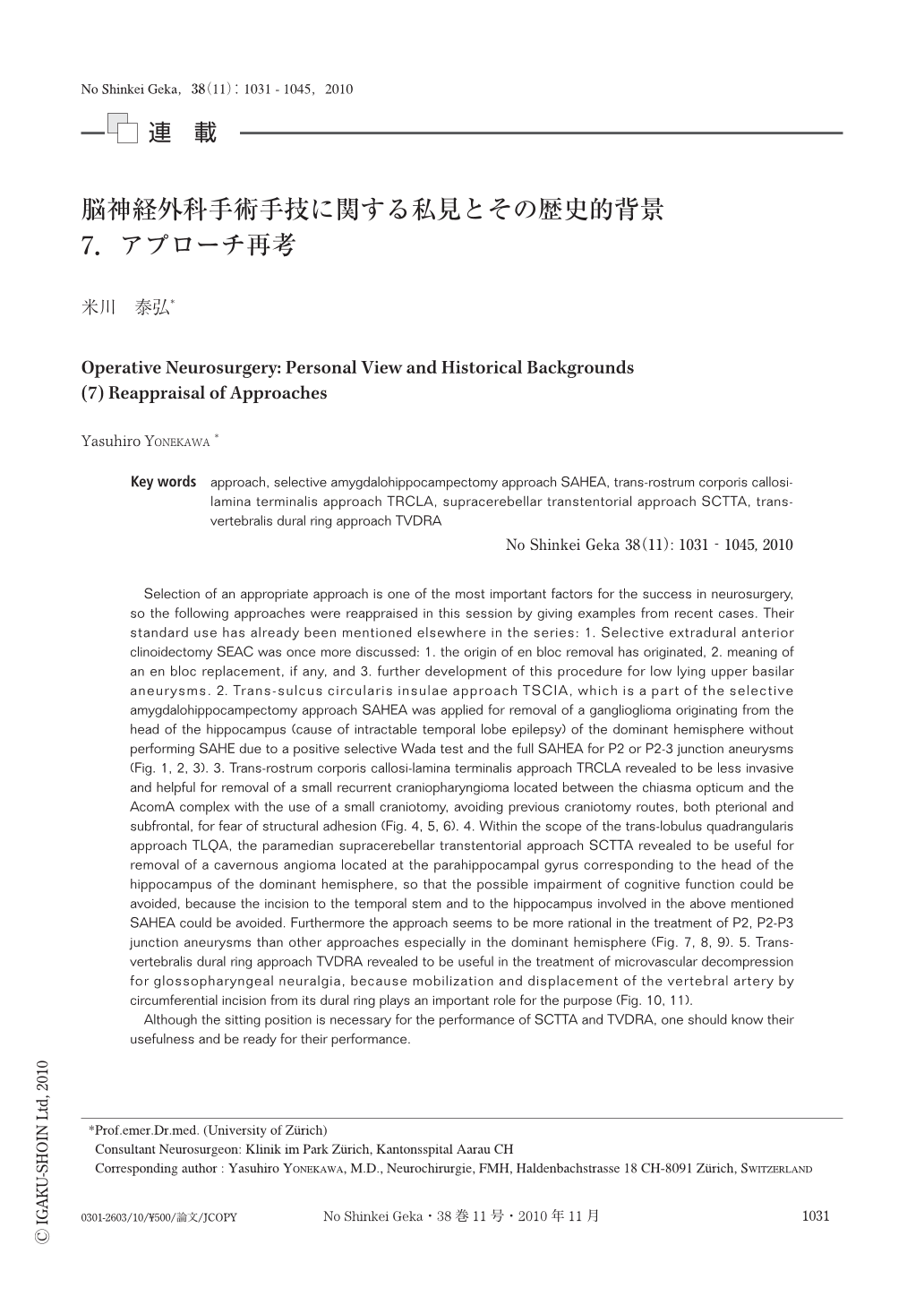
Selection of an appropriate approach is one of the most important factors for the success in neurosurgery, so the following approaches were reappraised in this session by giving examples from recent cases. Their standard use has already been mentioned elsewhere in the series: 1. Selective extradural anterior clinoidectomy SEAC was once more discussed: 1. the origin of en bloc removal has originated, 2. meaning of an en bloc replacement, if any, and 3. further development of this procedure for low lying upper basilar aneurysms. 2. Trans-sulcus circularis insulae approach TSCIA, which is a part of the selective amygdalohippocampectomy approach SAHEA was applied for removal of a ganglioglioma originating from the head of the hippocampus (cause of intractable temporal lobe epilepsy) of the dominant hemisphere without performing SAHE due to a positive selective Wada test and the full SAHEA for P2 or P2-3 junction aneurysms (Fig. 1, 2, 3). 3. Trans-rostrum corporis callosi-lamina terminalis approach TRCLA revealed to be less invasive and helpful for removal of a small recurrent craniopharyngioma located between the chiasma opticum and the AcomA complex with the use of a small craniotomy, avoiding previous craniotomy routes, both pterional and subfrontal, for fear of structural adhesion (Fig. 4, 5, 6). 4. Within the scope of the trans-lobulus quadrangularis approach TLQA, the paramedian supracerebellar transtentorial approach SCTTA revealed to be useful for removal of a cavernous angioma located at the parahippocampal gyrus corresponding to the head of the hippocampus of the dominant hemisphere, so that the possible impairment of cognitive function could be avoided, because the incision to the temporal stem and to the hippocampus involved in the above mentioned SAHEA could be avoided. Furthermore the approach seems to be more rational in the treatment of P2, P2-P3 junction aneurysms than other approaches especially in the dominant hemisphere (Fig. 7, 8, 9). 5. Trans-vertebralis dural ring approach TVDRA revealed to be useful in the treatment of microvascular decompression for glossopharyngeal neuralgia, because mobilization and displacement of the vertebral artery by circumferential incision from its dural ring plays an important role for the purpose (Fig. 10, 11). Although the sitting position is necessary for the performance of SCTTA and TVDRA, one should know their usefulness and be ready for their performance.
Copyright © 2010, Igaku-Shoin Ltd. All rights reserved.