Japanese
English
- 有料閲覧
PPV購入案内
1,320円 (1,200円+税10%) こちらは、409ページから416ページの文献です。購入には医書.jp本会員登録が必要です。
会員登録完了後に改めて上記「購入サイトへ」を選択してください。
または「購入サイトへ」選択後に「購入ログイン」、「新規会員登録」の順に進んでください。
会員登録について詳しくはをご確認ください。
- Abstract 文献概要
- 1ページ目 Look Inside
- 参考文献 Reference
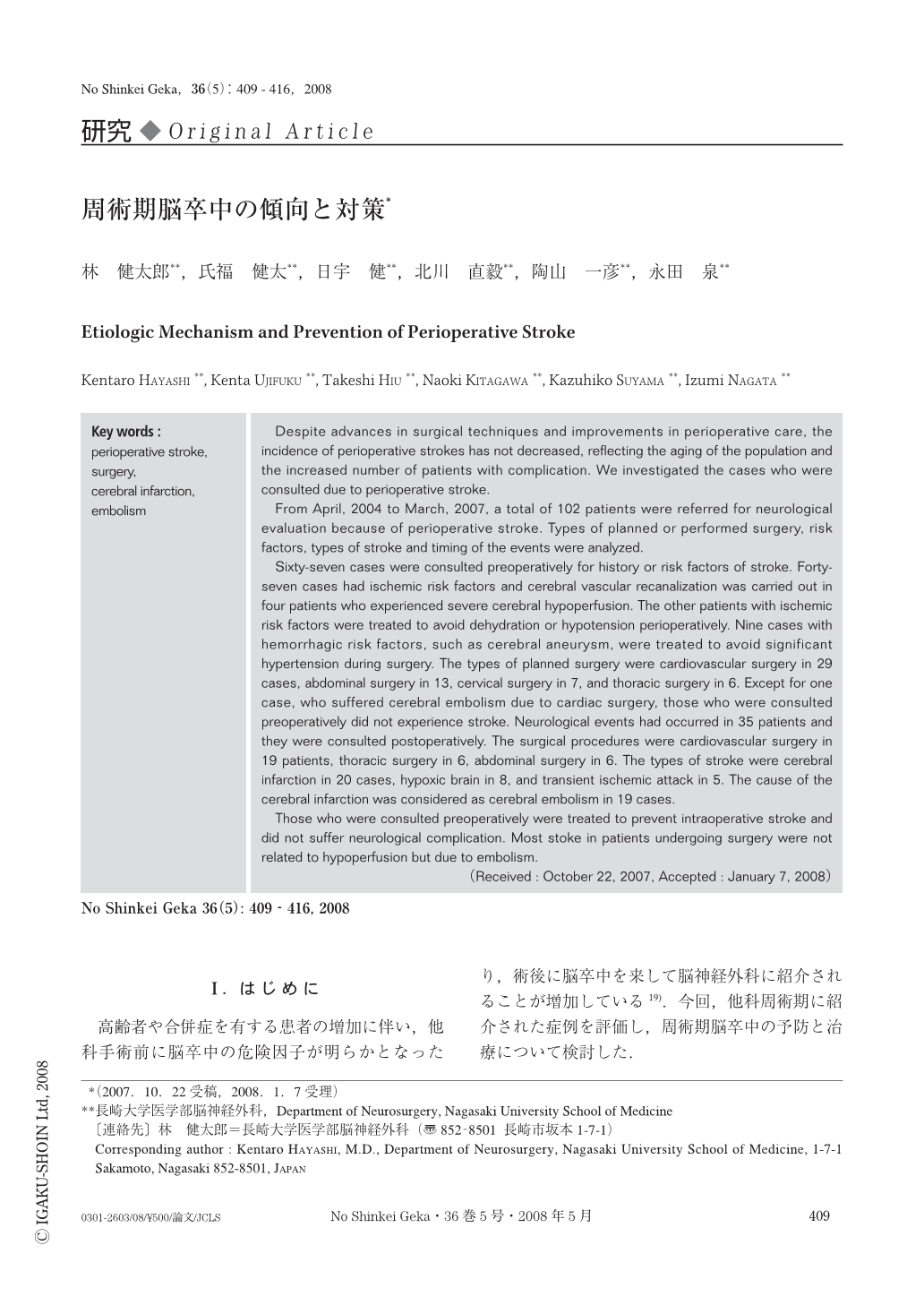
Ⅰ.はじめに
高齢者や合併症を有する患者の増加に伴い,他科手術前に脳卒中の危険因子が明らかとなったり,術後に脳卒中を来して脳神経外科に紹介されることが増加している19).今回,他科周術期に紹介された症例を評価し,周術期脳卒中の予防と治療について検討した.
Despite advances in surgical techniques and improvements in perioperative care, the incidence of perioperative strokes has not decreased, reflecting the aging of the population and the increased number of patients with complication. We investigated the cases who were consulted due to perioperative stroke.
From April, 2004 to March, 2007, a total of 102 patients were referred for neurological evaluation because of perioperative stroke. Types of planned or performed surgery, risk factors, types of stroke and timing of the events were analyzed.
Sixty-seven cases were consulted preoperatively for history or risk factors of stroke. Forty-seven cases had ischemic risk factors and cerebral vascular recanalization was carried out in four patients who experienced severe cerebral hypoperfusion. The other patients with ischemic risk factors were treated to avoid dehydration or hypotension perioperatively. Nine cases with hemorrhagic risk factors, such as cerebral aneurysm, were treated to avoid significant hypertension during surgery. The types of planned surgery were cardiovascular surgery in 29 cases, abdominal surgery in 13, cervical surgery in 7, and thoracic surgery in 6. Except for one case, who suffered cerebral embolism due to cardiac surgery, those who were consulted preoperatively did not experience stroke. Neurological events had occurred in 35 patients and they were consulted postoperatively. The surgical procedures were cardiovascular surgery in 19 patients, thoracic surgery in 6, abdominal surgery in 6. The types of stroke were cerebral infarction in 20 cases, hypoxic brain in 8, and transient ischemic attack in 5. The cause of the cerebral infarction was considered as cerebral embolism in 19 cases.
Those who were consulted preoperatively were treated to prevent intraoperative stroke and did not suffer neurological complication. Most stoke in patients undergoing surgery were not related to hypoperfusion but due to embolism.
Copyright © 2008, Igaku-Shoin Ltd. All rights reserved.