Japanese
English
- 有料閲覧
PPV購入案内
1,320円 (1,200円+税10%) こちらは、1157ページから1162ページの文献です。購入には医書.jp本会員登録が必要です。
会員登録完了後に改めて上記「購入サイトへ」を選択してください。
または「購入サイトへ」選択後に「購入ログイン」、「新規会員登録」の順に進んでください。
会員登録について詳しくはをご確認ください。
- Abstract 文献概要
- 1ページ目 Look Inside
- 参考文献 Reference
Ⅰ.はじめに
硬膜動静脈瘻(DAVF:dural arteriovenous fistula)の治療は,経静脈アプローチにて静脈洞壁にあるシャント部位とその近傍の静脈を塞栓することが第一選択とされている.今回われわれは,経静脈的アプローチが困難であった上錐体静脈洞部DAVFに対して,経動脈的塞栓術に経静脈的塞栓術を併用して良好な結果を得たので報告する.
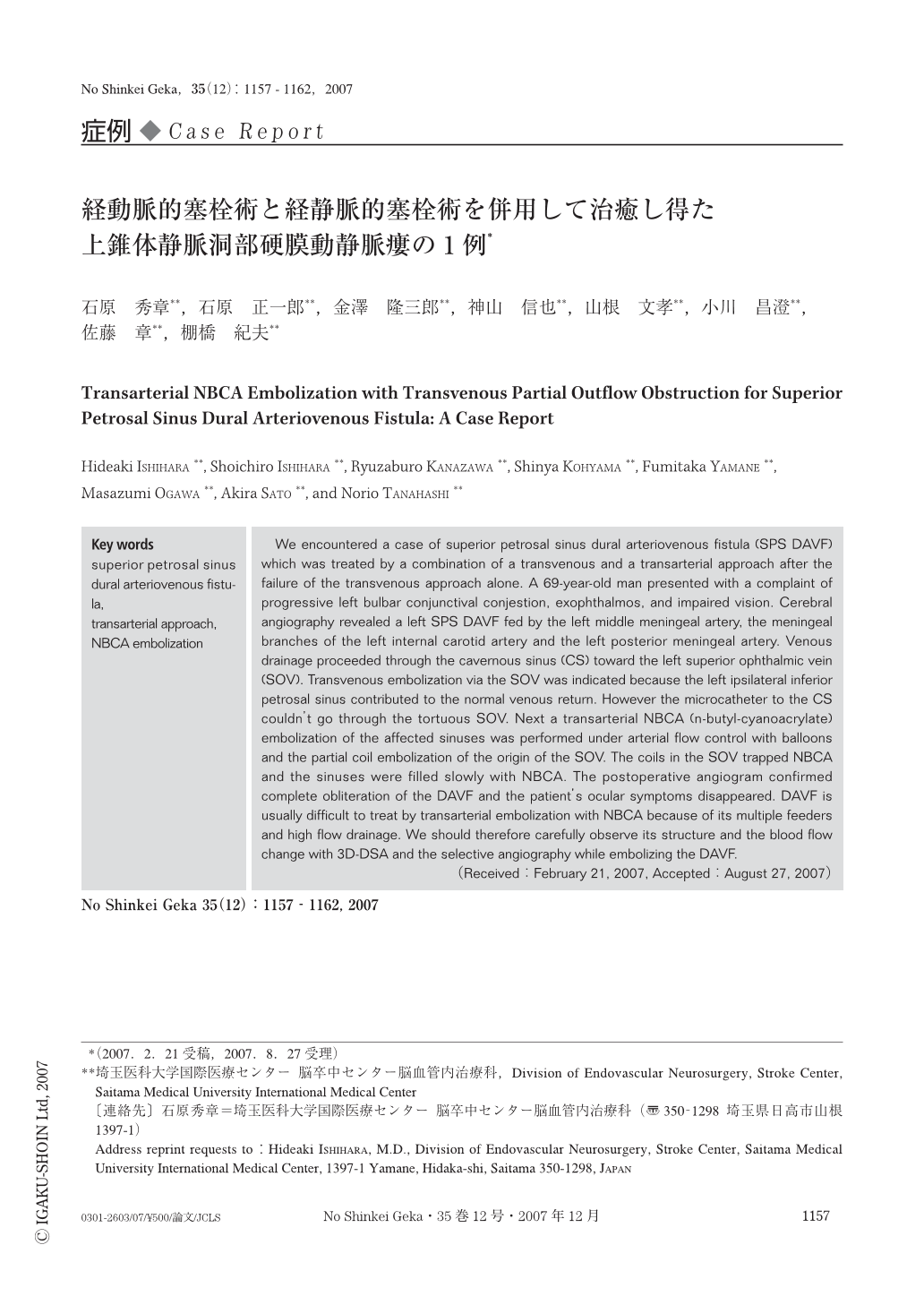
We encountered a case of superior petrosal sinus dural arteriovenous fistula (SPS DAVF) which was treated by a combination of a transvenous and a transarterial approach after the failure of the transvenous approach alone. A 69-year-old man presented with a complaint of progressive left bulbar conjunctival conjestion, exophthalmos, and impaired vision. Cerebral angiography revealed a left SPS DAVF fed by the left middle meningeal artery, the meningeal branches of the left internal carotid artery and the left posterior meningeal artery. Venous drainage proceeded through the cavernous sinus (CS) toward the left superior ophthalmic vein (SOV). Transvenous embolization via the SOV was indicated because the left ipsilateral inferior petrosal sinus contributed to the normal venous return. However the microcatheter to the CS couldn’t go through the tortuous SOV. Next a transarterial NBCA (n-butyl-cyanoacrylate) embolization of the affected sinuses was performed under arterial flow control with balloons and the partial coil embolization of the origin of the SOV. The coils in the SOV trapped NBCA and the sinuses were filled slowly with NBCA. The postoperative angiogram confirmed complete obliteration of the DAVF and the patient's ocular symptoms disappeared. DAVF is usually difficult to treat by transarterial embolization with NBCA because of its multiple feeders and high flow drainage. We should therefore carefully observe its structure and the blood flow change with 3D-DSA and the selective angiography while embolizing the DAVF.
Copyright © 2007, Igaku-Shoin Ltd. All rights reserved.