Japanese
English
- 有料閲覧
PPV購入案内
1,320円 (1,200円+税10%) こちらは、799ページから808ページの文献です。購入には医書.jp本会員登録が必要です。
会員登録完了後に改めて上記「購入サイトへ」を選択してください。
または「購入サイトへ」選択後に「購入ログイン」、「新規会員登録」の順に進んでください。
会員登録について詳しくはをご確認ください。
- Abstract 文献概要
- 1ページ目 Look Inside
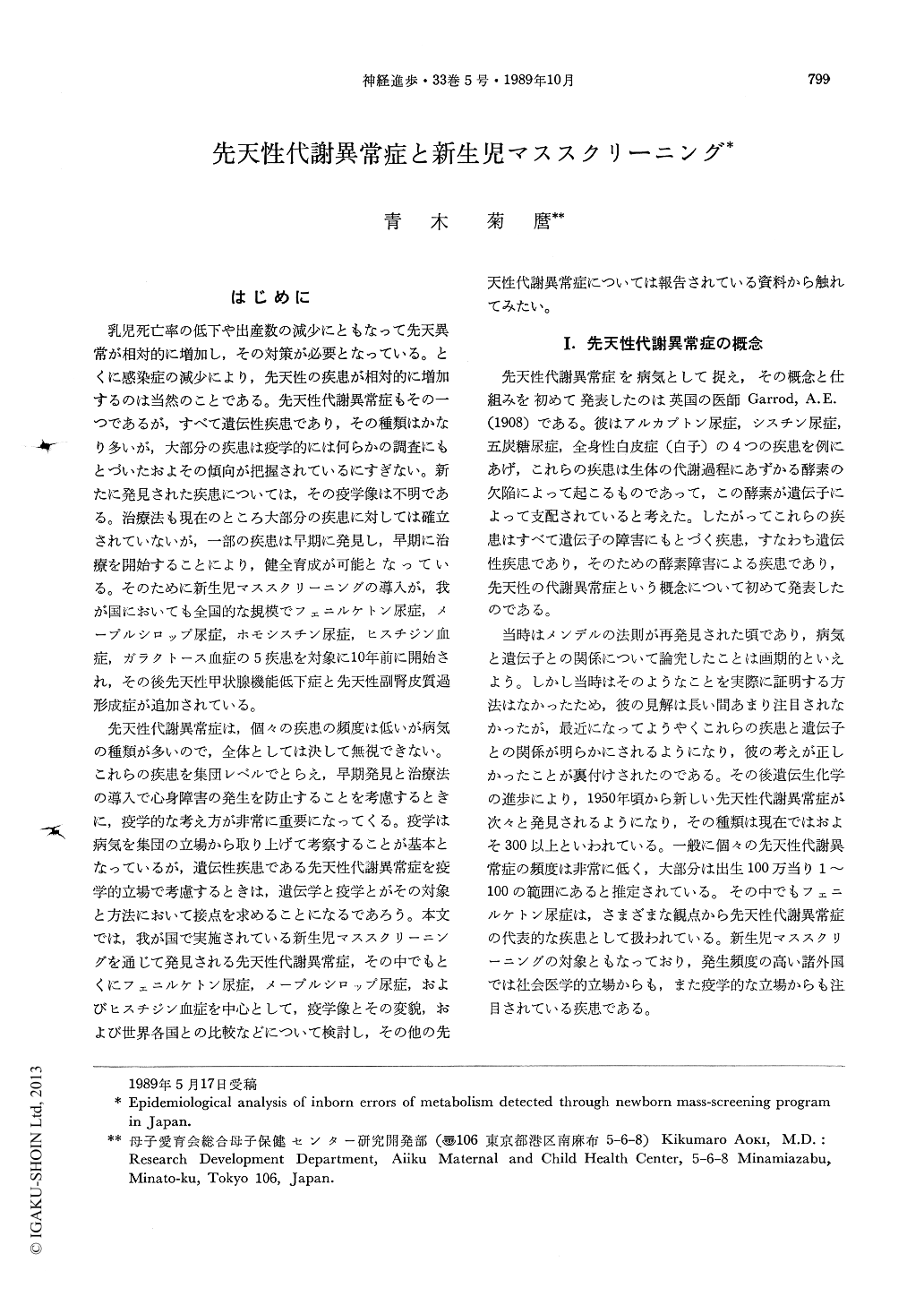
はじめに
乳児死亡率の低下や出産数の減少にともなって先天異常が相対的に増加し,その対策が必要となっている。とくに感染症の減少により,先天性の疾患が相対的に増加するのは当然のことである。先天性代謝異常症もその一つであるが,すべて遺伝性疾患であり,その種類はかなり多いが,大部分の疾患は疫学的には何らかの調査にもとづいたおよその傾向が把握されているにすぎない。新たに発見された疾患については,その疫学像は不明である。治療法も現在のところ大部分の疾患に対しては確立されていないが,一部の疾患は早期に発見し,早期に治療を開始することにより,健全育成が可能となっている。そのために新生児マススクリーニングの導入が,我が国においても全国的な規模でフェニルケトン尿症,メープルシロップ尿症,ホモシスチン尿症,ヒスチジン血症,ガラクトース血症の5疾患を対象に10年前に開始され,その後先天性甲状腺機能低下症と先天性副腎皮質過形成症が追加されている。
先天性代謝異常症は,個々の疾患の頻度は低いが病気の種類が多いので,全体としては決して無視できない。これらの疾患を集団レベルでとらえ,早期発見と治療法の導入で心身障害の発生を防止することを考慮するときに,疫学的な考え方が非常に重要になってくる。
This article has attempted to show how the incidence of phenylketonuria was improved through a better decrease of consanguineous marriage. A newborn mass-screening program for the early detection of phenylketonuria, maple syrup urine disease, homocystinuria, histidinemia, and galactosemia, using Guthrie's method, was started throughout Japan in 1977. The total number of newborn screened by March 1987 reached 14 million: this represents nearly 95% of the newborns born during 1978~1987. A follow-up study of the cases detected by this program has been performed by a collaborative study group since the initiation of this screening program. The total number of phenylketonuria detected through this mass-screening program was 122, yielding a calculated incidence of one in 117,787 during 1978 to 1987 (Table 4), which is lower than estimated incidence before starting this screening program. In 1961, Tanaka et al. calculated the incidence of phenylketonuria at about one in 56,000 to 63,000, and in 1977, Gamou et al. estimated it at about one in 15,000 to 53,000. A recentdecrease in the rate of consanguineous marriage, which was surveyed by Imaizumi as 16.17% at 1942 and 3.9% at 1983 in general population, seems to be a reasonable factor for the lower incidence of phenylketonuria during these ten years of newborn screening program. The rate of first cousin marriage in parents of phenylketonuric patients, which was 34.85% (1961, by Tanaka) and 21.05% (1977, by Oura), decreased to 3.20% according to the present study. The distribution of the patients is different from the parts by dividing this country into ten districts. Kyushu district shows the highest incidence than other districts. This tendency is more prominent in maple syrup urine disease, and the rate of consanguineous marriage is also the highest in Kyushu district.
Copyright © 1989, Igaku-Shoin Ltd. All rights reserved.